Thousands of pest photos submitted for identification.

Japanese Lady Beetle

Japanese Lady Beetle

6110    Good evening.  We are trying to identify the insects in the attached pictures. These were recently found in caragana trees, as well as lilac flowers gone to seed. We also found a few in green ash trees which are situated close to the lilacs. Could you assist us in the identification of these insects and offer suggestions as to how to rid us of the insects? Any additional information about them would also be appreciated. We are located in rural Manitoba (Cooks Creek). Graham

Most ladybugs are beneficial and good for the environment, but the Asian Lady Beetle can be a bad bug for certain plants and in the home. More information:  https://www.thespruce.com/good-and-bad-ladybugs-2656236

scarab beetle

scarab beetle

6109  Measuring 3 cm in length, we found this bug (a beetle?) in our finished basement, in Toronto, ON, in August. It has been a rain-filled summer and the basement has definitely felt damp. Can someone help me identify what it is?  Thanks,  Laura

Like no. 6105, this is a scarab beetle (Coleoptera: Scarabaeidae) in the genus Osmoderma; see https://tinyurl.com/ycmskym6 for an example. It is strictly an accidental ‘visitor.’  Ed Saugstad, retired entomologist; Sinks Grove, WV.

plant bug

plant bug

6108  My name is Lorie Hayter from Lower Sackville NS. These flying, bitting bugs have been on my black locust tree for the past 2 summers. Not sure what they are or how to get rid of them.

This is a plant bug (Hemiptera/Heteroptera: Miridae) in the genus Lopidea, possibly Lopidea media; see https://tinyurl.com/y7c5986w for an image. They likely will not cause serious harm to the trees.  Ed Saugstad, retired entomologist; Sinks Grove, WV.


short-snouted/broad-nosed weevil

short-snouted/broad-nosed weevil

6107   Hi.  My name is Rob.  I live 40 km West of Toronto. Suddenly we have hundreds of these guys mainly on our door frames and window screens. They just started to crawl on interior walls and ceilings. They really tiny- like 3 millimeters in size.  It’s beginning of August and first I spotted them 3 weeks ago. My 50 acres place is located in wooded area with a lot of shrubs and garden plants.  Thanks. 

This is another short-snouted/broad-nosed weevil (Coleoptera: Curculionidae; subfamily Entiminae) that I cannot identify to species. See no. 6104 for another example. Ed Saugstad, retired entomologist; Sinks Grove, WV.

wood wasps

wood wasps

6106  Hi there the picture I have attached I found in the basement of my parents house in Canada, I live in Edmonton Alberta. I was wondering if these are Mahogany also known as paper wasps and if so how to go about finding the best and how to kill it.  A picture is attached. Thanks.  Jaimie 

The three larger insects are wood wasps (Hymenoptera: Siricidae), likely in the genus Sirex; see https://tinyurl.com/y8rortn5 for some images. Commonly known as horntails, their larvae tunnel in the wood of dead or dying trees.  Ed Saugstad, retired entomologist; Sinks Grove, WV.

scarab beetle

scarab beetle

6105    Hi,  Found this big guy in the garage today. He has some spider webs on him, but I wasn’t about to take them off…he only PLAYS dead! Beside a loonie for sizing.  Thanks!   Sharon.   Winnipeg Manitoba

This is a This is a scarab beetle (Coleoptera: Scarabaeidae) in the genus Osmoderma; see https://tinyurl.com/ycmskym6 for an example. These are not pests; their larvae develop in rotting wood; often in hollow trees.  Ed Saugstad, retired entomologist; Sinks Grove, WV.

short-snouted/broad-nosed weevil

short-snouted/broad-nosed weevil

6104   Attached are the following 2 photos of a bug mostly in the basement and they now are appear to be moving up to the main and second floors of our house. We live in Calgary.  What kind of big is this and how do we get rid of it?  Thanks JT.

This is a short-snouted/broad-nosed weevil (Coleoptera: Curculionidae; subfamily Entiminae), but I am uncertain as to its specific identification. The adult weevils often enter buildings where they basically are nuisance pests that cause no serious harm, but their larvae can be serious pests – see http://tinyurl.com/monvaej for detailed information. Ed Saugstad, retired entomologist; Sinks Grove, WV.


ground-nesting bee

ground-nesting bee

6103  Hi. i found tons of these on my garden flowersbtoday on lac largille val des bois quebec. Not sure if its a green wasp. we have a wasp nest under the eavestrough. its new this spring. we have tons of bees as well. please help me id it.    thanks Sonja 

This is a solitary ground-nesting bee, but I cannot see the details needed to confidently say to which family it belongs. It most likely is a halictid (‘sweat bee’), but some megachilids (leaf-cutter bees) can be similar in appearance. In either case, it is a valuable pollinator that should be allowed to carry out its duties.  Ed Saugstad, retired entomologist; Sinks Grove, WV.

tile-horned prionus

tile-horned prionus

6102   Hi,   Attached is a photo of a beetle we found by an outside doorway of our home. We live in Lake Country, BC Canada where it is summer and has been very hot and dry. It is 2 inches long.  It does have a bit of white dust or something on its body, antennae and legs.  Thanks!

This appears to be a tile-horned prionus, Prionus imbricornis (Coleoptera: Cerambycidae); see https://tinyurl.com/y7t26gw3 for an image and more detailed information. Ed Saugstad, retired entomologist; Sinks Grove, WV.

leaf beetle

leaf beetle

6101   Hi. My name is Teresa. I have an infestation of these bugs on one type of bush at my camp site in Saskatchewan Landing Provincial Park. (first noticed in mid to late June but still active as they move to new bushes) Do you know what they are?

This is a leaf beetle (Coleoptera: Chrysomelidae); it looks like Blepharida rhois, known as the sumac flea beetle. See https://tinyurl.com/y7w539sb for some images. Ed Saugstad, retired entomologist; Sinks Grove, WV.


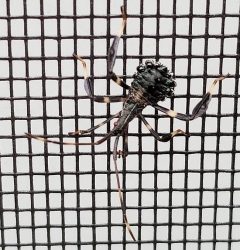
female wolf spider

female wolf spider

6100  Aldershot area which is on the border between Hamilton and Burlington, Ontario. I searched through the spiders on your website but couldn’t find this one.   Found this spider today in an empty plant container. Took its pic and let it go. It’s body was about 1/2″ long. What’s curious is the three red orbs that seem to be attached to its body.  Maybe the red orbs are eggs? And it seems to be missing a leg.

This is a female wolf spider (family Lycosidae) with her egg sac; the red objects are mites. Many mites seen in such situations are phoretic (essentially hitchhikers getting a free ride), but some, such as those in the genus Leptus, are ectoparasitic, feeding on the spider’s fluids. Ed Saugstad, retired entomologist; Sinks Grove, WV.

long-horned wood-boring beetle

long-horned wood-boring beetle

6099   I found it in Moncton, NB (August)   There have been several of them flying around and landing on the deck. Mike. 

This is a long-horned wood-boring beetle (Coleoptera: Cerambycidae) in the genus Monochamus, it looks like a northeastern pine sawyer, M. notatus – see https://tinyurl.com/y9huk6a3 for an image. This does not appear to be a serious pest, as its larvae bore in trees that already are dead or dying.  Ed Saugstad, retired entomologist; Sinks Grove, WV.

German cockroach and nymphs

German cockroach and nymphs

6098  Hello.   I have had the attached bugs for approximately 4-5 months (spring until end of summer).  They are approximately an inch (adult) and are mostly in the kitchen. They come out at night. They are indoors.   I am in Ottawa Ontario. Joanne, Thank you. 

Like No. 6097, these also are German cockroaches, an adult and two young nymphs. See https://tinyurl.com/h3nd9z8 elsewhere on this site for some control recommendations. Ed Saugstad, retired entomologist; Sinks Grove, WV.

German cockroach nymph

German cockroach nymph

6097   Hello ,   Found this insect in the 5th floor apartment, Noticing since 2 months (may), Toronto.   This comes in night outside specially in bathroom , earlier was in kitchen dustbin cabinet too but now after lot of cleaning reduced in kitchen,  found today in bedroom under the bed hiding when we were moving the bed , always prefers dark they are getting too many now.  Please suggest have small kids in home , are they dangerous any remedy to get rid off.  One more thing, they live in small sliding gaps between wooden floor and adjoining wall junction.  Thanks ,  Gaurav

This is a nymph of a German cockroach, Blattella germanica (Blattodea: Ectobiidae), a cosmopolitan pest species that can be difficult to bring under complete control. See https://tinyurl.com/h3nd9z8 elsewhere on this site for some control recommendations.  Ed Saugstad, retired entomologist; Sinks Grove, WV.

pole borer

6096

6096    Could you identify this for me please?  Found it while emptying my dehumidifier in the basement. About 1 inch in length.  Sarah M.   Toronto, Ontario.  July, 2017.  Thank you.

This is a pole borer, Neandra brunnea (Coleoptera: Ceranbycidae; subfamily Parandrinae). See https://tinyurl.com/y97oksfo for an image and more detailed information. Ed Saugstad, retired entomologist; Sinks Grove, WV.

dirt-colored seed bug or false chinch bug

dirt-colored seed bug or false chinch bug

6095  We just suddenly have thousands of these invading our back yard. We are in Penticton BC Canada in the south Okanagan Valley.

This is a nymph of a bug in the superfamily Lygaeoidea, possibly either a dirt-colored seed bug (family Rhyparochromidae) or a false chinch bug (family Lygaeidae). In either case, these are nuisance pests that do little actual harm. Ed Saugstad, retired entomologist; Sinks Grove, WV.


leaf-footed bug nymph

leaf-footed bug nymph

6094    Please tell me what this is.   I live in Quinte West, Ontario and this bug was on my screen door around dinner time. I live close to a creek and have many spruce and cedar trees around. The she’ll on its back almost looks prehistoric with spikes on it.  Hope to hear from you. Dana 

This is a nymph of a leaf-footed bug (Hemiptera/Heteroptera; Coreidae); likely Acanthocephala terminalis – see https://tinyurl.com/yck2aytl for an image. This does not appear to be a serious pest species. Ed Saugstad, retired entomologist; Sinks Grove, WV.

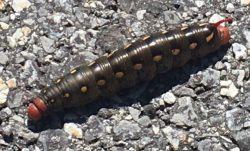
Sphinx moth caterpillar

Sphinx moth caterpillar

6093  Hi.  Photo taken yesterday near Franklin Qc.    Arnold 

This is a caterpillar of a sphinx moth (Lepidoptera: Sphingidae; it appears to be that of a bedstraw hawk moth, Hyles gallii -see https://tinyurl.com/y9r6smr8 for images and more detailed information. Ed Saugstad, retired entomologist; Sinks Grove, WV.

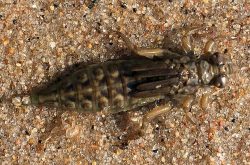
dragonfly naiad (nymph)

dragonfly naiad (nymph)

6092   Hello,  My name is Tammy. I am from Winnipeg, MB. We found this bug crawling along the wet sand on the eastern shore of Lake Winnipeg. Can you identify it?

This is a naiad (nymph) of a dragonfly that has completed its aquatic development and is seeking a safe place to undergo metamorphosis to the adult winged stage. Ed Saugstad, retired entomologist; Sinks Grove, WV.


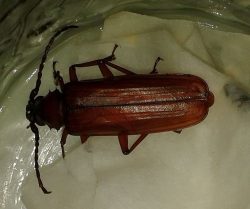
long-horned wood-boring beetle

long-horned wood-boring beetle

6091  I just found this insect on my clematis vine. It is 10:30pm, still very hot here in Kamloops.  The body is close to 4 cm.  I would appreciate identification. Thank you.  Lynne

This is a long-horned wood-boring beetle (Coleoptera: Cerambycidae), possibly Ergates spiculatus, known as the timberworm -see https://tinyurl.com/ybxpjl8b for images and more detailed information. Ed Saugstad, retired entomologist; Sinks Grove, WV.

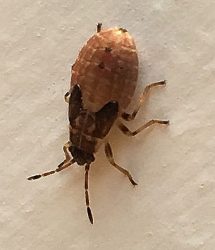
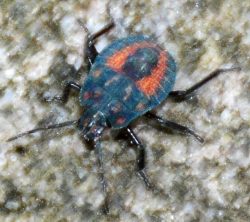
Stink bug nymph

Stink bug nymph

6090   I spotted this small bug while camping at Awenda Provincial Park in Ontario and thought at first it could be a tick, but then compared the picture to tick pictures online and it looks different. Could you please identify this bug for me? Thanks.  Angela

This is a nymph of a stink bug (Hemiptera/Heteroptera: Pentatomidae. It appears to be one of the predatory species in either the genus Perillus or Podisus; I cannot tell for certain. Ed Saugstad, retired entomologist; Sinks Grove, WV.

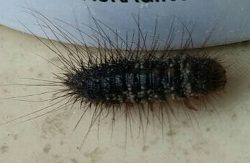
Dermestidae carpet beetle larva

Dermestidae carpet beetle larva

6089    Hello.  We have been noticing more and more of these popping up in our home. I live in barrie ontario and these photos were taken in July 2017.    They are indoors in the kitchen. I find one or two everyday. Today was the last draw as I found one in my lunch bag. It’s pretty hot out lately. I see them during the day and at night.   Thanks for your help.  Andrew

This is a larva of a beetle in the family Dermestidae (carpet/skin/hide/larder beetles and allies). I cannot tell for certain whether it has two sharp curved ‘spines’ (urogomphi) at the end of its abdomen; if it does, it is in the genus Dermestes (larder beetles), if it does not, it likely would be in the genus Attagenus (black carpet beetle and relatives). Either of these can infest a wide variety of organic materials, including dry stored food products, so you should carefully check all your food storage areas for signs of infestation. See https://tinyurl.com/zl9w25c elsewhere on this site for some control recommendations.  Ed Saugstad, retired entomologist; Sinks Grove, WV.

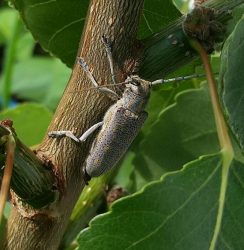
roundheaded poplar borer

roundheaded poplar borer

6088   Found this Beetle in Sherwood Park Alberta.  Mike C. 

This is a roundheaded poplar borer, Saperda calcarata (Coleoptera: Cerambycidae), see https://tinyurl.com/3t6lf74 for an image and more detailed information.  Ed Saugstad, retired entomologist; Sinks Grove, WV.

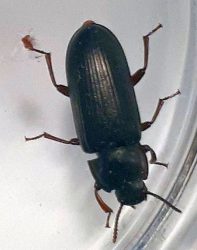
darkling beetle

darkling beetle

6087  Hello, could you help me in identifying this bug found indoors in Montreal, Canada.  kindly yours, Danny

This is a darkling beetle (Coleoptera: Tenebrionidae), likely in the genus Tenebrio – see https://tinyurl.com/pf53k4 for an example. Their larvae are known as mealworms, and they occasionally can become pests of grains that have been improperly stored – see https://tinyurl.com/y8craz7d for details.  Ed Saugstad, retired entomologist; Sinks Grove, WV. 

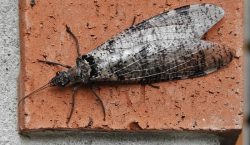
Fishfly

Fishfly

6086   Hi, I’m Lorraine from North Vancouver BC. This flying bug showed up on the morning of July 21, and has been resting on an exterior brick wall all day long. I live in a forested area with many hemlock and cedar trees, as well as large maples. We also have some dead or decaying trees that woodpeckers peck away at in search of bugs. The weather today was cloudy and much cooler than usual for this time of year, with a bit of light rain. The only bugs that I see regularly are spiders, ants, including carpenter ants, hornets, wasps, leatherjackets, and mosquitoes. This bug is about 3 inches long. I have never seen a bug this large. It look like a boring insect, so I’m wondering if this bug is harmful to our beautiful trees. Hope not! Lorraine, North Vancouver, BC

This is a fishfly (Megaloptera: Corydalidae; subfamily Chauliodinae); it looks like Dysmicohermes disjunctus – see https://tinyurl.com/y7gjkpkk for an image. These insects are completely harmless.   Ed Saugstad, retired entomologist; Sinks Grove, WV.

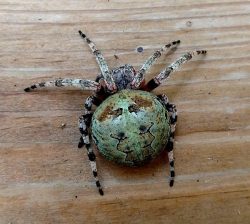
giant lichen orb weaver

giant lichen orb weaver

6081   Hello, My name is Danielle, I was in Penetanguishene, Ontario visiting some family when we came across this spider. It was sitting on the screen of the kitchen window with its legs all tucked together and facing out in front of its body. It was rather large, its body being roughly the size of a quarter and quite bulbous. After looking at a few references online, I believe it may possibly be a “cat face” orb weaver. Thanks for your help.  – Danielle 

This appears to be Araneus bicentenarius, known as the giant lichen orb weaver; see https://tinyurl.com/y8zhpmjz for images and more information. Ed Saugstad, retired entomologist; Sinks Grove, WV.

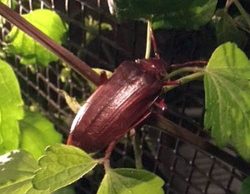
brown prionid

brown prionid

6085   Please help me what is this. It was climbing up my coach after everyone came inside. It is summer at night time around 10 all the lights are on and they were never shut off we are remodelling our kitchen sink so there was a hole in our kitchen or maybe you could have come inside I’m not sure live in New Hampshire in a mobile home park

This appears to be a brown prionid, Orthosoma brunneum (Coleoptera: Cerambycidae), see https://tinyurl.com/kbm3n7z for images and more information. These will not cause any damage to or in your home.  Ed Saugstad, retired entomologist; Sinks Grove, WV.

scale insects

scale insects

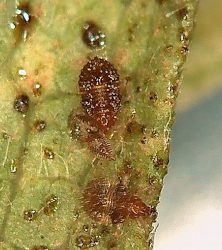
6084  Mike  here in Winters, California. These photos were taken on a Salvia Clevlandii leaf, date and time as noted on photos.  They were taken with an Aven eScope, so I don’t know the magnification, but these were not visible to the naked eye. Any help greatly appreciated as this has turned into an infestation of over a dozen previously healthy plants.  Thank you.  

These appear to be scale insects of some kind; try applications of an insecticidal soap for control. Ed Saugstad, retired entomologist; Sinks Grove, WV.

pupa and larva of a lady beetle

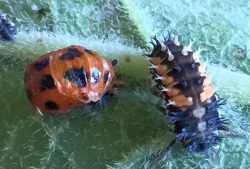
6083  Good morning, I found these insects on my Italian plum tree on Vancouver Island. They attach to leaves and fruit by punchers on they back end and cause damage. They are about 4-5mm in length. Any ideas?

These are a pupa and larva of a lady beetle (Coleoptera:, Coccinellidae); likely the Asian multi-colored lady beetle, Harmonia axyridis. These are not damaging your plants, but feed on aphids and other small, soft-bodied insects – see https://tinyurl.com/3cc75vc for more detailed information. Ed Saugstad, retired entomologist; Sinks Grove, WV.

Stink Bug

Stink Bug

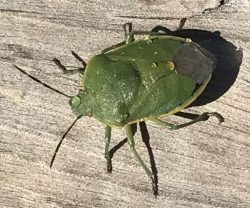
6082  Hi, We found this crawling in our rooftop deck, middle of the day, mid-summer and have never seen one before. It’s about 1.5cm. We have a lot of container plants and something has been chomping on a few, but we can’t find the culprit. Could this be it? Is it a beetle / weevil? Anything to be worried about? Thanks! Carole A., Vancouver, BC.

This is not a beetle, but a stink bug (Hemiptera/Heteroptera: Pentatomidae), likely in the genus Chlorochroa  – see https://tinyurl.com/y8ugbelr for an example. It would not be responsible for any ‘chomping’ damage, as it has piercing-sucking rather than chewing mouthparts. Ed Saugstad, retired entomologist; Sinks Grove, WV.


lined June beetles

lined June beetles

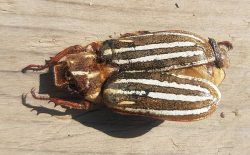
6080  Hello. My son Griff found this fuzzy winged critter outside our barn this morning right below a birds nest. It’s been a late summer here in Aldergrove, BC. The heat just recently arrived and its July 2017. I did a bit of looking and I’m guessing a scarub beetle of some sort perhaps?   Thanks! Shannon

This is one of the lined June beetles (Coleoptera: Scarabaeidae) in the genus Polyphylla, possibly the 10-lined June beetle, Polyphylla decemlineata. See https://tinyurl.com/y7cqxh3u for more detailed information.  Ed Saugstad, retired entomologist; Sinks Grove, WV.


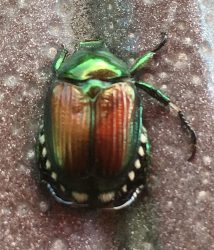
Japanese beetle

Japanese beetle

6079 What kind of pest is this.   Stripping tree about 40 of them on a yearling birch.

This is a Japanese beetle, Popillia japonica (Coleoptera: Scarabaeidae), a very obnoxious pest in many parts of North America. Their larvae are turf pests, feeding on the roots of grasses, and the adult beetles feed voraciously on foliage and soft fruits. See https://tinyurl.com/hzjj3my for more detailed information.  Ed Saugstad, retired entomologist; Sinks Grove, WV.

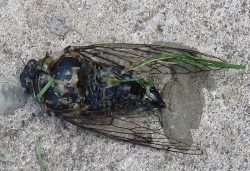
‘dog-day’ cicada

‘dog-day’ cicada

6078   Is this some kind of clear wing Sphinx moth? It’s about 4cm long. I was mowing grass in Georgetown Ontario yesterday and this insect was very angry at my lawn mower. It kept attacking it for over 5 minutes then it came at me. I shut down the lawn mower and it left. When I started it up, it came back and when it pitched on the mower I swatted it. The green in the picture is grass blades I think. Steve.

This is a cicada (Hemiptera/Auchenorrhyncha: Cicadidae); likely one of the so-called ‘dog-day’ cicadas in the genus Neotibicen – see https://tinyurl.com/ybltmat5 for details. These insects are harmless; regardless as to how you interpreted its actions, I can assure you that it was not its intent to ‘attack’ anything.  Ed Saugstad, retired entomologist; Sinks Grove, WV.