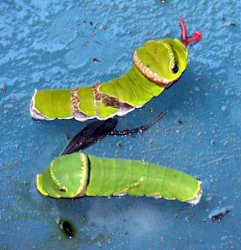
Caterpillars of the common Mormon butterfly
6869. Found in my terrace garden. ASSAM, INDIA
Number 6869. These are caterpillars of the common Mormon butterfly, Papilio polytes (Lepidoptera: Papilionidae); Click here for detailed information.

Thousands of pest photos submitted for identification.
6869. Found in my terrace garden. ASSAM, INDIA
Number 6869. These are caterpillars of the common Mormon butterfly, Papilio polytes (Lepidoptera: Papilionidae); Click here for detailed information.
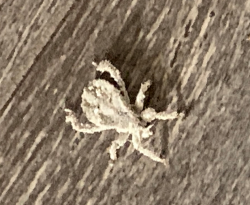
6868. Found under couch. Assassin bug? Penticton, BC. Canada
Number 6868. This is a nymph of an assassin bug known as a masked hunter (Reduvius personatus; Hemiptera/Heteroptera: Reduviidae), a cosmopolitan species often found indoors and reputed to have a very painful ‘bite’- Click here for more detailed information.
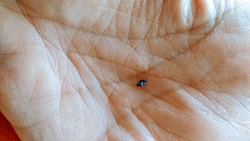
6867. These were found in my home last month. I find black eggs an whatever it is, bites, lays eggs everywhere esp. on me round flat.. white paper like eggs, an they get into all of my food source.. .. an turn into a worm species .. some are round hard shell black furry… that burrow into my skin .. please help! Thank you. Ocean city, Nj. United States
Number 6867. This is a tiny bug of some kind, possibly a minute pirate bug (Hemiptera/Heteroptera: Anthocoridae). They are predators on other small insects, and can inflict a painful but harmless bite. They would not be responsible for any of the other problems you mentioned. Click here for more detailed information.
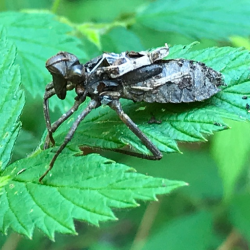
6866. I have never seen this type of bug/insect at our cottage before so am anxious/curious to know what it is and details. The photo was taken on May 27th, 2020 at Fire Route 214, Beaver Lake Road, Cathacoma, Ontario. Thank you. Toronto, ONTARIO. Canada
Number 6866. This is a shed ‘skin’ (exoskeleton) of a dragonfly naiad (the aquatic, immature stage). When a naiad completes its growth, it emerges from the water and clambers up on anything handy, secures a grip, then splits open and the adult slowly emerges. Click here for a short video clip of this process.
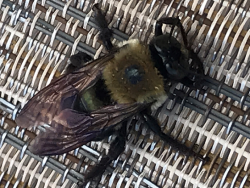
6865. Not used to seeing these in our area. Toronto, Ontario. Canada
Number 6865. This appears to be a female eastern carpenter bee, Xylocopa virginica (Hymenoptera: Apidae). Click here for more detailed information.
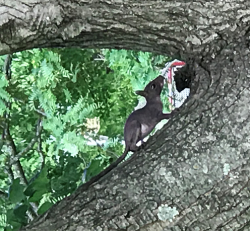
6864. My mom saw this on her walk a few weeks ago. She also took a video because it was making a really weird sound. Looks like a naked rat but we can’t find anything online that matches. We are located in South Jersey.
Number 6864. It could be a juvenile roof rat (Rattus rattus); Click here for a comparison chart.
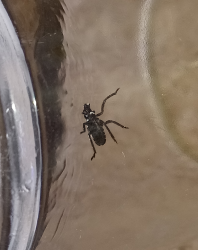
6863. What is this bug? Thanks, Rose. Oreland, PA. United States
Number 6863. This is a young nymph of a spotted lanternfly, Lycorma delicatula (Hemiptera/ Auchenorrhyncha : Fulgoridae). This is an introduced invasive species of concern to agriculture; Click here for detailed information.
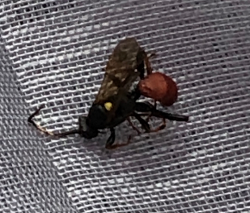
6862. Was flying around the window behind the curtain, has a body like a hornet just slimmer with a brown lower section. Barrie, Ontario. Canada
Number 6862. This appears to be an ichneumon wasp (Hymenoptera: Ichneumonidae). These all are parasitic on other arthropods (mainly other insects and spiders) and are harmless to humans. Click here for an example.
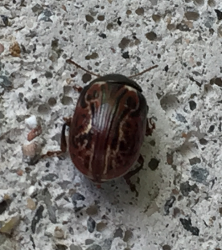
6861. May 29,2020. Found on foundation wall. I am an avid gardener and have never seen this beetle before. This is the third one seen this week. Weather has been 30c+ with high humidity. Miramichi, New Brunswick. Canada
Number 6861. This is a leaf beetle (Coleoptera: Chrysomelidae); it appears to be a russet alder leaf beetle, Calligrapha alni – Click here for an image and more information.
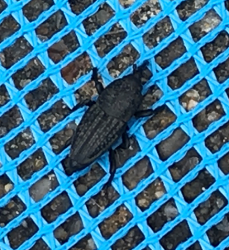
6860. Found floating in our pool. Ottawa, Ontario. Canada
Number 6860. This is a weevil (Coleoptera: Curculionidae), it looks like a member of a group known collectively as billbugs. These can be serious pests of grasses/turf. Click here for an example.
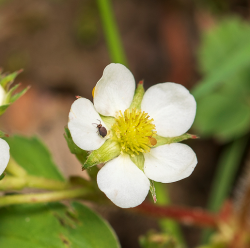
6859. This photo was taken last June on a wild strawberry flower, however I have just found some more of the same insect on dandelions. I was wondering what kind of insect it is and whether or not I should be concerned or need to take any kind of action. Cantley, QC. Canada
Number 6859. These are globular springtails (Collembola: Sminthuridae); they feed primarily on decaying plant matter, fungal spores, and algae. One European species, known as the lucerne flea, is a pest on alfalfa. Click here for an example.
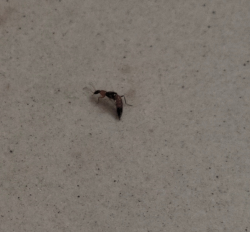
6858. Its bite led to blisters and burning. Haryana, India.
Number 6858. This is a rove beetle (Coleoptera: Staphylinidae) in the genus Paederus. It did not bite you, you are experiencing a reaction (paederus dermatitis) to its body fluids. Click here for a detailed explanation.
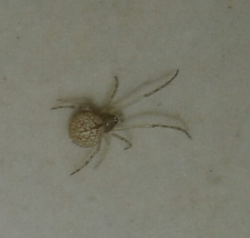
6857. I found this tiny spider in our verandah in Bosila, Mohammapur, Dhaka, Bangladesh in May,2020.
Number 6857. It’s a cobweb/comb-footed spider (family Theridiidae). This is the family that the notorious widow spiders belong to, but ones like your specimen are harmless to humans. Click here for more detailed information
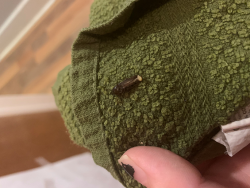
6856. Ottawa Ontario, end of May, evening, indoors old house top floor bedroom.
Number 6856. This appears to be a click beetle (Coleoptera: Elateridae) that has been somewhat squished. A harmless accidental intruder. Click here for details.

6855. Just recently started to see these in our vestibule. Looks like a type of beetle. Crushed one and it is very hard. It was still alive after I squeeze it using my grabber. Eventually died when I sprayed it with 1Shot wasp spray. Scarborough, ON. Canada
Number 6855. This is a scarab beetle (Coleoptera: Scarabaeidae), likely one of the so-called May beetles/June bugs in the genus Phyllophaga. They are foliage feeders while the larvae (‘white grubs’) of some species can be destructive lawn/turf pests feeding on roots of grasses. Click here for an example.

6854. Just found one bug in my bathroom. I don’t know its type. Your help is appreciated. Waterloo, Ontario. Canada
Number 6854. This appears to be a ground beetle (Coleoptera: Carabidae) in the subfamily Lebiinae, Click here for more detailed information. There also some beetles in the family Anthicidae (ant-like flower beetles) having a similar appearance, but their antennae usually are slightly clubbed rather than thread-like in carabids. Strictly an accidental and harmless intruder.

6853. Small dark brown/black beetles are everywhere, in cupboards, linen, bed, bathroom… They smell bad when you touch them and have a small white worm larvae. The beetles are up to a 1/4″ big. I haven’t been able to get rid of them by cleaning with soap and water but it helps. Saskatoon, Saskatchewan. Canada
Number 6853. These appear to be darkling beetles (Coleoptera: Tenebrionidae), but the image is too dark to make a more precise identification. In order to get rid of them, you need to find and eliminate their food source. Some species will feed on a wide variety of dry stored food products including whole grains (usually those damaged by moisture).

6852. Large infestation found in a crawl space of the building. Hundreds living in the dirt around a pool of sewage caused by a disconnected waste pipe from the unit above. Size of average spider is about 1 inch. Toronto, ON. Canada
Number 6852. This is a hacklemesh/lace weaver (family Amaurobiidae); it looks like Amaurobius ferox, commonly known as the black lace weaver – Click Here. They can bite, but the bite is not dangerous to humans. This is a matriphagous spider, meaning that the young devour the mother after hatching. After her young hatch, she lays a second set of eggs on which the newly hatched spiders feed. Then a few days later, she actively encourages her offspring to devour her.

6851. Please get back to me soon! North York, On. Canada
Number 6851. The image is not clear enough for a confident identification; it might be a nuisance pest species such as a foreign grain beetle, Ahasverus advena (Coleoptera: Silvanidae). Also known as new house beetles, they feed on the molds and fungi that grow on poorly seasoned lumber or wet plaster and wallboard. Control, other than vacuuming them up, is not necessary. Click Here for more detailed information.

6850. Today was really hot outside, I had the AC on the whole day but this insect found a way in. I found It on the curtains of my room. Just wandering what it was. Montreal, Quebec. Canada
Number 6850. This is a click beetle (Coleoptera: Elateridae). These often accidentally get indoors, but do no harm there. Click here for details.

6849. It was VERY docile, there were two of them on a piece of fabric in my garage (used as a storage space). They didn’t move at all even when moving the fabric. Seemed almost asleep. Victoria, British Columbia. Canada
Number 6849. This is a larva of a lady beetle (Coleoptera: Coccinellidae); ones like this are general predators on other small, soft-bodied insects such as aphids. Click here for more detailed information.

6848. My husband found this guy today on his walk. He was much bigger but ge stepped on him. Langley, BC. Canada
Number 6848. This is an elm sawfly, Cimbex Americana (Hymenoptera: Cimbicidae). Their larvae (which often are mistaken for caterpillars) primarily feed on leaves of elm and willow but may attack other trees as well. The adults chew on twigs/small branches to feed on sap. But they have no stinger and are completely harmless to humans. Click here for more detailed information.

6847. What type of bug is this? Is it dangerous? Should I release it or kill it? EDMONTON, AB. Canada
Number 6847. This is a ground beetle (Coleoptera: Carabidae), it looks like a granulated carabid, Carabus granulatus; Click Here for an image and more information. Most ground beetles are general predators on other small invertebrates, mainly other insects, and thus usually considered as beneficial.

6846. Found two of these worm-like guys on a kiwi tree May 25 in Gibsons, BC. At least 5 inches long and VERY skinny. The landscaper trimming the tree had never seen anything like it. Gibsons, BC. Canada
Number 6846. My best guess is that these may be parasitic nematodes in the family Mermethidae. These parasitize a wide variety of invertebrates, mainly insects and spiders. These usually are found in water, as they appear to cause their unwilling hosts to seek out water before they die, and the nematode then emerged from the dying host. However, there are some species that will crawl up on vegetation to lay their eggs where those may then be eaten by potential hosts.

6845. I am going crazy. I feel like I have creepy crawlies all over. I need confirmation what these are…i have looked at so many pictures. I thought bed bug ot tick. Then came up with weervil. I have found 2 in the bed and 3 in the bathtub. I have been killing a few in the hallway outside bathroom. But once i found them in bed, i freaked. I do have 2 dogs that will climb up the bed with me. Please help. THANK YOU. Airdrie, Alberta. Canada
Number 6845. This is a weevil (Coleoptera: Curculionidae); likely one of the broad-nosed/short-snouted weevils in the subfamily Entiminae. These often find their way indoors, but do no harm there. Click here

6844. This centipede dropped out of a planter I picked up at the store. Wondering if it’s invasive to Canada? Winkler, MB. Canada
Number 6844. This is a stone centipede (Chilopoda: Lithobiomorpha); it looks like Lithobius forficatus, an introduced species now widespread in North America, including Canada. They are harmless to humans. Click here for an example.

6843. Abington, Pa. United States
Number 6843. This is a European hornet, Vespa crabro (Hymenoptera: Vespidae). As a general rule, these are less aggressive and more tolerant of human presence than their smaller cousins, yellow jackets and bald-faced hornets. Click here for more detailed information.

6842. Dozens suddenly on my balcony and windows, with the first warm spring days. Helsinki, Finland.
Number 6842. This looks like a birch catkin bug, Kleidocerys resedae (Hemiptera: Heteroptera: Lygaeidae), a species that occurs in Europe and North America. These basically are nuisance pests that do no real harm. Click here for more detailed information.

6841. I have been seeing this bugs for the last 3 weeks once a while. Maybe 10 of them. They are attracted to light since I can see them on windows or on a turned on tv. What kind of bug is it and does it harmful? The bug length is about 1/6″ to 1/4″. Toronto.
Number 6841. This is an elm leaf beetle, Xanthogaleruca luteola (Coleoptera: Chrysomelidae). These beetles and their larvae feed on leaves of elm trees; they would do no harm indoors. Click here for more detailed information.

6840. 1st dealing with black carpet beetles, a woodlouse spider early may & now found this bug in my apt of building in city. Been thought all beetles & insects in Ont being orange & black but none matched. Was on my bathroom counter middle of may 2020. Cornwall, ON. Canada
Number 6840. This is a checkered beetle (Coleoptera: Cleridae). Most of these are general predators on other small arthropods; a few species are pollen feeders. Click here for an example

6839. This very small bug was found on a cedar tree near a wooden deck on a rural, treed property in Eastern Manitoba on May 20, 2020. Winnipeg, Manitoba. Canada
Number 6839. This appears to be a dwarf spider (family Linyphiidae; subfamily Erigoninae); Click here for an image. Nice find!

6838. Want to know if this could be a kissing bug, it’s small back it has you small antennas and almost like a mosquito type nose thing. It’s about or just over 1/2 inch long. Winnipeg, Manitoba. Canada
Number 6838. This is an assassin bug (Hemiptera/Heteroptera: Reduviidae). True kissing bugs (subfamily Triatominae) do not occur in Manitoba. Click here for more detailed information

6837. May 2020 found in backyard. Moncton, NB. Canada
Number 6837. This is a giant water bug, Hemiptera/Heteroptera: Belostomatidae. Also known as toe-biters or electric light bugs, they are voracious predators on other aquatic life forms, including other insects, tadpoles, and minnows. They are strong fliers that can be found quite some distance from water, and can deliver a very painful ‘bite’ if mishandled. Click here for more detailed information