Thousands of pest photos submitted for identification.

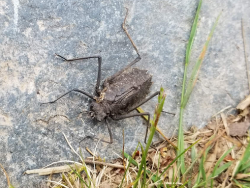
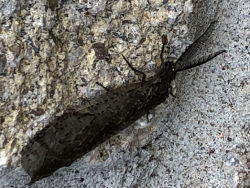
Fishfly

6409. I have lived in Ontario, all my life, and have never seen this type of Insect creature before! It was approximately 2.5 -3 inches in length, and about 1 inch in girth. Could you please Identify? I was in Peterborough last week(18-21 June 2019) and it was around my friends pool during the day. It was able to fly but only a short distance (20 ft or so each time we approached and nudged it away from our dogs. It did not make any sounds). Please get back to me with your prognosis at your convenience! Thanking you in advance. Central Eastern Ontario, Trenton, Ontario. Canada


Number 6409. This is a fishfly (Megaloptera: Corydalidae; Chauliodes sp.). Their larvae, called hellgrammites, are aquatic predators on other small life forms. Click Here for more detailed information

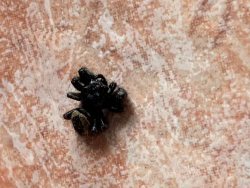
Nymph of a Plant Bug

6408. This bug crawled on my leg in a restaurant downtown Toronto – kindly help identify. Thank you. 1234 college st
St, Toronto Ontario. Canada


Number 6408. This is a nymph of a plant bug in the family Miridae. Strictly a plant feeder.

Jumping Spider

6407. Found this spider walking on my kitchen ceiling, never seen one like this before, should I be concerned. Hanmer, Ontario. Canada


Number 6407. This is a jumping spider (family Salticidae); may be in the genus Phidippus. These are harmless to humans.

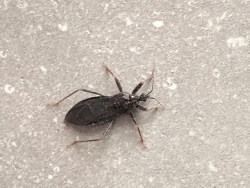
Assassin bug

6406.  Found two of these today in the house. Hoping not harmful. Regina, Saskatchewan. Canada


Number 6406. This is an assassin bug (Hemiptera/Heteroptera: Reduviidae) called the masked hunter (Reduvius personatus), an introduced species with a cosmopolitan distribution. These are general predators on other small arthropods, and are reputed to have a very painful (but not dangerous) bite.

Predaceous Diving Beetle

6405.  The bug on the wall of house flys and bites. Winnipeg, Manitoba, Canada


Number 6405. This is a female predaceous diving beetle (Coleoptera: Dytiscidae). These are general predators on small aquatic life forms; they are strong fliers and often are found quite some distance from the nearest water. Their bite is harmless.

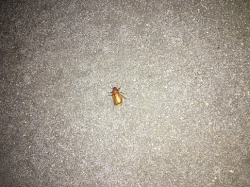
Click beetle

6404  I found 5 of these in different locations in my house and one I found had a lot of little one around, the big ones jump and are really hard to kill. They are almost a centimetre long. could you please help me thanks in advance. Big River, New Brunswick. Canada


Number 6404. This is a click beetle (Coleoptera: Elateridae), a harmless accidental intruder.

Assassin bug

6403  What kind of insect that I discovered this morning hidden under plate. Is it a cockroach or? Thank you. Montreal, Qc. Canada


Number 6403. This is an assassin bug (Hemiptera/Heteroptera: Reduviidae) called the masked hunter (Reduvius personatus), an introduced species with a cosmopolitan distribution. These are general predators on other small arthropods, and are reputed to have a very painful (but not dangerous) bite.

Centipede

6402  I’m wanting to know what the prominent bugs are on the glue strip that was left under the couch. I think they are the culprits that bite us and leave giant welts. I also have a photo a what appears to be the same bug, only 10 times bigger. thanks, Rod. Sycamore Ridge Drive, Simpsonville, SC 29681 United States


Number 6402. The largest critter at upper right is a centipede, possibly a house centipede (Scutigera coleoptrata). These are venomous, but will not bite unprovoked. Most of the insects on the strip appear to be flying ants or gnats; certainly nothing that would be responsible for any bites.

Mayfly

6401  Small and long flying bug with three tails. They have resided on our balcony. There’s at least 50 of them. I had swatted them all away (some dead) and they came back in greater numbers a few days later. We live close to a river and do not have any lights on our balcony. CALGARY, Alberta. Canada


Number 6401. This is a mayfly (order Ephemeroptera). These spend most of their lives as nymphs/naiads at the bottoms of streams and lakes where they constitute an important part of the feed web there. The adults you see seldom live more than a day; just long enough to mate and lay eggs. They do not feed and are completely harmless.

Metallic wood boring beetle

6400  Not sure what type of beetle this is. Carleton Place, ON. Canada


Number 6400. This is a metallic wood boring beetle (Coleoptera: Buprestidae) in the genus Dicera, Click here for an example. Their larvae often are called flat-headed wood borers because the area immediately behind their head usually is much wider and flatter than the rest of their body. Some species can be serious timber pests.

Nymph of a boxelder bug

6399  8. They seem to start off as the small red ones, and grow into the bigger brown ones. Unless they’re different species, infesting at the same time :/ Kelowna, British Columbia Canada


Number 6399. This is a nymph of a boxelder bug (Hemiptera/Heteroptera: Rhopalidae; Boisea sp.). Generally considered nuisance pests, they have been known to damage fruit late in the season – Click here for more detailed information.

Scarab beetle

6398  Hi there, I live in a low rise condo building on the 4th floor and every night in the summer, around dusk, a swarm of what look like flying, gold beetles come out from somewhere in the roof flashing. I have a good quality picture of one. What are they and how can I be rid of them?? Thanks; Mike


Number 6398. This is a scarab beetle (Coleoptera: Scarabaeidae), they are not living in the roof flashing, but flew up there. Their larvae are underground feeders on plant roots and some species can be serious lawn/turf pests.

Dragonfly nymph

6397  Found at Shubenacabie Canal Park near the lake, June 15 2019. Quite large, over 2 cm long, heavily armoured. Halifax, Nova Scotia, Canada


Number 6397. You must be near a stream or pond, as this is a dragonfly nymph that has completed its growth and has left the water in order to find a safe place to transform into the winged adult stage. 

Click beetle

6396  Please identify. This was found in my newer build home near light switch in en-suite. Never seen before. Was smaller than picture. Brantford, Ontario Canada


Number 6396. This is a click beetle (Coleoptera: Elateridae), a harmless accidental intruder.

Assassin bug

6395  Found this on our carpeted stairs in the evening. Today it’s been raining all day. We have only seen this one – but unsure what it is. We think it’s an assassin bug but not sure. If so, is it dangerous? What are we supposed to do? Thanks. Orleans, Ontario, Canada


Number 6395. This is an assassin bug (Hemiptera/Heteroptera: Reduviidae) called the masked hunter (Reduvius personatus), an introduced species with a cosmopolitan distribution. These are general predators on other small arthropods, and are reputed to have a very painful (but not dangerous) bite. No control is necessary.

Nymph of a cockroach

6394  Hello, Found this under a tea towel on my kitchen counter. June 14, 2019 in the Hamilton region. Thought it might be a German Beetle hoping it wasnt a bed bug but couldnt rule any out. If it was a bedbug why would I find it under a tea towel in my kitchen? Thanks very much for your help.  Dundas, Ontario  Canada


Number 6394. This is a nymph of a cockroach (order Blattodea); it looks like an Ectobius sp.

Iarder beetle

6393  Small. 2 spruce street, Charlottetown, Charlottetown C1A 3G6 Canada


Number 6393. This is a larder beetle, Dermestes lardarius (Coleoptera: Dermestidae), a cosmopolitan species that can be a pantry pest.  Click here 

Pseudoscorpion

6392  Please identify this arachnid/insect if possible and could you please let us know if dangerous to humans and pets? Thank you. 6 Fairknowe Drive, Apt 8 Brockville, ON K6V 1J5 Canada


Number 6392. It’s a pseudoscorpion, a non-venomous relative of true scorpions and spiders. They are general predators on other small arthropods. Click here for more detailed information.

Crane flies

6391  I found these this morning when I opened my curtains for the day. I grabbed a tape measure to give an idea of the size of them. They haven’t moved in about 3 hours, now. What are they?Nepean, Ontario,  Canada


Number 6391. This is a mating pair of crane flies (Diptera: Tipulidae); completely harmless.

Darkling beetle

6390  Cool Finished basement June 12, 2019. 32 Edna St. Noëlville, Ontario P0M 2N0 Canada


Number 6390. This is a darkling beetle (Coleoptera: Tenebrionidae). Ones like this often are found under bark of logs or dead trees; its occurrence indoors is strictly accidental.

Organ-pipe mud dauber wasp

6389  Central Alabama – Indoors @ about 73 degrees Fahrenheit – Evening hours. 2635 Chandalar Circle, Pelham, Alabama 35124 United States


Number 6389. This is an organ-pipe mud dauber wasp, Trypoxylon politum (Hymenoptera: Crabronidae); Click here for more detailed information.

Checkered beetle

6388  I found this in my bed in late May, just found another flying inside of my lamp last night. I have about 5 bites. The bites are mosquito like bumps that are extremely itchy even beyond 1 week. Very small. Black body with red stripe. Will have to zoom in picture to get best look. What is this? Should I get my house sprayed? Burlington, ON L7M 4A4 Canada


Number 6388. It’s a checkered beetle (Coleoptera; Cleridae). No need to be concerned about this one. Not only would it not be responsible for any bites but it is a beneficial predator on other small arthropods.

Larva of a brown lacewing

6387  364 Diefenbaker Dr. Fort McMurray, Alberta T9k 2k3 Canada


Number 6387. This is a larva of a brown lacewing (Neuroptera: Hemerobiidae). These are general predators on other small soft-bodied arthropods such as aphids and small caterpillars.

Short-snouted/broad-nosed weevil

6385  Found this on our futon today. 13407 67 street, Edmonton, AB T5C0C6 Canada


Number 6385. This is a short-snouted/broad-nosed weevil (Coleoptera: Curculionidae; subfamily Entiminae). These often enter buildings in search of shelter but do no harm there.

Nymph of a German cockroach

6384  Not sure what this bug is! Can you help me. 4045 Robinson St, Suite No. 27, Regina, Saskatchewan S4S3E1 Canada


Number 6384. This is a nymph of a German cockroach, Blattella germanica (Blattodea: Blattellidae), a very common peridomestic pest species.  Click here for more detailed information.

Pomace fly

6383  This fly is inside my house in large numbers. They are very small (same size as a fruit fly), and have been present for months. The enlarged photograph is with a 40X total magnification. Please help me identify them so I know how to get rid of them. 42 Prince Charles Dr, Georgetown, ON L7G 3V1 Canada


Number 6383. This is a vinegar/pomace fly (Diptera: Drosophilidae), the same family as the so-called ‘fruit fly’ of household nuisance fame. It looks like Drosophila repleta, commonly known as the dark-eyed fruit fly. Click Here for more detailed information.

Beetle

6382  I’ve included the top and underside of the bug. Please help me, Mimi. 40 nepean street, ottawa, ontario K2P0X4 Canada


Number 6382. This beetle is in the family Dermestidae (skin/hide/larder/carpet beetles and allies); it resembles Anthrenus fuscus. Click here  for some control suggestions

Booklice

6381  Beginning last august, these bugs have started appearing all over my house, I even found a clustered of them in my mattress. They are about half a mm big, smaller than a sesame, deep brownish red and have a two segmented body. They disappeared during the winter, but now have began to appear again. I am planning to move soon and one of my main concerns is that they may travel hiding in my stuff to my new apartment. Do these bugs live indoors or outdoors? Are there ways to kill all their eggs? Please help. Thanks.  Vancouver, BC.  Canada


Number 6381. These look like booklice (Psocodea: Liposcelidae). They are cosmopolitan nuisance pests that prefer damp/humid environments that favour mould growth, as they feed primarily on mould spores and bits of decomposing organic matter.  Click here for more detailed information including some control suggestions. I wouldn’t worry about accidentally transporting some in your belongings when you move, as your residence-to-be likely already has some.
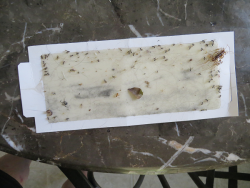
March fly

6380  This is a flying beetle that has been swarming in large groups. They have been landing on our houses and vehicles. They are on everything and are everywhere these last six days.( May 31 – June 05) When I go to flick one away it will cling to my finger. They walk fast all the time when not flying around. While on my school bus, they will search out and feed, in groups of four and five, on the dead flies that I have on my windshield.
983 Ennishone Road, DSL de Drummond, NB E3Y1S3 Canada


Number 6380. This is a March fly (Diptera: Bibionidae). They do no harm, but can become nuisance pests when they occur in large numbers. Click here  for more detailed information.

American dog tick

6379  I live in Markham Ontario Canada I found this crawling in my apartment what is it it was on my bed. 100 main street n, Markham, Ontario Canada

Number 6379. This is an American dog tick (aka wood tick; Dermacentor variabilis), a hard tick in the family Ixodidae. Click here for more detailed information
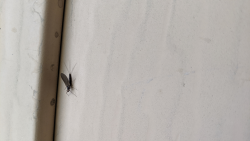
Sowbug

6378  523 Cedarille SW, Calgary, Alberta T2W 2H6 Canada

Number 6378. This is a sowbug, a terrestrial crustacean in the order Isopoda. The vast majority of these are harmless scavengers on decomposing organic matter.

Ichneumon wasp

6377  I found this bug flying along the inside of my kitchen window yesterday (June 1st 2019). I thought it might be a wasp but it wasn’t moving very fast unlike most wasps around this area. The weather here has been dry and about 20 deg daytime highs for the past week. Any idea what it is? Warmly, Vera. 4217 Capilano Rd, North Vancouver, BC V7R4J6 Canada

Number 6377. This is an ichneumon wasp (Hymenoptera: Ichneumonidae). These all are parasitic on other arthropods, mainly other insects. They are not venomous and are harmless to humans.

Wolf spider

6376  Asphalt, Kincardine, Ontario N2Z 1G1 Canada

Number 6376. This is a wolf spider (family Lycosidae). These are active hunters that do not spin a capture web; they have excellent (for spiders) eyesight. Large specimens can deliver a painful (but not dangerous) bite if mishandled, but they are not aggressive towards humans