Thousands of pest photos submitted for identification.

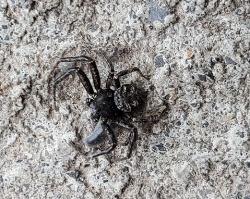
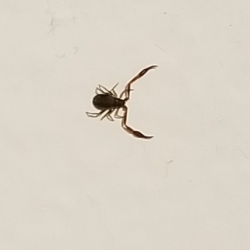
Pseudoscorpion

6375  Will try to find another for a better picture if you want. RR2 Box49 Site 4, Barrhead, AB, AB T7N 1N3 Canada

Number 6375. This is a pseudoscorpion, a tiny non-venomous relative of true scorpions and spiders. These are general predators on other small arthropods (such as book lice) and thus usually considered beneficial. Click here  for more detailed information.

Oak timberworm weevil

6374  2Ramer, Al 36069 United States

Number 6374. This is a female oak timberworm weevil, Arrhenodes minutus (Coleoptera: Curculionidae).  Click here for more detailed information. I often find these in firewood here.

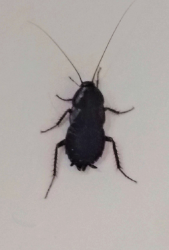
Oriental cockroach

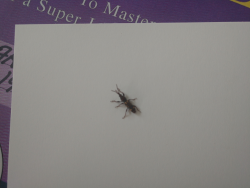
6373  Found a pic of a bug that looks like the one on my wall but it doesn’t say what it is and I can’t send you my pic. How can you help? From: Glen Burnie, MD 21060 United States

Number 6373. The insect in your image appears to be an oriental cockroach, Blatta orientalis (Blattodea: Blattidae).  Click here for a fact sheet

Larva of a carpet beetle

6372  What is this? Its in my bedroom and washroom. From: Oshawa, On L1l0b1 Canada

Number 6372. This is a larva of a carpet beetle (Coleoptera: Dermestidae) in the genus Anthrenus (varied carpet beetle and allies).  Click here elsewhere on this site for some control suggestions

Silverfish

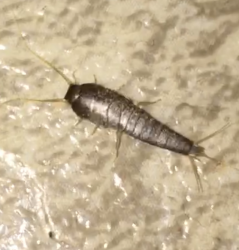
6371  I saw this in the washroom in my motel, I’m just wondering what kind of bug this is. It was almost the size of a coin(nickel). From: Ridge rd 16, Thunder Bay Ontario Canada

Number 6371. This is a silverfish, Lepisma saccharina (Zygentoma: Lepismatidae), a cosmopolitan nuisance pest.  Click here for more detailed information

Young nymph of a bed bug

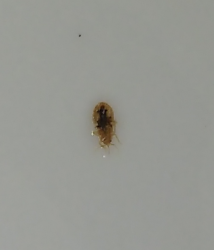
6370  Description: THIS PHOTO IS OF THE INSECT AFTER IT WAS PRESSED BETWEEN MY FINGERS, AND DEAD. Size is less than 1/4 of my pinky nailbed. Colour is transparent with black on the INTERIOR. No wings. Maybe 4-8 legs. Found crawling along blanket on couch while I lay there on main floor of house. Saw from corner of my eye. WHEN: Found close to 12am week before May long weekend 2019, cool in house but high humidity setting, outside around 12°.
** ALSO found another (similar) day before, sitting alive on my bed blanket beside my cat (thought was a crumb because of jagged edges until I picked it up – were legs). Second floor of house. It looked slightly brown on a navy comforter. Both cats are twitching/scratching, have crusty spots on them near head areas but no flea poo I see when I flea comb them. I spilled water on carpet beside bed while ago & soaked up with salt ( still there). I often find various piles of white specks on bed comforter, assumed was salt from cat’s paws but I’m quite anal about no salt on bed.. Could it be eggs? ?- It looks like lice, please tell me it’s not! Now I feel like I’ve been bitten everywhere! I have had the ODD single itchy red bump show up on my leg in the morning. The house has a lot of recycled/second hand items; not properly maintained. From: Stoney Creek, Ontario L8G3W1 Canada

Number 6370. This looks like a very young nymph of a bed bug (Hemiptera/Heteroptera: Cimicidae); the black substance is a partially digested blood meal. Click here for a very comprehensive fact sheet on bed bugs.

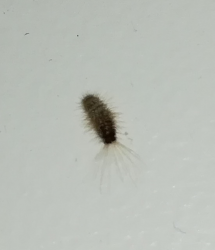
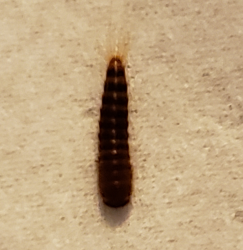
Larva of a carpet beetle

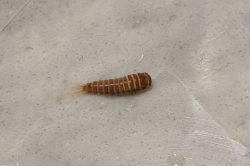
6369  Found in Canada, inside the bathroom in May. No others visible. From: Edmonton, AB T5Y2L3 Canada

Number 6369. It’s a larva of a carpet beetle (Coleoptera: Dermestidae) in the genus Attagenus (black carpet beetle and allies). Click here elsewhere on this site for some control suggestions

Crab spider

6368  Calm/chilly weather, 5C. Mid-May, Spring 2019. Found indoors, and relocated outdoors. Appears to be 1/2 inch width when legs in, and 3/4″ – 1″ when spread apart. From: Didsbury, Alberta T0M 0W0 Canada

Number 6368 . It’s a crab spider (family Thomisidae), might be a Bassaniana sp.; harmless to humans.

Weevil

6367  Hi can you please identify this bug for me? Im renting 2 story townhouse condo ( basment and main floor). I saw multiple of these bugs both upstairs amd downstairs. Initially i thought they were lice but they didnt go away. What is it and How do i get rid of it? Thank you. From: Toronto, North york M2M 0B4 Canada

Number 6367 This is a weevil (Coleoptera: Curculionidae). It’s overall shape is consistent with that of the granary weevils in the genus Sitophilus Click here. Check all your food storage areas for signs of infestation, and discard/destroy any items found to be infested. Keep all infestable dry food items in insect-proof containers or under refrigeration.

Rove beetle

6366  May 15 2019. It’s been rainy and the ground is moist. I have an outdoor pen for my indoor cats so that they can be protected while outside. I found about 12 of these very small insects on my cat who came in from the garden behind our house. They are very small about a cm or so and moved quickly. I first thought they were small black seeds but then they started wiggling on the brush, like small ants and moved quickly on a piece of kleenex. They seemed to be making her scratch. Are these Rove Beetles? From: Guelph, Ontario N1C1E3 Canada

Number 6366 This is indeed a rove beetle (Coleoptera: Staphylinidae). As you likely already know, these are general predators on other small arthropods, and should cause no harm to your cats.

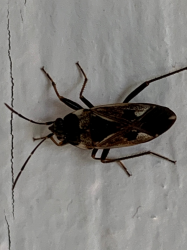
Elm seed bug

6365  Found inside our white curtains inside the home in both our living room and our bedroom- vacuumed and washed curtains but still finding more of these bugs- they can fly but are slow moving otherwise. we have cats. What can we do? What are they? We have never seen them before. From: Vancouver, British Columbia V5t2l1 Canada

Number 6365 This is an elm seed bug, Arocatus melanocephalus (Hemiptera/Heteroptera: Lygaeidae), an introduced species that has become a nuisance pest in some areas of western North America. These pose no threat to your cats. Click here for more detailed information.

Larva of a beetle

6364  I’ve found 2 of these in my bathroom this week, not sure what they are. They seem very slow moving and only look a few mm long. From: Ontario, Pefferlaw, Pefferlaw L0e1n0 Canada

Number 6364 This is a larva of a beetle in the family Dermestidae (carpet/hide/skin/larder beetles, etc.). They will feed on an extremely wide variety of organic materials, primarily those of animal origin.  Click here or elsewhere on this site for some control suggestions.

Mygalomorph spider

6363  From: Kelowna North, BC V1V 2N5 Canada

Number 6363 This is a mygalomorph spider, likely a folding-door trapdoor spider in the genus Antrodiaetus Click here for more detailed information

Carpet beetle

6362 Found it alive on the towel in the bathroom. Can you tell me what is it? Is it a bed bug? Thank you! From: Regina, Saskatchewan S4P 3X3 Canada

Number 6362 This is a carpet beetle (Coleoptera: Dermestidae), possibly a varied carpet beetle, Anthrenus verbasci. Click here for detailed information and Click here elsewhere on these pages for some control suggestions.

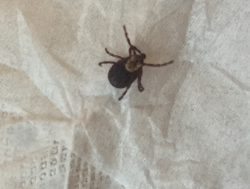
Female hard tick

6361  From: Oakville, Ontario L6H 0J1 Canada

Number 6361 This is a female hard tick (family Ixodidae) in the genus Dermacentor, likely Dermacentor variabilis, known as the American dog tick or wood tick.  Click here for more detailed information.

Pseudoscorpion

6360 This bug was on a toilet paper that was on the table in the bedroom, found it in the morning. From: Phoenix, Arizona 85008 United States

Number 6360 This is a pseudoscorpion, a non-venomous arachnid related to scorpions and spiders. These are general predators on other small arthropods,  Click here for more detailed information.

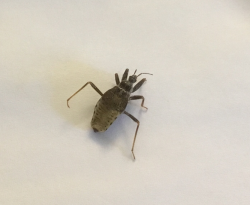
Nymph of an assassin bug

6359 I was either stung or bitten by this insect. Currently is red rash about the size of a toonie all around, no bullseye. Would like to know what it is. Any reason for concern? Thank you. From: Simcoe, Ontario N3y4p7. Canada

Number 6359 This is a nymph of an assassin bug (Hemiptera/Heteroptera: Reduviidae) known as the masked hunter (Reduvius personatus). It’s bite can be quite painful, but is not medically significant. Click here for more detailed information.

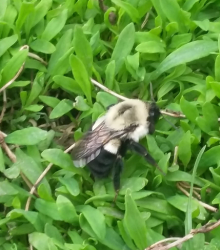
Eastern bumble bee

6358 From: Hamilton, Ontario L8k2k6. Canada

Number 6358 This appears to be a common eastern bumble bee, Bombus impatiens (Hymenoptera: Apidae).  Click here for more detailed information.

House centipede

6357 Found on back in bed. What is it? From: Smithville, Ontario L0R 2A0. Canada

Number 6357 This appears to be a dead house centipede (Scutigera coleoptrata) that has lost most of its legs. Click here for more detailed information.

Odorous house ant

6356 1/8” specimen guessing odorous house ant. Just looking for confirmation. Thanks. From: Pittsburgh, PA 15237 United States

Number 6356 It certainly looks like an odorous house ant – Click here

larder beetle

6355 From: St. Adolphe Manitoba R5A 1A1. Canada

Number 6355 This is a larder beetle, Dermestes lardarius (Coleoptera: Dermestidae), a cosmopolitan pest species. Click here for more detailed information.

Varied carpet beetle

6354  From: Carleton Place, ON K7C 4R7. Canada

Number 6354 This looks like a varied carpet beetle, Anthrenus verbasci (Coleoptera: Dermestidae). See Click here or more detailed information and Click here elsewhere on this site for some control recommendations.

Western Conifer Seed Bug

6353  I think the images I sent yesterday were lost. This insect was inside my home in April. I put it in alcohol to kill, dry and photograph. Is it possibly a blood-sucking conenose? From: Toronto, Ontario M4B1P4. Canada

Number 6353 This is a western conifer seed bug, Leptoglossus occidentalis (Hemiptera/Heteroptera: Coreidae), a common and widespread nuisance pest. Click here for more detailed information.

Moth Fly, Drain Fly or Sewer Fly

6352  From: Vancouvee, Vancouver BC. Canada

Number 6352 This is a moth fly (Diptera: Psychodidae). Also known as drain flies or sewer flies, they are harmless but can be nuisance pests. click here for more detailed information

Wasp Moths

6351 I guess the typical question you get is: What is this insect called? And in perfect tempo with this normative progression, I’ll try a polite variation: I would love very much, as will and resources provide/allow, if you could help me to identify this insect – or otherwise alien creature. Thank you for the good work you do, as a general standard in the commitment it demands from all of you, and further in service to the endless compulsions of human curiosity. And Good Day. From: Kisumu, Nyanza 40610, Kenya.

Number 6351 This moth is one of the so-called ‘wasp moths’ in the subfamily Arctiinae (Lepidoptera: Erebidae); it appears to be in the genus Amata – click here for an example

Pseudoscorpion

6350 Taken April 24 2019. In Revelstoke BC. On a painted wall in kitchen. Approx 3 to 4mm wide. Has 8 legs but is not a spider. Claw like pinchers on the front antenna i assume. I thought it was some kind of tic. Flat body as well similar to a tic. But the front antenna or legs are extremely long. Hope my pic doesn’t suck to much that you cant figure it. Only seen 1 in the house so far. From Revelstoke, British Columbia

Number 6350 This is a pseudoscorpion, a non-venomous arachnid related to scorpions and spiders. These are general predators on other small arthropods, Click here for more detailed information.

Oriental cockroach

6349 Toronto in the spring, in my bathroom. Approx. as long as a toonie. Even if it’s not deadly, it nearly killed me; it practically gave me a heart attack. From Toronto, ON

Number 6349 This is an oriental cockroach, Blatta orientalis (Blattodea: Blattidae), a cosmopolitan pest species. Click here for more detailed information and Click here or elsewhere on this site for some control recommendations.

Ichneumon wasp

6348 Is this a mosquito. Best way to treating. We have had a lot of rain. Temperatures are 50-70 degrees Fahrenheit. From Evansville, USA

Number 6348 This insect needs no treatment/control as it is an ichneumon wasp (Hymenoptera: Ichneumonidae). These wasps all are parasitic on other arthropods, mainly other insects.

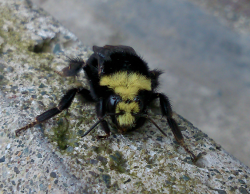
Bumble bee

6347 Not sure if the photos are good enough, but hoping you can identify this….bee? Best I can come up with is a Carpenter Bee? It’s head was fuzzy though, so that is what throws me off. Thanks in advance! From Victoria, British Columbia

Number 6347 It’s a bumble bee, not a carpenter bee. It looks like Bombus vosnesenskii, known as the yellow-faced bumble bee; Click here for an image.

Larva of a carpet beetle

6346 I found this small copper colored worm on my daughter’s clothing. What is it and what do I do to get rid of it, assuming there are more? From Niverville, MB

Number 6346 This is a larva of a carpet beetle (Coleoptera: Dermestidae); it appears to be in the genus Attagenus (black carpet beetles and allies). Click here or elsewhere on this site for some control recommendations.

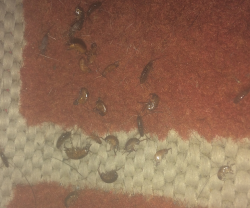
Scuds or Sideswimmers

6345 I keep finding these all over my patio rug. Can’t seem to figure out what they are or how they keep turning up since I have a screened in patio. There are hundreds of them. Most seem to be dead but there are some that seem to jump around. They just stared to turn up early March. From Myrtle Beach, USA

Number 6345 These are amphipods, crustaceans also known as scuds or sideswimmers. Most species are aquatic, but a few (such as yours) may be found on very damp/wet soil or other surfaces. These species sometimes are referred to as ‘lawn shrimp’ and are harmless; Click here for more detailed information.

Tuxedo bug

6344  We are finding these all around our house – doesnt seem like they fly… please help! …doesnt look like a seed bug or kissing bug! From Lindell beach, BC

Number 6344 This is a tuxedo bug, Raglius alboacuminatus (Hemiptera/Heteroptera: Rhyparochromidae); a Eurasian species that appears to have been introduced into North America about 20 years ago. These are nuisance pests that do not appear to cause any real harm. Click here for more detailed information.

Sowbugs

6343 Found in interior window frame March 31, Mississauga, ON. Some live, some dead. From Mississauga, ON

Number 6343 These are sowbugs, terrestrial crustaceans in the order Isopoda. These basically are harmless scavengers on decomposing organic matter, but they sometimes become nuisance pests when large numbers occur indoors. They breathe through gills that must be kept moist, so moisture management is the best control.