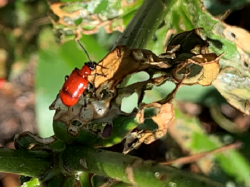
Yellow bear caterpillar

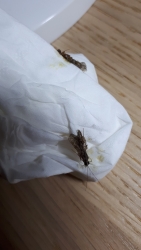
7054.         Rusty coloured caterpillar. Have also found more yellower ones with small patches of the rusty colour. This is a first with eggs. Ottawa, Ontario. Canada

Number 7054. This looks like a yellow bear caterpillar (Spilosoma virginica; Lepidoptera: Erebidae); the adult is known as the virgin tiger moth. The white objects are not eggs, but the cocoons of a parasitic wasp in the family Braconidae. When the larvae have finished feeding on the innards of the caterpillar, they chew through the caterpillar’s skin, spin a cocoon and undergo pupation.
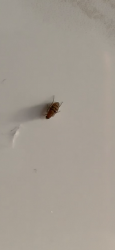
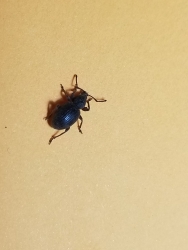
Scuttle fly

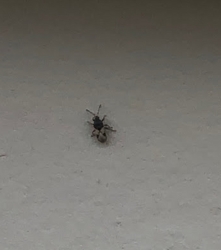
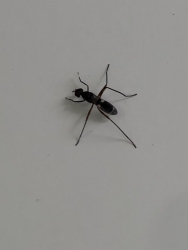
7053.         These keep crawling out from behind the overhead fan above my stove. At first I thought they were flies but then I realized it doesn’t look to have wings. Then I thought it might be a roach but it doesn’t seem to have antenna. It’s summer time and very hot in the apartment. It kind of looks like a scuttle fly but why doesn’t it have wings? Thanks for your help! Vancouver, BC. Canadaa

Number 7053. This does look like a scuttle fly (Diptera Phoridae); Click here for an image. In addition to some species having wings so transparent as to be nearly invisible, some other phorids are completely wingless.

Broad-nosed/short-snouted weevil

7052.         Found inside our home during the spring summer months have never noticed them before until this year thanks for your assistance. Kamloops, British Columbia. Canada

Number 7052. This is a broad-nosed/short-snouted weevil (Coleoptera: Curculionidae; subfamily Entiminae). These weevils often enter buildings in search of shelter, but do no harm there. Click here for an image

Nymph of a bed bug

7051.         Enid, OK. United States

Number 7051. This appears to be a nymph of a bed bug (Hemiptera/Heteroptera: Cimicidae). Click here for a very detailed fact sheet that includes some control recommendations.

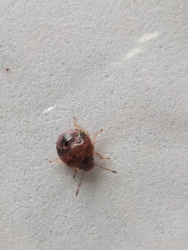
Nymph of a stink bug

7050.          Found indoors on belt from closet. Body is approx 6mm long and 5mm wide (not including antennae). Aug 2020. Calgary, AB. Canada

Number 7050. This is a nymph of a stink bug (Hemiptera/Heteroptera: Pentatomidae), but I cannot provide a specific identification. It may be a predatory species. Click here for an image & Click here for more information.

Scarab beetle

7049.        Landed on my boyfriend’s back while he was watering the plants on our balcony. He came inside and I saw it. North York, ON. Canada

Number 7049. This is a scarab beetle (Coleoptera: Scarabaeidae). From the appearance of its flattened elytra, it may be in the genus Osmoderma. Those are not pests; their larvae live in decomposing punky wood. Click here for more detailed information.

Elm seed bug

7048.        Finding these all over our house and seem to be living in our front door frame. They are quite small but large in number! Any idea what these are and how to get rid of them? Kelowna, BC. Canada

Number 7048. This is an elm seed bug, Arocatus melanocephalus (Hemiptera/Heteroptera: Lygaeidae), an introduced species that has become a nuisance pest in many areas. Click here for more detailed information.

Long-horned wood-boring beetle

7047.         It was about 2-3 inches long. Kamloops, British Columbia. Canada

Number 7047. This is a long-horned wood-boring beetle (Coleoptera: Cerambycidae) in the subfamily Prioninae; possibly Prionus californicus, one of the largest beetles in Canada. Commonly known as the California root borer, its larvae can cause serious damage to tree and vine roots. Click here for more detailed information.

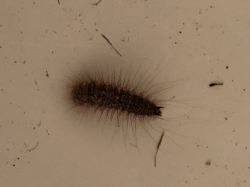
Larva of a larder beetle

7046.       Found in bathroom twice one July and one in August. Leduc, Alberta. Canada

Number 7046. This is a larva of a larder beetle, Dermestes lardarius (Coleoptera: Dermestidae) or a close relative. Click here for some control recommendations.

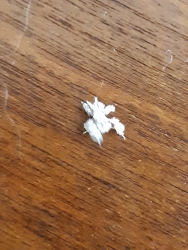
Nymph of an assassin bug

7045.      I found this little guy while dusting. Thought it was lint until I saw it moving. I have no idea what it is, pure white. Smiths Falls, ON. Canada

Number 7045. This is a nymph of an assassin bug known as a masked hunter (Reduvius personatus; Hemiptera/Heteroptera: Reduviidae), a cosmopolitan species often found indoors and reputed to have a very painful ‘bite’- Click here for more detailed information.

Hairy chinch bug

7044.        Hello, I have noticed my backyard infested with tiny black bugs, I can see them on grass, walls, patio furniture etc. Can you please let me know what is this and if any product to treat them. Milton, Ontario. Canada.


Number 7044. This appears to be a hairy chinch bug, Blissus leucopterus hirtus (Hemiptera/Heteroptera: Blissidae), a lawn/turf pest – Click here for details including control recommendations.

Stilt-legged fly

7043.        I have found these recently in my kitchen. We have a new exotic plant but other than that we cannot figure out where they are coming from. Killed 6 yesterday and usually see one or two per day for the last week to 10 days.
Thank you. St. Albert, AB. Canada

Number 7043. This appears to be a stilt-legged fly Diptera: Micropezidae); possibly Taeniaptera trivittata. These are harmless scavengers; Click here for more detailed information.

Flat-backed millipede

7042.        This crawler is skinny and about an inch long, and comes out in late July. They are near the pool and in the basement for about a month then disappear. Thanks for any light you can shed. Fenwick, Ontario. Canada

Number 7042. This is a flat-backed millipede, possibly a garden millipede, Oxidus gracilis (Polydesmida: Paradoxosomatidae). These primarily are scavengers on decomposing organic matter, but may become nuisance pests when they occur in large numbers. Click here for more detailed information..

Caddisfly

7041.         Have been chasing these around for days. Cannot figure out where they are coming from and how to get rid of them. Thought they came from outside, but the house has been mosquito net proofed for days now. Raid Home did not really help. Montreal, Quebec. Canada

Number 7041. You must live near a body of water (stream/pond/lake) as this appears to be a caddisfly (order Trichoptera) that has lost most of its wing scales – Click here for an example of an intact specimen. Their larvae are aquatic, and most species construct tubular cases that they live in. These are completely harmless, and will do no damage.

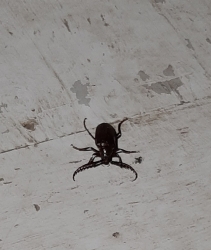
Predaceous diving beetle

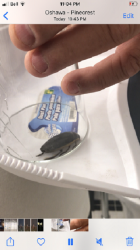
7040.        Found at night, inside my house, in the bathroom. August 2020. 23 degrees Celsius outside. Oshawa, Ontario. Canada

Number 7040. This is a predaceous diving beetle (Coleoptera: Dytiscidae). They and their larvae (“water tigers”) are general predators on other small aquatic life forms. They also are very strong fliers, and may be found quite some distance from any water source.

Nymph of a hairy chinch bug

7039.         There are hundreds of these small bug crawling all over the back of my house. Some have the white stripe some do not. I have no idea how to get rid of them or where they are coming from. Elmira, Ontario. Canada

Number 7039. This looks like a nymph of a hairy chinch bug, Blissus leucopterus hirtus (Hemiptera/Heteroptera: Blissidae), a lawn/turf pest – Click here for details including control recommendations.

Larva of a larder beetle

7038.       Been finding these on top of my dryer periodically. July, August. Usually 3 or 4 at a time. Will curl like a crescent moon if touched. About 1/4” in length. Didn’t realize they had furry multiple legs until I macro zoomed the photo. Ardmore, AB. Canada

Number 7038. This is a larva of a larder beetle, Dermestes lardarius (Coleoptera: Dermestidae) or a close relative. They only have six small legs near the head end (left, in your image); the ‘furry’ legs are just long setae (body hairs).  Click here for some control recommendations.

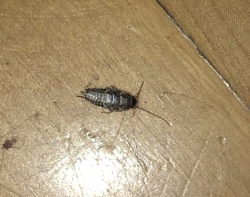
Bristletail

7037.      I found it dead in my house, I am wondering what it is? Montréal, QC. Canada

Number 7037. This is a bristletail (order Zygentoma) in the family Lepismatidae that has lost its scales and some of its appendages. It might be either a firebrat (Thermobia domestica) or a silverfish (Lepisma saccharinum); both are cosmopolitan nuisance pests – Click here for more detailed information.

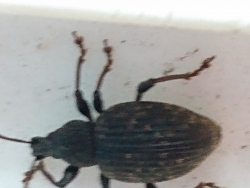
Broad-nosed/short-snouted weevil

7036.        We find them outside and inside. We live in Newmarket, Ont. Canada

Number 7036. This is a broad-nosed/short-snouted weevil (Coleoptera: Curculionidae; subfamily Entiminae). It might be a black vine weevil, Otiorhynchus sulcatus; Click here for an image.

Nymph of a hairy chinch bug

7035.      Just out of the blue we found thousands of these bugs all over or front walkway, porch, planting areas and around the perimeter of our property. It’s been very hot with little rain until recently. I killed them the first time with a bug killer but found them again in full force tonight. I killed them with water and dish soap this time but I’m sure they’ll be back. Thanks so much for your help. Bolton, ON. Canada

Number 7035. This looks like a nymph of a hairy chinch bug, Blissus leucopterus hirtus (Hemiptera/Heteroptera: Blissidae), a lawn/turf pest – Click here for details.

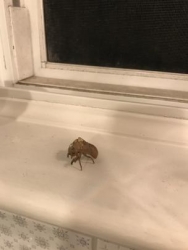
Cicada

7034.        Found this thing in my kitchen. Very frightening. Kitchener, Ontario. Canada

Number 7034. This is nothing to worry about; it is the empty ‘shell’ (exoskeleton) of a cicada (Hemiptera/Auchenorrhyncha: Cicadidae), likely in the genus Neotibicen (annual/dog-day cicadas). Click here for a video of the molting process.

Assassin bug

7033.         Outside my room on balcony was trying to fly too. Kandal, Phnom Penh. Cambodia

Number 7033. This appears to be an assassin bug (Hemiptera/Heteroptera: Reduviidae). These are general predators on other terrestrial arthropods; Click here for another example.

Star-nosed mole

7032.        Notth Bay, Ontario. Canada

Number 7032. This is a star-nosed mole, Condylura cristata, a most unusual creature with an incredibly sensitive olfactory system. Click here for more detailed information.

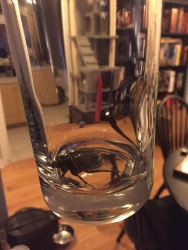
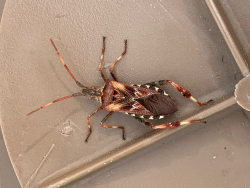
Western conifer seed bug

7031.      This spider has been hanging around our brown compost bin for the last couple of days. Please tell me what kind it is. Many thanks. Mont Tremblant, Quebec. Canada

Number 7031. This is not a spider, but a western conifer seed bug, Leptoglossus occidentalis (Hemiptera/Heteroptera: Coreidae). Although harmless, these can become nuisance pests when they enter homes in search of shelter. Click here for more detailed information.

Rove beetle

7030.    This bug total killed every onion plant in my garden. Rockyford, Alberta. Canada

Number 7030. This appears to be a rove beetle (Coleoptera: Staphylinidae). These would not have hurt your onions as they are predators, not herbivores. They may have been feeding on whatever was killing the onions. Click here for a detailed explanation.

Naiad (larva) of a dragonfly

7029.      We found this buried in the mud in the creek that runs through our farm in July. We’ve never seen anything like it and have been on this farm for over 40 years! Stouffville, Ontario. Canada

Number 7029. This is a naiad (larva) of a dragonfly; they are general; predators on other small aquatic life forms. Click here for more detailed information.

Broad-nosed/short-snouted weevil

7028.       Please identify. Thank you! Kanata, ON. Canada

Number 7028. This appears to be a broad-nosed/short-snouted weevil (Coleoptera: Curculionidae; subfamily Entiminae). These weevils often enter buildings in search of shelter, but do no harm there. Click here for an image.

Larva of a lacewing

7027.     While sitting on our sofa during the evening I noticed this bug walking on my wife’s leg. I gently allowed it to walk onto my finger nail, it walked down my finger stopped and began biting my hand. I killed it with a Kleenex tissue. Bug was about 1/8” to 3/16” long. I took the picture with my iPhone 8, I was able to zoom in for a much better view. It had huge mandibles. Other day same bug was biting my 2 yr old granddaughter on her back while she was in her small wading pool. What kind of bug is this? Date is Aug 3. Hot and humid. We just had thunderstorm with lot of rain. Thanks for your help! Hagersville, Ontario. Canada

Number 7027. This is a larva of a lacewing (Neuroptera: Chrysopidae). These are general predators on other small, soft-bodied arthropods such as aphids and caterpillars. For reasons unclear, they sometimes will ‘sample’ human skin, but their bite is harmless. Click here for more detailed information.

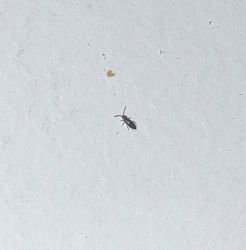
Springtail

7026.    They are all small for now but they are slow and I count like 4 to 5 now. Montreal, Quebec. Canada

Number 7026. This looks like a springtail, a primitive arthropod in the order Collembola. However, these usually jump when disturbed. Click here for details

Nymph of an assassin bug

7025.      This was crawling in my office today. What is it? Looked like a pile of dust moving across the ground. Lafayette, Colorado. United States

Number 7025. This is a nymph of an assassin bug known as a masked hunter (Reduvius personatus; Hemiptera/Heteroptera: Reduviidae), a cosmopolitan species often found indoors and reputed to have a very painful ‘bite’- Click here for more detailed information.

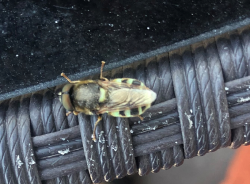
Soldier fly

7024.       Hi I’m from Edmonton, Alberta. It’s super hot here at 30C. Found whatever this is on my patio table. Kept spinning in a circle. Just curious to what it is. Thanks. Edmonton, Alberta. Canada

Number 7024. This is a soldier fly, Diptera: Stratiomyidae; the adults frequent flowers and may aid in pollination while the larvae primarily are scavengers on decomposing organic matter. I often find their larvae in our compost pile. Click here for more detailed information.

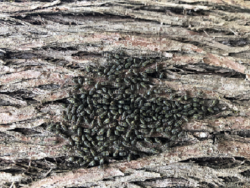
Psocids

7023.      Clusters of these bugs appeared this week (August1) on various tree trunks. The picture is a medium sized cluster. Some trees had many clusters. We are wondering what they are and if they are harmful to the trees. Thank you. Apsley, Ontario. Canada

Number 7023. These are psocids (Psocodea: Psocidae) known as bark lice or tree cattle. They are completely harmless. Click here for more detailed information.

Lily leaf beetle

7022.       We first noticed these bugs in July, eating the leaves off our lilies. Edmonton, Alberta. Canada

Number 7022. This is a lily leaf beetle, Lilioceris lilii (Coleoptera: Chrysomelidae), an introduced pest species. Click here for more detailed information.