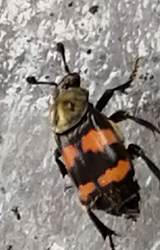
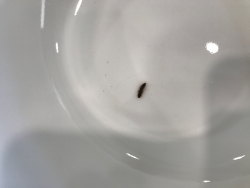
Larva of a beetle

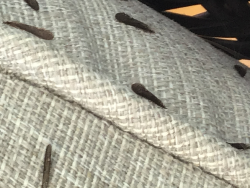
6988.       Hi, we have a few of these in our house and they creep us out – they look a little bit fuzzy and they crawl around. They’re around 3 – 5 mm long. What are they? Pinantan Lake, BC. Canada

Number 6988. This is a larva of a beetle in the family Dermestidae (hide/skin/carpet/larder beetles and allies), likely that of a larder beetle Dermestes lardarius; Click here for a fact sheet with detailed information. You should check all food storage areas for signs of infestation.
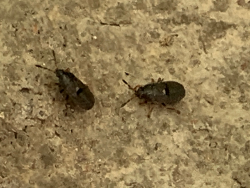
Nymphs of a hairy chinch bug

6987.      These are outside near the garden and on the sunny, hot landscaping rocks. They come out in the hundreds around 5:00pm in the hot sun. At first we thought they were ants. Lakehurst, ON. Canada

Number 6987. These look like nymphs of a hairy chinch bug, Blissus leucopterus hirtus (Hemiptera/Heteroptera: Blissidae), a lawn/turf pest – Click here for details.

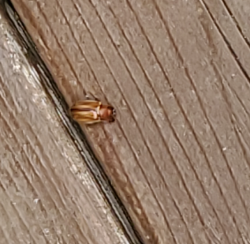
Nymph of a hairy chinch bug

6986.        Looking for information/identification of this beetle. Is commonly present on our old deck. However, just after moving into the house, they appeared under and behind many of our boxes in large numbers. They didn’t appear in my basement until after my move in. Thanks! Gatineau Quebec. Canada

Number 6986. Not a beetle; the image is too small to be certain, but it looks like a nymph of a hairy chinch bug, Blissus leucopterus hirtus (Hemiptera/Heteroptera: Blissidae) – Click here. If so, this would be a rather odd place to find them.

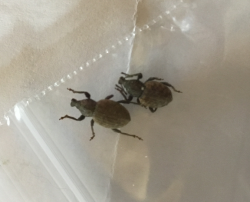
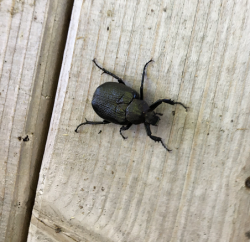
Broad-nosed/short-snouted weevils

6985.    Hi these bugs are found in the basement In the rooms that do t have carpet mostly. Fairmont Ho Springs, BC. Canada

Number 6985. These are broad-nosed/short-snouted weevils (Coleoptera: Curculionidae; subfamily Entiminae). Click here for an example.

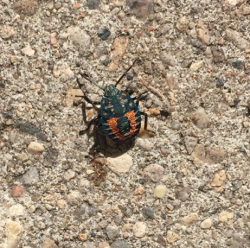
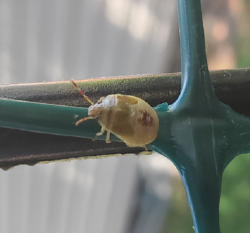
Nymph of a stink bug

6984.      Hello, this little guy fell on my leg, I apologize for the bit of blurred. My friend and I are bickering because she thinks it’s a tick. I found the other picture from google from your website, but to unavail I couldn’t find it on your website, not sure what it is. Appreciate any help. North bay, Ontario. Canada

Number 6984. This is a nymph of a stink bug (Hemiptera/Heteroptera: Pentatomidae); it looks like one of the predatory species in the genus Apoecilus. Click here for an image & Click here for more information.

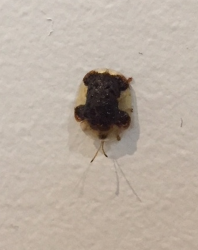
Clavate tortoise beetle

6983.    I just found this very small, flat bug on the wall inside my walkout basement apartment. It flew when I tried to remove it. I’ve never seen one before and am curious to know what it is! Whitchurch-Stouffville, Ontario. Canada

Number 6983. This is a clavate tortoise beetle, Plagiometriona clavata (Coleoptera: Chrysomelidae). This is a common and widespread species; Click here for more detailed information.

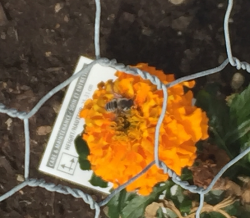
Native solitary bees

6982.     They scare me whenever I water the plants and I have no idea what they are. Do they sting? Calgary, Alberta. Canada

Number 6982. This is one of the many species of native solitary bees. These are primarily ground (burrow) or cavity-nesting, and are very valuable as pollinators. They are not aggressive, but can sting if mishandled. Just let them go about their business.

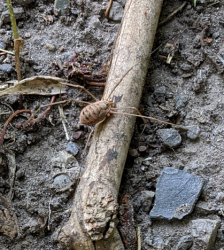
Cockroach

6981.     I’m trying to figure out if this is a cockroach can you please help me. westville, NS. Canada

Number 6981. This is a cockroach (Blattodea: Ectobiidae); it is in the genus Ectobius and may be Ectobius lapponicus. Known as the dusky cockroach, it is a European species that has become established in the Maritime Provinces; Click here for more detailed information.

Leaf beetle

6980.      Dartmouth, Nova Scotia. Canada

Number 6980. This may be a leaf beetle (Coleoptera: Chrysomelidae), but the image is not clear enough to be certain. Click here for more detailed information including control recommendations.

Nymph of a stink bug

6979.    1Sainte-Thérèse, Québec. Canada

Number 6979. This is a nymph of a stink bug (Hemiptera/Heteroptera: Pentatomidae) that appears to have molted recently. It may be one of the predatory species in the genus Podisus (soldier bugs). Click here for an image & Click here for more information.

Osmoderma scabra

6978.     Please identify this beetle. Thanks. Huntsville, Ontario. Canada

Number 6978. This is Osmoderma scabra (Coleoptera: Scarabaeidae). Known as the rough Osmoderma, their larvae live on and in rotting wood; they are completely harmless. Click here for an example.

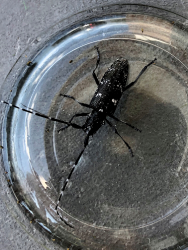
Long-horned wood-boring beetle

6977.    Delta, BC. Canada

Number 6977. This is Monochamus scutellatus, a long-horned wood-boring beetle (Coleoptera: Cerambycidae) known as the white-spotted sawyer or spruce sawyer. Click here for more detailed information.

Sawfly

6976.      In a bus stop on Hamilton Mountain. Hamilton, Ontario. Canada

Number 6976. This is a sawfly (Hymenoptera: Symphtya), possibly in the family Tenthredinidae). The larvae of most of these are foliage feeders. Click here for more detailed information.

Broad-nosed/short-snouted weevil

6975.       Have found a few of these around the house. Wondering what they are. Ottawa, Ontario. Canada

Number 6975. This is a broad-nosed/short-snouted weevil (Coleoptera: Curculionidae; subfamily Entiminae). These weevils often enter buildings in search of shelter, but do no harm there. Click here for an example.

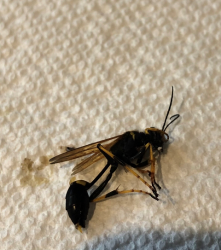
Sceliphron caementarium

6974.     Found when I got home from work inside my house. Never seen a wasp with a body like this one. It’s the length of a regular size paper clip. Langley, BC. Canada

Number 6974. This is Sceliphron caementarium (Hymenoptera: Sphecidae), known as the black and yellow mud dauber; Click here for an image. They feed their young on spiders that they capture, paralyze, and place in their mud ‘nest.’ They are not at all aggressive towards humans.

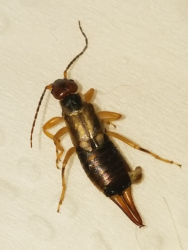
Earwig

6973.    Crawling on hallway wall.

Number 6973. This is an earwig (order Dermaptera). These basically are nuisance pests that primarily scavenge on decomposing organic matter. A few are predators on other small arthropods and some can occasionally cause damage to tender vegetation. Click here for more detailed information

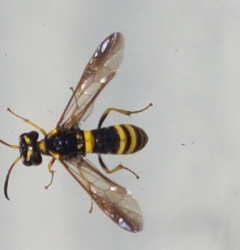
Snipe fly

6972.     Port Coquitlam, BC. Canada

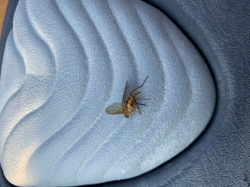
Number 6972. This is a snipe fly (Diptera: Rhagionidae) in the genus Rhagio,  Click here for an example. These are predatory on other small arthropods.

Rove beetle

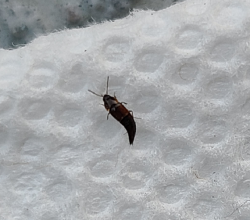
6971.  I saw this on my balcony yesterday on my child’s playmat . Tiny little bug but runs very fast . Is thus dangerous ? Is it larvae or actual size of bug ? Is it normally found in bc ? Have never seen it before. Thanks. Surrey, British Columbia. Canada

Number 6971. This is an adult rove beetle (Coleoptera: Staphylinidae). These are general predators on other small arthropods, and ones like yours are completely harmless to humans. There are a few tropical species in the genus Paederus that exude a fluid that can cause skin/eye irritation. Click here for a detailed explanation.

Caddisflies

6970.    They are ruining our backyard relaxation. They are all over our deck, patio furniture covers and other places. They have wings, long antennae and are blackish brown in color. They don’t bite and will fly into your eyes, ears, mouth and nose. We need to identify them And need info on how to get rid of them. Any assistance will be greatly appreciated. Windsor, Ontario. Canada

Number 6970. These appear to be caddisflies (order Trichoptera). These are harmless; the adults either do not feed at all or may partake of nectar like their sister group, butterflies and moths. Their larvae are aquatic, and constitute an important part of the freshwater food web. You would not be able to get rid of them without causing great harm to other freshwater organisms. Click here for more detailed information.

Imperial moth

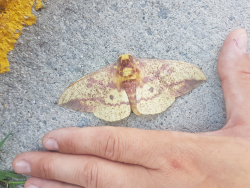
6969.      Out front of my building on a cool summer morning July. Hamilton, Ontario. Canada

Number 6969. This is an imperial moth, Eacles imperialis (Lepidoptera: Saturniidae). These moths unfortunately are becoming increasingly uncommon over much of their range. Click here for more detailed information.

Harvestman

6968.      Colborne, ON. Canada

Number 6968. This is a harvestman, an arachnid in the order Opiliones. Sometimes also called ‘daddy long-legs’, they are non-venomous and harmless. See Click here for more detailed information.

Larva of a moth-Geometridae

6967.        I thought this was a stick until I grabbed it, about 2.5 inches long. It was on one of my outdoor plants. No idea what it is. Fredericton, NB. Canada

Number 6967. This is a larva of a moth in the family Geometridae. They often are called inchworms or loopers because of their distinctive mode of locomotion resulting from their having prolegs only at the end of their abdomen. Click here for a short video clip. Some species are excellent twig mimics.

Nymph of a hairy chinch bug

6966.          Million of them in the backyard, are they harmful? Waterloo, On. Canada

Number 6966. This appears to be a nymph of a hairy chinch bug, Blissus leucopterus hirtus (Hemiptera/Heteroptera: Blissidae). These can cause damage to lawns/turf;  Click here for more detailed information.

Ten-lined June beetle

6965.           I’m trying to identify this beetle I found on the sidewalk in Maple Ridge, BC (July). It’s about an inch long. My husband thinks it’s a Colorado beetle but the photos don’t quite match. Would it eat our potato crop? Any help would be appreciated. Maple Ridge, BC. Canada

Number 6965. This is a ten-lined June beetle, Polyphylla decemlineata (Coleoptera: Scarabaeidae). These will not harm your potato crop, but their larvae can cause damage to tree roots. Click here for more detailed information.

Fly-Tachinidae

6964.         July 2020 saw this fly on my plant outdoors. Have never seen one with this colouring before. Should I be wary? Kanata, ON. Canada

Number 6964. This fly is a friend. It is in the family Tachinidae, and the larvae of all species in this family are parasitic on other arthropods, mainly other insects.

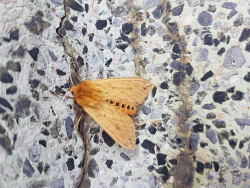
Tiger moth

6963.        Out front of my building on a partially cloudy day not too hot out light Breeze. Hamilton, Ontario. Canada

Number 6963. This is a tiger moth (Lepidoptera: Erebidae; subfamily Arctiinae); likely an adult of the so-called woolly bear of weather forecasting fame.  Click here for images and more detailed information.

Ground-nesting bees

6962.      These look like tiny bees. They swarm by the 1000’s over my lawn, in cedar shrubs, and higher into lower branches of my beech trees. …from May to July. Looks like they hatch from the soil?? – mainly on sunny days. They appeared about 3 years ago and seem to be getting worse each year. They are only about 1/2″ – 5/8″ long. Wings are folded over the back when resting, unlike in the photo ( this one is dead). Any idea what they are, and should I be concerned? Thanks. Bancroft, Ontario. Canada

Number 6962. This is one of the many species of solitary ground-nesting bees, likely in the subfamily Halictinae. These are valuable pollinators, but some species in this subfamily known as sweat bees will sting if swatted when they alight on your skin (they are attracted to perspiration).

Sowbug

6961.        Found in an apartment stairwell. Tisdale, Saskatchewan. Canada

Number 6961. This is a sowbug, a terrestrial crustacean in the order Isopoda; the vast majority of these are harmless scavengers on decomposing organic matter. They breathe through gills that must be kept moist, so keeping your environs as dry as possible will discourage them from staying. Click here for more information.

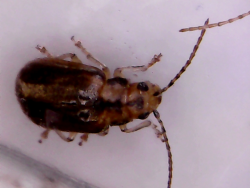
Leaf beetle

6960.      This bug is eating the leafs of one particular Green Bush, The Bush is dying. There are round holes on the leafs that are close. Some leafs only have their skeleton left. Milton, Ontario. Canada

Number 6960. This is a leaf beetle, Coleoptera: Chrysomelidae; it looks like a viburnum leaf beetle (Pyrrhalta viburni), see https://tinyurl.com/y26u3hg6 for images. This is an introduced species; Click here for more detailed information including control recommendations.

Burying/sexton beetle

6959.        This was walking around on my patio. Found it to be an interesting thing just wanted to know what it is? Sault Ste Marie, ON. Canada

Number 6959. This is a burying/sexton beetle (Coleoptera: Silphidae) in the genus Nicrophorus; it appears to be Nicrophorus tomentosus.  Click here for an image. Known as the gold-necked carrion beetle or tomentose burying beetle, they locate and prepare the carcasses of small mammals or birds for their larvae, and then provide parental care. Click here for more information on these fascinating insects.

Spiny oak slug moth

6958.         1/2 inch long, brown in colour with light green and orange markings This one is tiny. The adult is more than an inch long. Found in hot weather after a rain. Lakefield, Ontario. Canada

Number 6958. This is a spiny oak slug moth, Thorybes pylades (Lepidoptera: Limacodidae). Click here for images and more detailed information.

Click beetle

6957.       June/july started showing up with earwigs as well. Not very fast or concerned with people but seems to have come out of no where. Seen a different one every day it seems like. Should I be concerned? What are they? Hartford, Connecticut. United States

Number 6957. This is a click beetle (Coleoptera: Elateridae), a harmless accidental ‘visitor.’ The larvae (wireworms) of some species can be garden pests. Click here for more detailed information.

Scarab beetle

6956.      What’s this insect called …never seen one before. Waterloo, Ontario. Canada

Number 6956. This is a scarab beetle (Coleoptera: Scarabaeidae); it is a grapevine beetle, Pelidnota punctata. Also known as the spotted pelidnota, the adult beetle feeds primarily on grape leaves and frit, but seldom causes real damage. The larvae feed on rotting wood, usually underground. Click here for more detailed information.