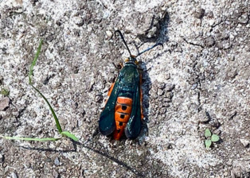
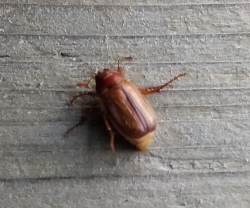
Scarab beetle

6955.        These have been flying in clumsy swarms around our home in Fall River, Nova Scotia at dusk during the month of June/July. They seem to be attracted to the gutter area of our house. Is there any way we can manage these bugs? Fall river, Nova Scotia. Canada

Number 6955. This is a scarab beetle (Coleoptera: Scarabaeidae) in the subfamily Melolonthinae. These often are called May beetles or June bugs; their larvae (white grubs) feed on plant roots underground, and some species can be serious lawn/turf pests. The adult beetles are foliage feeders, but only a few species (such as the Japanese beetle and rose chafer) cause serious damage. There’s not much you can do about them unless you control the larval stage. Click here for an example.
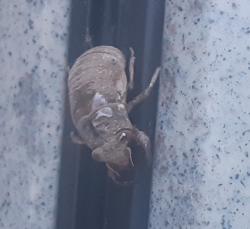
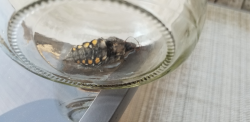
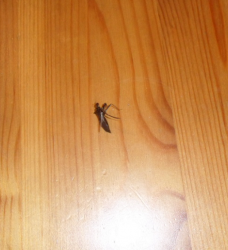
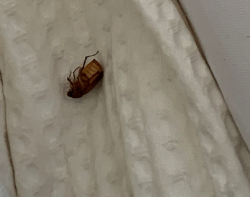
Exoskeleton of a cicada

6954.         We found this outside in our backyard on one of our kayaks and can’t figure out what it is. We have not went out in our kayaks at all lately so we couldn’t have picked it up somehow while out on the water so we have no clue how it got here and what it is. London, Ontario. Canada

Number 6954. This is the empty ‘shell’ (exoskeleton) of a cicada (Hemiptera/ Auchenorrhyncha: Cicadidae), likely in the genus Neotibicen (annual/dog-day cicadas). Click here for a video of the molting process.

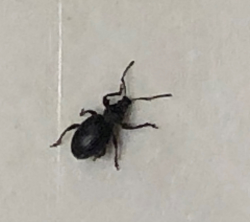
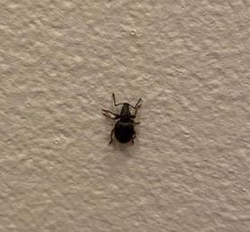
Weevil

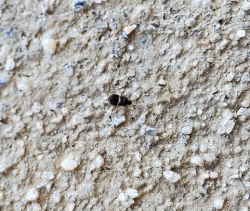
6953.       Hi, I initially found these black insects under one of our bed sheets, and thought it were signs of bed bugs. I then found them in other places in the house. They look like weevils, i’m hoping you can help confirm. Thanks. Richmond Hill, Ontario. Canada

Number 6953. This is indeed a weevil (Coleoptera: Curculionidae); specifically, it is a broad-nosed/short-snouted weevil in the subfamily Entiminae. These weevils often enter buildings in search of shelter, but do no harm there. Click here for an example.
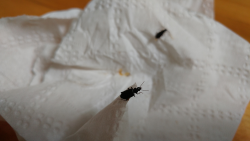
Ground beetle

6952.      I have been seeing many insects like this since over 2 weeks in my home. This morning I seem to have rolled over one in my bed and it bite me under my tigh and the bite woke me up. I saw it escape quickly in my bed sheets before I killed it. It is about 10 mm long and between the antennas it has small claws like contraptions on the top of its head if you look carefully… What is this insect?? Alma, Quebec. Canada

Number 6952. This is a ground beetle (Coleoptera: Carabidae). These are general predators on other small arthropods, mainly other insects. If this is what bit you, it was strictly reflexive on its part, and the bite is harmless. Click here for more detailed information.

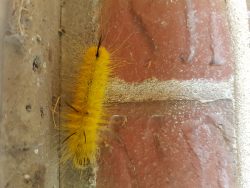
Caterpillar of an American dagger moth

6951.       Found him on my balcony. Hamilton, Ontario. Canada

Number 6951. This is a caterpillar of an American dagger moth, Acronicta americana (Lepidoptera: Noctuidae). Click here for images and more detailed information.

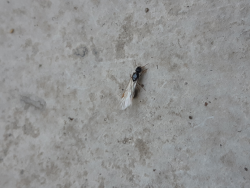
Carpenter ant

6950.      I found one of these ants on my back walkway. Can you identify it? I found scraping on the pressure treated wood in the stairwell under my back deck. Can you tell me if that is related to the ant? There is a pile of wood scrapings underneath the damage. Thank you. Toronto, ON. Canada

Number 6950. This looks like a carpenter ant (Camponotus sp.), and the scraping in your second image does look like carpenter ant damage. Did the ‘shavings’ look like this Click here? Click here for more information including control recommendations.

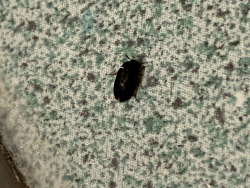
Carpet beetle

6949.        Can someone please let me know what type of bug this is? It is found near the toilet, sink, carpet, beds of our home. I have been getting bug bites on my lower body and I believe this bug is causing that bite. Any identification would be helpful. Calgary, Alberta. Canada

Number 6949. This is a carpet beetle (Coleoptera: Dermestidae) in the genus Attagenus (black carpet beetles and allies). They would not be responsible for any bites, but you should inspect any woolen/silk fabrics/clothing as well as dry stored food products for signs of their larvae – Click here for an image and Click here for some control recommendations.

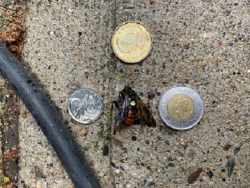
Sphinx moth

6948.          Found it pretty much dead on my lawn in the town of Manila. Canada

Number 6948. This is a sphinx moth (Lepidoptera: Sphingidae) in the genus Manduca, likely M. quinquemaculata, whose caterpillar is known as the tomato hornworm. Either its wings never expanded after it emerged from its pupa, or something has torn them off. Click here for an image.

Nymphs of the hairy chinch bug

6947.            Very small black bug with a white stripe on the back. We have thousands of these on our foundation concrete. They seem to be active during the day, and less active when the sun sets. Gatineau, Quebec. Canada

Number 6947. These may be nymphs of the hairy chinch bug, Blissus leucopterus (Hemiptera/Heteroptera: Blissidae), a common pest of lawns/turf. Click here for more detailed information.

Water boatman

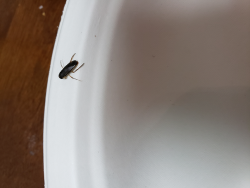
6946.             These insects were found late at night 11pm/12am. They were all around the window trying to get into the house. About 20 of them did find their way in the house crawling on the ground and flying around the lights. About 5-10mm long with 4 legs and possibly 2 more small ones under the front portion of the body. The day had been warm (July 6the about 20 degrees all day). A light rain in the evening for about an hour. Please let me know if you need anything else from me. Thank you. St.Albert, Alberta. Canada

Number 6946. This appears to be an aquatic insect known as a water boatman (Hemiptera/Heteroptera: Corixidae). They are good fliers, and often are attracted to lights at night. They are completely harmless. Click here for more detailed information.

Day-flying firefly

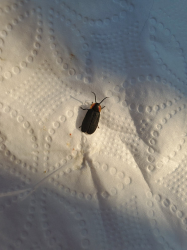
6945.            Found outside flying in July around 7:30 pm in South Western Ontario. Only one seen at the time of capture. Any ideas on species? Thanks so much. Woodstock, Ontario. Canada

Number 6945. This appears to be a day-flying firefly (Coleoptera: Lampyridae). Some net-winged beetles (Coleoptera: Lycidae) in the genus Plateros can be very similar in appearance, but their wing covers have a reticulate pattern rather than being smooth.

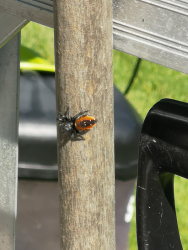
Jumping spider

6944.             Please can you tell me what this is. I’m worried to walk barefoot in the grass. Thank you. Richmond, BC. Canada

Number 6944. This is a jumping spider (family Salticidae) in the genus Phidippus, likely Phidippus johnsoni; Click here for an image. They are harmless to humans.

Broad-nosed/short-snouted weevil

6943.           Langley, British Columbia. Canada

Number 6943. This is a broad-nosed/short-snouted weevil (Coleoptera: Curculionidae; subfamily Entiminae). These weevils often enter buildings in search of shelter, but do no harm there. Click here for an example.
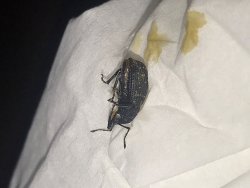
Male velvet ant

6942.         Sumbitch got hit five times with a flyswatter before I killed it. Waynesboro, Tennessee. United States

Number 6942. This is a male velvet ant (Hymenoptera: Mutillidae), likely in the genus Timulla. These are parasitic primarily on ground-nesting bees and wasps, and the wingless females (sometimes called ‘cow-killers’) have a wickedly painful sting. Males lack a sting, and are harmless.

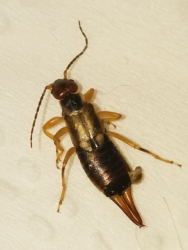
Earwig

6941.        I just caught this about 5 inches under the foot of my bed and has 6 legs just now and would like to know what on earth is this my friends? Steve.

Number 6941. This is an earwig (order Dermaptera). These basically are scavengers, but some may be predatory on other small arthropods as well. Finding them is no cause for alarm. Click here for more detailed information.

Assassin bug

6940.      Hello, Please let me know what this is. Toronto Canada, photo taken June 20 – 25. Thank you very much. Maria. Toronto, Ontario. Canada

Number 6940. This appears to be an assassin bug known as a masked hunter (Reduvius personatus; Hemiptera/Heteroptera: Reduviidae), a cosmopolitan species often found indoors and reputed to have a very painful ‘bite’- Click here for more detailed information.

Two-marked treehoppers

6939.       These bugs are really tiny, they jump and they are on my raspberry canes and also my milkweed plants. Colton, SD. United States

Number 6939. These appear to be two-marked treehoppers, Enchenopa binotata (Hemiptera/Auchenorrhyncha: Membracidae). Click here for detailed information.

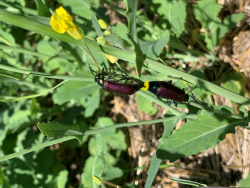
Blister beetle

6938.      Found a few in canola field. Seem to eat the stems just under the flowers. Crazy j, Sk. Canada

Number 6938. This is a blister beetle (Coleoptera: Meloidae) in the genus Lytta; they look like Nuttall’s blister beetle, Lytta nuttalli  Click here for an image.

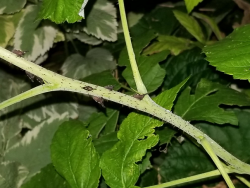
Squash vine borer

6937.        Does anyone know what this thing is?? York, ON. Canada

Number 6937. This is a squash vine borer, Melitta curcurbitae (Lepidoptera: Sesiidae), a serious garden pest. Click here for more detailed information.

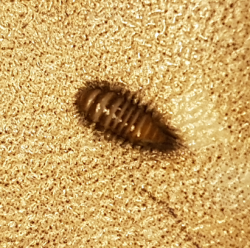
Larva of a carpet beetle

6936.         Found indoors, is about 3-5mm long. Never seen before. Any ideas? Holland Landing, Ontario. Canada

Number 6936. This is a larva of a carpet beetle (Coleoptera: Dermestidae) in the genus Anthrenus (varied carpet beetle and allies). Click here for detailed information.

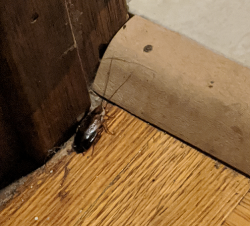
Cockroach

6935.       July 2, 11:30pm North Kawartha, Ontario. Canada

Number 6935. This is a cockroach, but it does not appear to be one of the common peridomestic pest species. Click here

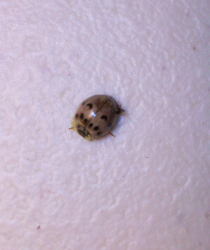
Lady beetle

6934.      Found this bug on the bed sheet cover early one morning. Waipahu, HI. United States

Number 6934. This is a lady beetle (Coleoptera: Coccinellidae); ones like this are general predators on small, soft-bodied arthropods such as aphids and scale insects. Click here for an image

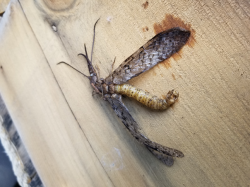
Male eastern dobsonfly

6933.       This was swimming in our pool. No idea what it is. Paris, ON. Canada

Number 6933. This is a male eastern dobsonfly, Corydalus cornutus (Megaloptera: Corydalidae), it would have been drowning, not swimming. Dobsonfly larvae (hellgrammites) are aquatic, but the adults are strictly aerial. The long, sickle-like mandibles of males are harmless, but those of the females (as well as hellgrammites) are very stout and can draw blood. Click here for more detailed information.

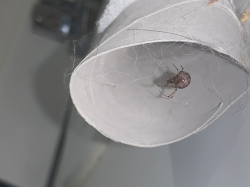
Comb-footed/cobweb spider

6932.      Toronto, Ontario. Canada

Number 6932. This is a comb-footed/cobweb spider in the family Theridiidae, possibly a triangulate cobweb spider, Steatoda triangulosa. They are harmless to humans, and may eat more dangerous spiders, Click here for more detailed information.

Elm sawfly

6931.    Pilot Butte, Saskatchewan. Canada

Number 6931. This is an elm sawfly, Cimbex Americana (Hymenoptera: Cimbicidae).  Click here for more detailed information.

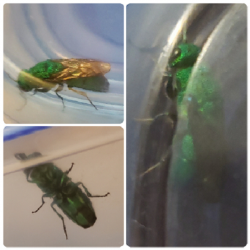
Cuckoo wasp

6930.      Do you know what this is? The closet I could find online was an Emerald Ash Boarer except it doesn’t have a green shell just translucent brown wings. Sunderland, Ontario. Canada

Number 6930. This is a cuckoo wasp (Hymenoptera: Chrysididae). These are parasitic on (primarily ground-dwelling) solitary bee and wasp species; Click here for additional information.

May beetles

6929.       It was too large to be a bed bug. It was approximately 1.5 cm and had a very large abdomen. Vancouver, BC. Canada

Number 6929. This is a beetle in the family Scarabaeidae of the type known as May beetles or June bugs. They are good (albeit clumsy) fliers that are attracted to lights at night and often accidentally get indoors. They will do no harm there. Click here for some suggestions.

Broad-nosed/short-snouted weevil

6928.       In Calgary, AB, It seems every year in June when the weather is warm and rainy, I keep finding this little black beetle crawling up walls or coming out from under baseboards in my bathroom, basement and kitchen/near the back door. The ones in the basement are like this little guy in the picture but I also find bigger light brown ones.
The black ones are slightly smaller than a ladybug. What is it, why do they keep coming back year after year and how do I eliminate them??? Calgary, AB. Canada

Number 6928. This is a broad-nosed/short-snouted weevil (Coleoptera: Curculionidae; subfamily Entiminae). These weevils often enter buildings in search of shelter, but do no harm there. You really cannot eliminate them short of hermetically sealing your house. Click here for an example.
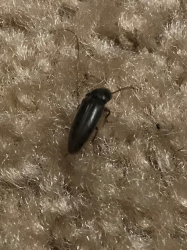
Click beetle

6927.      Manassas, Virginia United States

Number 6927. This is a click beetle (Coleoptera: Elateridae), a harmless accidental intruder. Click here for more detailed information.

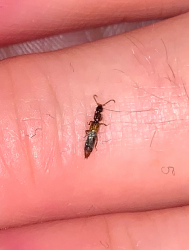
Rove beetle

6926.        There a been a number of these small less than 5 mm flying bugs around our 4th floor apartment that last few evenings. We find them on the couch or flying around the living room. Waterloo, Ontario. Canada

Number 6926. This is a rove beetle (Coleoptera: Staphylinidae), they are general predators on other small arthropods. Some species can secrete a noxious fluid that can cause eye/skin irritation. Click here for some examples.

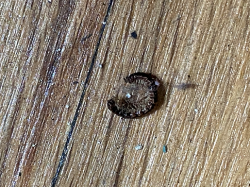
Flat-backed millipede

6925.      Hi i know I do not live in Canada but I was hoping that you could tell me what kind of bug this is. I have now seen two of them and where do they come from? NEW YORK, NY. United States

Number 6925. This is a flat-backed millipede, Diplopoda: Polydesmida; they are very common outdoors in moist, shady habitats. The vast majority of these are harmless scavengers on decomposing organic matter. One species, the so-called garden millipede, can damage very tender plants. Click here for an image

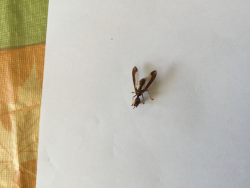
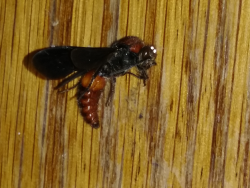
Wasp-mimicking mantisfly

6924.        Lanark, Ontario. Canada

Number 6924. Great find! This is a wasp-mimicking mantisfly, Climaciella brunnea (Neuroptera: Mantispidae); Click here for images and more information.

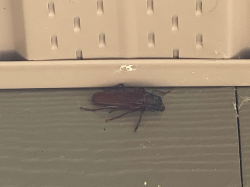
Long-horned wood-boring beetle

6923.      Do you know what this insect is? Was on side of house, just over 2 inches long, brown colour. Is it harmful to house or trees? Midland, ON. Canada

Number 6923. This is a long-horned wood-boring beetle (Coleoptera; Cerambycidae); it looks like a brown prionid, Orthosoma brunneum. It will not damage your house or trees, Click here for more detailed information.