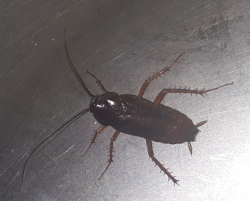
Cockroaches

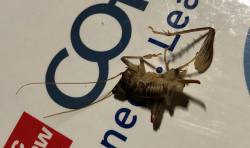
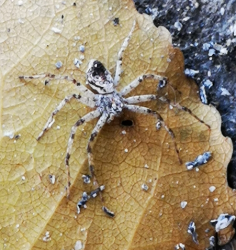
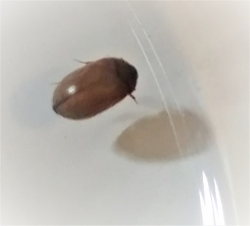
6693.      So these are pics of 2 different guys who were found in my sink and bathtub, but I’m pretty sure they’re the same bug. They were going in may and june, in toronto. Yesterday I found another one who looks similar on my living room floor, in the middle of the day. I would add a photo of him, but I squashed him so it’s not a good photo. He had 3 long legs on either side and long skinny antennae (longer than the length of his body) He was dark mohagany, close to black with a hard shell. I didnt see any wings.my hope is that these aren’t cockroaches. Please help! Thanks. Toronto, Ontario. Canada


Number 6693.  These are indeed cockroaches.  Click here for some control recommendations 
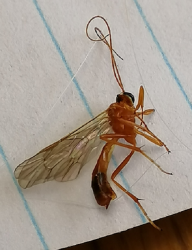
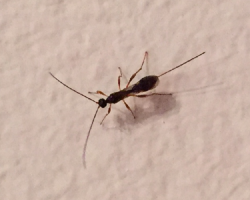
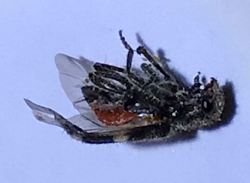
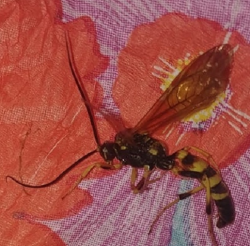
Ichneumon wasp

6692.      We have found a few of them in that last few days and wondering what they are as we have not seen them before, we are finding them in our home and I have kids so just wondering what they are. Seal Cove WB., NL. Canada


Number 6692.  This is an ichneumon wasp (Hymenoptera: Ichneumonidae). Ones of this type usually are parasitic on moth or butterfly larvae/pupae. They lack venom and are harmless to humans. Click here for an example.

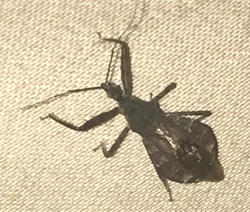
Western conifer seed bug

6691.      Found crawling on patio door in an. Also similar to one seen in family restaurant. Timberlea, Nova Scotia. Canada


Number 6691.  This a western conifer seed bug, Leptoglossus occidentalis (Hemiptera/Heteroptera: Coreidae), a very common and widespread nuisance pest. No control is needed. Click here for more detailed information.

Camel/cave cricket

6690.      Saskatoon, SK. Canada


Number 6690.  This is a camel/cave cricket (Orthoptera: Rhaphidophoridae). These usually are found in relatively dark, undisturbed places. They basically are harmless scavengers, but sometimes can become nuisance pests when they occur indoors. Click here for more detailed information.

Whitemarked spider beetle

6689.      Just moved into a furnished apartment, found this while cleaning, I searched the web and can’t seem to find anything like it. Can someone tell me what kind of bug it is please. Thank you! St. John’s, Newfoundland. Canada


Number 6689.  This is a whitemarked spider beetle, Ptinus fur (Coleoptera: Anobiidae; subfamily Ptininae). This is a cosmopolitan species that can become a pantry pest. Click here for more detailed information.

Fishing spiders

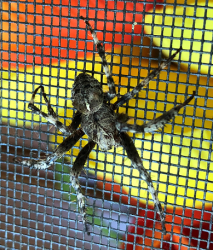
6688.      Found outside my house. Cool morning. October 4th 2019. Calgary, Alberta. Canada


Number 6688.  This looks like one of the fishing spiders (family Pisauridae) in the genus Dolomedes, these are harmless to humans.  Click here for an image.

Drugstore beetle

6687.      These beetles have recently appeared in my bedroom (2nd floor in a house). They are always found in individual, 1 – 2 everyday. Only seen them on/near my bed so far, which is also close to window and a coffee tree plant.


Number 6687.  This is either a cigarette or drugstore beetle, these are cosmopolitan pest species that can infest a wide variety of dry stored food products. Click here for detailed information including control recommendations.

Beetle

6686.      The bug is probably around 0.5 CM long, and it was found crawling on our curtains/around our window ledge. We’ve seen it a few times around the condo, and we have no idea where it comes from or what it is. I found a few more in random places in the apartment – sometimes in the sink, sometimes on the curtain, and most recently in a cupboard! I tried taking a close up photo this time – does this help confirm whether it is in fact a beetle, and is it harmful? Any advice on how to eliminate it? It’s the first time I’ve ever ever had issues with pests in the condo. Thanks, Phoebe.


Number 6686.  This is a beetle in the family Dermestidae (carpet/hide/skin/larder beetles and allies); it might be a black carpet beetle in the genus Attagenus – Click here for control recommendations.

Young nymph of an assassin bug

6685.      This is the only photo. This bug is very small. Maybe a millimetre. Slemon Park PEI. Canada


Number 6685.  This is a young nymph of an assassin bug (Hemiptera/Heteroptera: Reduviidae) known as the masked hunter (Reduvius personatus). This is a cosmopolitan species often found in buildings where they prey upon other insects found there, They are reputed to have a very painful bite. 

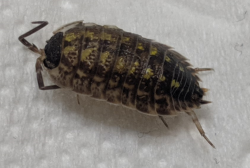
Terrestrial crustacean

6684.      Found in the basement. Less than half an inch. Edmonton, Alberta. Canada


Number 6684.  This is a terrestrial crustacean in the order Isopoda. They go by a variety of common names, including sowbugs, pillbugs, slaters, woodlice, and roly polys. They are harmless scavengers on decomposing organic matter, but occasionally become nuisance pests when they occur indoors in large numbers.

Parasitic wasp

6683.      Found on the wall of my condo unit on a warm humid day after a few cooler rainy days. Not sure how it got in as balcony doors and windows are kept closed. Toronto, Ontario. Canada


Number 6683.  This is a parasitic wasp, likely in the family Braconidae. These all are parasitic on other arthropods, mainly other insects. Click here for another example

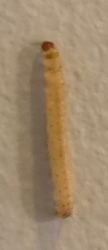
Caterpillar

6682.      This was on my wall this morning. Looks similar to the scarlet malachite but without the pointy things. It was about 1 cm long. I live in BC. Thank you.


Number 6682.  This is a caterpillar rather than a beetle larva. One possibility is that it might be a caterpillar of the Indian meal moth, Plodia interpunctella (Lepidoptera: Pyralidae); Click here for more detailed information, including some control recommendations. These often leave their food source when mature to find a suitable place to pupate. You should check any areas where dry food products are stored for signs of infestation.

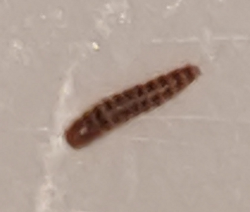
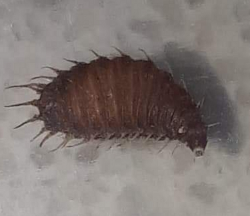
Larva of a carpet beetle

6681.      Closet floor. Toronto, ON. Canada


Number 6681.  This is a larva of a carpet beetle (Coleoptera: Dermestidae) in the genus Attagenus (black carpet beetles and allies). Click here for some control recommendations.

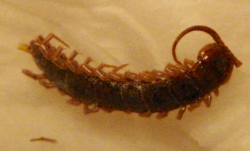
Centipede

6680.      Found dead on the carpet near the sliding balcony doors. Quite large, between 1/2 to 3/4 inch. Calgary, AB. Canada


Number 6680.  This is a centipede (class Chilopoda). These are general predators on other small arthropods, and ones like this are harmless to humans. Click here for more detailed information.

Checkered beetle

6679.      Found on firewood near Alliston Ontario. Hopefully these photos are of better quality. Thank you. Alliston, Ontario. Canada


Number 6679.  This is a checkered beetle (Coleoptera: Cleridae). These are general predators on other small arthropods, mainly other insects. Click here for an example

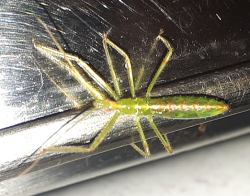
Nymph of an assassin bug

6678.      Taken 23rd of September. In the past few days I’ve repeatedly found bug bites with small white tubes that were easily pulled out. Now, I found this bug acting dead and not moving in any way to the point that I picked it up with needles under the wings to stage a photograph. It did not move until I opened the door, and it merely walked a few steps, shook it’s head, and “died” again. I am very puzzled, please help! Owen Sound, ON. Canada


Number 6678.  This is a nymph of an assassin bug (Hemiptera/Heteroptera: Reduviidae) in the genus Zelus. If this one were to bite you, you would know it as it is very painful. Click here for more detailed information.

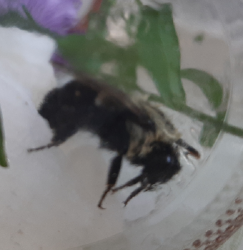
Bumble bee

6677.      Larger than a quarter. Totally black with yellow in circle on back and around the neck. If it’s a bee I want to let it go.  Langley, British Columbia. Canada


Number 6677.  This is a bumble bee, Hymenoptera: Apidae, Bombus sp. These are valuable pollinators, and several species are endangered/threatened. Click here for an image.

Larva (maggot) of a lesser house fly

6676.      Thus bug was found on a pet rabbit in the evening and the bunny passed away over night… coincidence? We’ve never seen this type of bug but have recently moved here. Toronto, Ontario. Canada


Number 6676.  This looks like a larva (maggot) of a lesser house fly (Diptera: Muscidae). Also known as a latrine fly, they breed in all manner of decomposing organic matter, Click here for details.

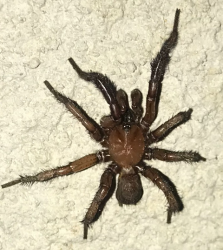
Male folding door trapdoor spider

6675.      Kamloops, British Columbia. Canada


Number 6675.  This is a male folding door trapdoor spider in the genus Antrodiaetus, Click here for an example. The males leave their burrows to wander about in search of females, which remain in their burrows. They are not dangerous to humans.

Female cross spider

6674.      Spider located in Quispamsis, New Brunswick on a house. Lower coverdale, New Brunswick. Canada


Number 6674.  This is a very gravid female cross spider, Araneus diadematus; Click here for an image.

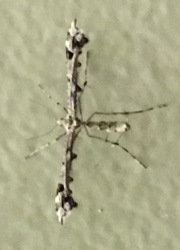
Plume moth

6673.      September 22/19 on living room wall. Hanmer, Ontario. Canada


Number 6673.  This is a plume moth (Lepidoptera: Pterophoridae). The T-shape resting pose is typical of this family. Click here for some examples.

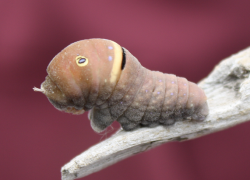
Caterpillar of a tiger swallowtail butterfly

6672.      Williams Lake, BC. Canada


Number 6672.  This is a caterpillar of a tiger swallowtail butterfly (Lepidoptera: Papilionidae; Papilio sp.), possibly that of a Canadian tiger swallowtail, Papilio Canadensis; Click here for an image. Normally green in colour, these caterpillars often assume a brownish hue just prior to pupation..

Click beetle

6671.      This was on my bedroom floor. I heard a clicking noise and saw it was jumping and would make a click noise when it landed. What is it? BRAMPTON, Ontario. Canada


Number 6671.  Well, strangely enough, it is a click beetle (Coleoptera: Elateridae). The ‘click’ occurs when they flex their body to right themselves from an upside-down position. Click here for details.

Cross spider

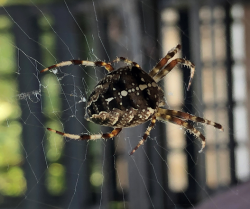
6670.      Keswick, Ontario. Canada


Number 6670.  This is a cross spider, Araneus diadematus; a very common and widespread orb weaver also known as the European garden spider on the other side of the Atlantic Ocean. All orb weavers are harmless to humans. Click here for more detailed information

Ichneumon wasp

6669.      Winnipeg, Manitoba. Canada


Number 6669.  This is an ichneumon wasp (Hymenoptera: Ichneumonidae); Click here for an example. These wasps all are parasitic on other arthropods, mainly other insects, and are harmless to humans.

Larva of an Asian multicolored lady beetle

6668.  What is this thing? Dangerous? HAMILTON, Ontario. Canada


Number 6668.  This is a larva of an Asian multicolored lady beetle, Harmonia axyridis (Coleoptera: Coccinellidae). This is an introduced species that sometimes can be a pest when they enter buildings in large numbers. Click here for more detailed information.

Orb weaving spider

6667.  Hello! I found this large spider on my front door this morning. I am interested to find out what kind it is as I I’ve never seen it before. I tried to identify it myself, but had no luck. Thank you in advance! Moncton, New Brunswick. Canada


Number 6667.  This is an orb weaving spider in the genus Araneus. They are harmless to humans. Click here for an example.

Assassin bug

6666.  In my bedroom. Very oldhouse, so lots of entry points. It’s been damp lately. Low twenties temp. But it’s just about fall and we’ve had cooler weather and lots of rain lately. About 1.5-2cm long. Wingham, Ontario. Canada


Number 6666.  This is an assassin bug (Hemiptera/Heteroptera: Reduviidae). They are general predators on other small arthropods, mainly other insects. Some species can have a very painful (but not dangerous) bite. Click here for more detailed information.

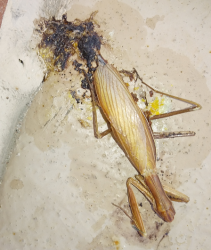
Praying mantis

6665.    I squash it on my front porch a few days ago. I have never seen an insect as such before and wonder what it is and if it bites? Thank you. Gatineau, Qc. Canada


Number 6665.  This is a praying mantis (order Mantodea) in the family Mantidae; I cannot tell you any more because of the damaged condition of this specimen. All mantids are general predators on anything that they can capture, but are harmless to humans. Click here for details.

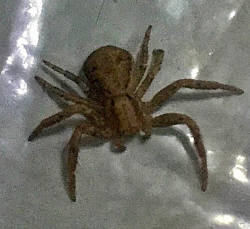
Crab spider

6664.    Found this on my husband’s shoulder in the house, and kept it in a bag! Thank You so much. kapuskasing, Ontario. Canada


Number 6664.  This is a crab spider (family Thomisidae). These are ambush hunters that do not spin a capture web, but simply lay in wait for something to come within grabbing distance. They are harmless to humans. Click here for more detailed information.

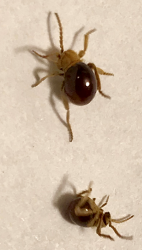
Spider beetles

6663.    Hi, Please help me identify these bugs, I keep finding them in the nooks and crannies of my old house. They are always in groups of many and they keep crawling. I have never seen them before in my life. Thank you. Karim. Montreal, Quebec. Canada


Number 6663.  These are spider beetles (Coleoptera: Anobiidae; subfamily Ptininae) in the genus Mezium, likely M. affine, known as the shiny or northern spider beetle. These can be pantry pests, infesting a wide variety of dry stored food products. Click here for more detailed information.

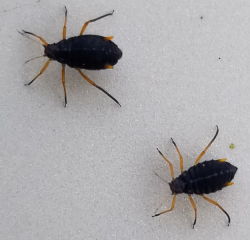
Aphids

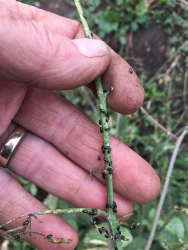
6662.    Tiny 5mm to 10mm, thousands of them seemingly behaving like ants on the move with back and forth traffic. Probably had a colony. Could possibly be feeding on the sap that’s shed from large popolar trees. Fort St. John, BC. Canada


Number 6662.  These are aphids (Hemiptera/Sternorrhyncha: Aphididae). Also known as plant lice, they all are sap feeders and often secrete excess fluid in the form of a sticky substance called honeydew. Some species can vector viral diseases of plants. Click here for more detailed information

Flea beetles

6661.    We are located just south of Saskatoon Saskatchewan, Canada


Number 6661.  These most likely are flea beetles (Coleoptera: Chrysomelidae; tribe Alticini); Click here for details on their life cycle.