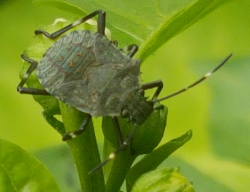
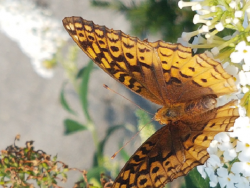
Fritillary

6660.    This was seen in Dunnville Ontario. Hamilton, Ontario. Canada


Number 6660.  This is a fritillary (Lepidoptera: Nymphalidae; Speyeria sp.) There are a few species that are so similar in overall appearance that I hesitate to make a specific identification from a single image. Scroll through the images of Ontario fritillaries at Click here for some examples.
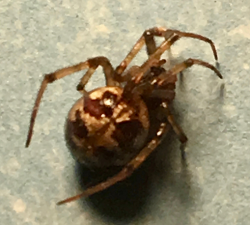
Cobweb/comb-footed spider

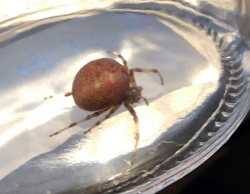
6659.    Size: abt. 1 cm. Found Sept 13 2019, in Ottawa, Ontario, under an old piece of furniture in a loose web. Tentatively identified as Steatoda nobilis (?). Ottawa, Ontario. Canada


Number 6659.  This is Steatoda triangulosa, a cobweb/comb-footed spider in the family Theridiidae. This species is harmless to humans. Click here for more detailed information.

Nymphs of the southern green stink bug

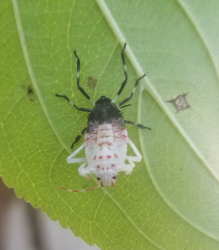
6658.    Found these bugs, along with dozens more, all on spent anise hyssop flower heads in my garden. They do not move much. Haven’t been able to find any bug image on line that identifies it, so I do not know what to do … protect, or eliminate. Thank you in advance, Hanne J. Vancouver, B.C. Canada


Number 6658.  These are nymphs of the southern green stink bug, aka green vegetable bug (Nezara viridula; Hemiptera/Heteroptera: Pentatomidae). Definitely a pest species; Click here for more detailed information.

Western conifer seed bug

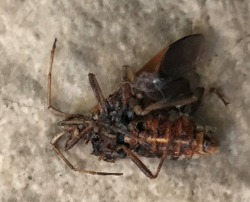
6657.    Hi there, I found this crawling on my desk in my room in the afternoon. It was crawling quite slowly, I used a fly swatter to kill it. When I crushed it I noticed that wings had come out. From what I can tell it had 6 legs and a set of antennas. I’m terrified of getting a cockroach infestation or any bug infestation for that matter! PLEASE HELP IDENTIFY THIS. Wolfville Nova Scotia, Canada


Number 6657.  I cannot be certain because of the mangled condition of the specimen, but it might be a western conifer seed bug, Leptoglossus occidentalis (Hemiptera/Heteroptera: Coreidae). Although harmless, these can become nuisance pests when they enter homes in search of shelter. Click here for more detailed information.

Weevil

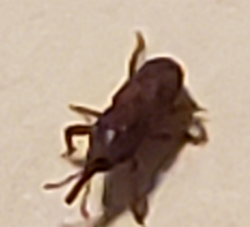
6656.    This has been found in a house about 3 blocks from St-Lawrence river. Could you advise what it is please? Thank you. J.C. Montreal, Quebec, Canada


Number 6656.  This is a weevil (Coleoptera: Curculionidae), but I cannot tell much more from this image. If it is very small (4 mm or less), it might be a grain/granary weevil in which case you should check your food/seed storage areas for signs of insect infestation. Click here

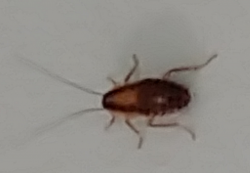
Nymph of a German cockroach

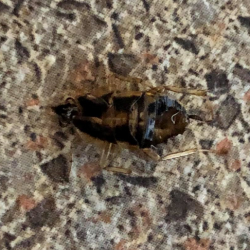
6655.    Found a couple (maybe 4 of 5) in the kitchen aat different moments of the day in less than a week. Montréal, Quebec. Canada


Number 6655.  I cannot be certain because of the mangled condition of the specimen, but it might be a nymph of a German cockroach, Blattella germanica (Blattodea: Ectobiidae), a peridomestic species difficult to bring under complete control. Click here for some control recommendations.

Larva of a carpet beetle

6654.    Absolute phobia of bugs… not sure what this is… terrified it’s a bed bug.. please help. Medicine Hat, Alberta. Canada


Number 6654. This is a larva of a carpet beetle (Coleoptera: Dermestidae) in the genus Attagenus (black carpet beetles and allies). Click here  for some control recommendations.

Nymph an assassin bug

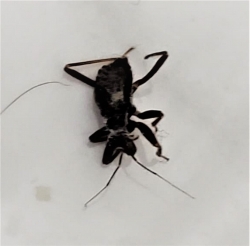
6653.    Hi, I have a picture of a bug that I found. Had a sharp pain shot up leg and saw little blood and then the bug on the ground in my washroom not sure what this was. Not sure if you could help out. Ontario


Number 6653. This is a nymph an assassin bug known as a masked hunter (Reduvius personatus; Hemiptera/Heteroptera: Reduviidae), a cosmopolitan species often found indoors and reputed to have a very painful ‘bite’- Click here for more detailed information.

Larva of a scarlet malachite beetle

6652.    Found on living room chair. Very small – about 1 cm wide & about 4-5 cm long. I think it may be carpet beetle larvae, but not sure. Calgary, AB. Canada


Number 6652. This is a larva of a scarlet malachite beetle, Malachius aeneus (Coleoptera: Melyridae) – Click here for detailed information. This is not a pest, but simply an accidental intruder. They are general predators on other small arthropods.

Nymph of a cockroach

6651.     We just moved into a furnished place and are seeing quite a few of these. Mostly in the kitchen, but this one was in the bathroom. They only seem to come out at night. Being told these are just sow bugs/wood bugs, but they look more like cockroaches to us. Zurich, ON. Canada


Number 6651. It is a nymph of a cockroach, likely a German cockroach, Blattella germanica (Blattodea: Ectobiidae), a peridomestic species difficult to bring under complete control. Click here  for some control recommendations.

Checkered beetle

6650.    Found near firewood. Alliston, Ontario. Canada


Number 6650. This is a checkered beetle (Coleoptera; Cleridae). These are general predators on other small arthropods. Click here for an example.

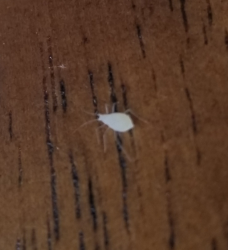
Aphid

6649.    White. Approx. 1.5 mm. 6 legs. Antennae. September/end of summer beginning of fall. WINNIPEG, MB. Canada


Number 6649. This is an aphid (Hemiptera/Sternorrhyncha: Aphididae). Also known as plant lice, they all are sap feeders and some species can vector viral diseases of plants. Click here for more detailed information

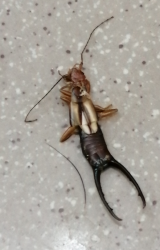
Earwig

6648.    Haugh. Grub Justin. Afghanistan


Number 6648. This is an earwig (order Dermaptera). They are harmless to humans, but their forceps-like cerci at the end of their abdomen can give a light pinch. Click here for details on their life history.

Orb weaving spider

6647.    Found September 8th in house, but patio door had been open a lot of the day on the 7th. Calgary, AB. Canada


Number 6647. This is an orb weaving spider in the genus Araneus, likely Araneus marmoreus (marbled orb-weaver), a highly variable species. Click here for an example. All orb weavers are harmless to humans.

Nymph of a brown marmorated stink bug

6646.    Just looking to identify this bug. Maidstone, ON. Canada


Number 6646. This is a nymph of a brown marmorated stink bug, Halyomorpha halys (Hemiptera/Heteroptera: Pentatomidae) in the act of shedding its ‘skin’ (exoskeleton), a process called molting; Click here for an image. This bug goes through five nymphal stages before becoming an adult; Click here for an image.

Long-horned wood-boring beetle

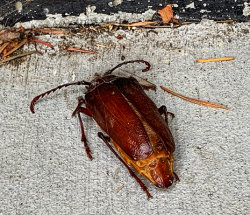
6645.    We found this beetle on the back walk by our house on Vancouver Island. I estimate it to be 2”-2.5” long. I have no idea what it is. Hoping you can help ID it. Thx. Victoria, BC. Canada


Number 6645. This is a long-horned wood-boring beetle (Coleoptera: Cerambycidae) in the subfamily Prioninae. These are among the largest beetles in North America; their larvae usually are found boring in large tree roots. Click here for an image.

Grain beetle

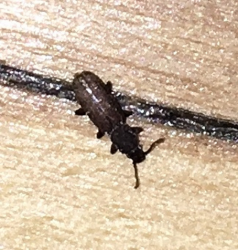
6644.    Size about 3-4 mm. Looks like it’s missing its legs. Québec, Québec. Canada


Number 6644. This is a grain beetle in the genus Oryzaephilus (saw-toothed and merchant grain beetles). These can infest a wide variety of dry stored food products. Click here for more detailed information.

Female eastern Hercules beetle

6643.    Bug is about 21/2 -3 inches long about 11/2 inches wide. Don’t know what it is or where it came from. Found it crawling across my laundry room floor. Wyandotte, Oklahoma. United States


Number 6643. This is a female eastern Hercules beetle, Dynastes tityus (Coleoptera: Scarabaeidae). Click here for more detailed information.

Hickory tussock moth caterpillar

6642.    Hamilton, Ontario. Canada


Number 6642. This looks like a hickory tussock moth caterpillar, Lophocampa caryae (Lepidoptera: Erebidae). Click here for more detailed information.

Non-biting midge

6641.    These little guys seem to appear out of nowhere two days after our first frost (-2 c, -4 c windchill) It was cold and rainy the day following the frost. They have been around for nearly a week now, it’s been unseasonally cool since the frost. They are on anything green including the grass and trees and unfortunately my veggy garden. If I walk on the grass or lightly shake any plant, dozens fly away. They are light green/white in colour and small, maybe 2 or 3 cms. I’m in zone 3a. What are these ? South Porcupine, Ontario. Canada


Number 6641. This is a non-biting midge (Diptera: Chironomidae). They are harmless, but can be nuisance pests when they occur in large numbers. Click here for more detailed information.

Broad-nosed/short-snouted weevil

6640.    I keep finding these in my house. What are these? Are they dangerous at all? Kitimat, British Columbia. Canada


Number 6640. This is a broad-nosed/short-snouted weevil (Coleoptera: Curculionidae; subfamily Entiminae); Click here for an example. These weevils often enter buildings in search of shelter, but do no harm there.

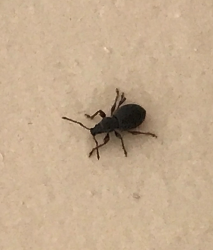
Broad-nosed/short-snouted weevil

6639.    I found this tiny beetle on the wall in the upstairs hallway of my home in September. I would like to know what it is if you could tell me please and thank you. KITCHENER, Ontario. Canada


Number 6639. This is a broad-nosed/short-snouted weevil (Coleoptera: Curculionidae; subfamily Entiminae); Click here for an example. These weevils often enter buildings in search of shelter, but do no harm there.

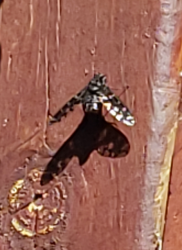
Bee fly

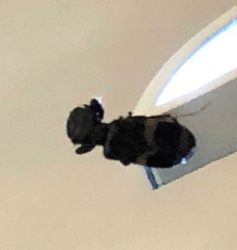
6638.     Found in our backyard in Brampton. Brampton, Ontario. Canada


Number 6638. This is a bee fly (Diptera: Bombyliidae), likely in the genus Xenox; Click here for an example. These are parasitoids on solitary ground and cavity-nesting bees (including carpenter bees).

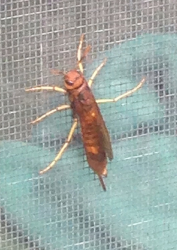
Pigeon tremex

6637.    This photo was taken in Regina, SK Canada at the beginning of September/19. It is on the outside of a window screen. Regina, SK. Canada


Number 6637. This is a pigeon tremex, Tremex columba (Hymenoptera: Siricidae). Also known as a horntail, their larvae tunnel in the wood of dead/dying hardwood trees where they are preyed upon by the larvae of giant ichneumon wasps in the genus Megarhyssa.  Click here for more detailed information.

False bombardier beetle

6636.    Lucedale, MS. United States


Number 6636. This is a false bombardier beetle, Galerita sp. (Coleoptera: Carabidae). Click here for more detailed information.

Broad-nosed/short-snouted weevil

6635.     Stony plain, Alberta. Canada


Number 6635. This is a broad-nosed/short-snouted weevil (Coleoptera: Curculionidae; subfamily Entiminae). These weevils often enter buildings in search of shelter, but do no harm there. Click here for more detailed information.

Orb weaving spider

6634.    Hi., thank you for your help and service. What type of spider is it? Is it poisonous? Can it cause some kind of harm to children or pets? Is it aggressive?, thank you. MONTREAL, QUEBEC. Canada


Number 6634. This is an orb weaving spider in the genus Araneus. Although they have venom glands and thus technically considered venomous, they are harmless to humans. Click here for another example.

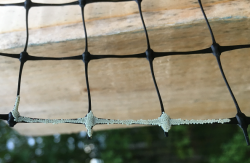
Eggs of a moth

6633.    Deer fence around raised garden bed. Don’t know if I should be concerned about these insect eggs. Paula, Hammonds Plains, Nova Scotia. Canada


Number 6633. These most likely are the eggs of a moth whose larvae would feed on tree/shrub leaves; I don’t think that you need to worry overmuch.

Nymph of a brown marmorated stink bug

6632.    On pepper plants. Hamilton, Ontario. Canada


Number 6632. This is a nymph of a brown marmorated stink bug, Halyomorpha halys (Hemiptera/Heteroptera: Pentatomidae). This is an introduced species that has become a pest in many areas of North America; Click here for more detailed information.

White-margined burrower bugs

6631.    These beetles were found in Winnipeg, Manitoba on a stump. The stump was not rotten only a few weeks ago was the tree cut down. Some of the beetles appeared all black and some were bright red and black. They were about 1/4 inch long. It is about 16-20 degrees Celsius today. Winnipeg, Manitoba. Canada


Number 6631. These are not beetles, but are white-margined burrower bugs, Sehirus cinctus (Hemiptera/Heteroptera: Cydnidae); Click here for an image. The adults and nymphs (the red ones) feed primarily on the seeds of nettles and plants in the mint family.

German cockroach

6630.    Hi. I’ve included photo of this insect. I found them mostly living in kitchen and bathroom, indoor. they are surrounded in the dark corner. It’s hard to catch them, they react active once you find them and run fast. It’s hard to. I thought they are roach at first, used bait and bug spray for roach. However, these actions did not work. Please help me. Thank you. Ottawa, Ontrario. Canada


Number 6630. This is a German cockroach, Blattella germanica (Blattodea: Ectobiidae), a peridomestic species difficult to bring under complete control. Click here for some control recommendations.

Blister beetle

6629.    Tasso Lake, Waterloo, Huntsville/Lake of Bays Ontario. Canada


Number 6629. This is a blister beetle (Coleoptera: Meloidae) in the genus Meloe. Sometimes called oil beetles, their bodily fluid (haemolymph) contains a chemical called cantharidin that can cause blisters on tender skin. Click here for example

Aphids

6628.    This is probably a very common garden pest but I’m having trouble identifying it. Magnification is about 90x using a digital microscope. There are swarms of these almost coating the top 8 inches of some Himalayan impatience plants as well as a section of a honeysuckle growing in a different part of my yard. Thank you in advance .. Brad. Calgary, Alberta. Canada


Number 6628. These are aphids (Hemiptera/ Sternorrhyncha: Aphididae). Also known as plant lice, they are sap feeders and some species can vector viral diseases of plants. Click here for more detailed information