Thousands of pest photos submitted for identification.

Leafhopper

6607.    In pot plants. Hamilton, Ontario. Canada


Number 6607. This is a leafhopper (Hemiptera/Auchenorrhyncha: Cicadellidae) in the genus Graphocephala, Click here for an example. There are several species in this genus that are very similar in appearance and difficult to separate on images alone. They do not appear to be serious pest species.

Pea or bean weevil

6606.    I had this weird bug, very small, multiple around the house mostly been finding them on the bed. I found them a lot around the bed, and they crawl up walls. They are very small. This is a zoomed in picture. They don’t seem to bite. I found a couple in the washroom as well. Scarborough.


Number 6606. This is a pea or bean weevil (Coleoptera: Chrysomelidae; subfamily Bruchinae). Not a true weevil, these beetles will infest seeds of many plants, primarily those in the legume family. You should check any areas where you store dry seeds of any kind for signs of insect infestation. Click here for an image.

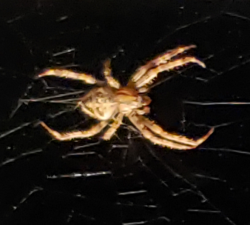
Orb weaving spider

6605.    Seen at night on a web spun on a light. We live in a rural area. Ariss, Ontario. Canada


Number 6605. This is an orb weaving spider (family Araneidae). The image is not clear enough for a specific identification; it may be in the genus Neoscona. All orb weavers are harmless to humans. Click here for another example.

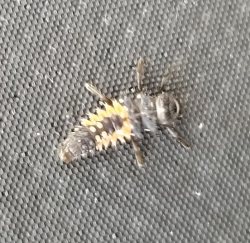
Larva of the Asian multi-colored lady beetle

6604.    Black with orange on the back. Looks like 6 legs, but the butt of the bug spikey. Port Hope, Ontario. Canada


Number 6604. This is a larva of the Asian multi-colored lady beetle, Harmonia axyridis (Coleoptera: Coccinellidae). Also known by other common names including the harlequin lady beetle, it is an introduced species. Click here for details on its life history.

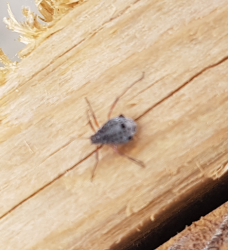
Giant willow aphid

6603.    We have 100s of these in our backyard – Do you know what they are? Will they leave? Barrie, ON. Canada


Number 6603. This looks like a giant willow aphid, Tuberolachnus salignus (Hemiptera/Sternorrhyncha: Aphididae; subfamily Lachninae). Click here for details on their life history.

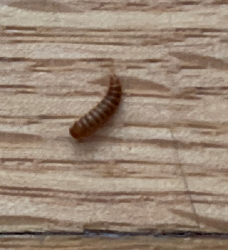
Larva of a beetle

6602.    These are always found under carpet in the living room. Only in that area we changed the carpet over the last year and again they are back. We’ve had the same wooden table not sure if that’s significant. We never see a bug or any type of thing that the larvae might turn in to, always just the larvae. Would really appreciate a correct identification of this annoying thing. Mississauga, Ontario. Canada


Number 6602. This is a larva of a beetle in the family Dermestidae (carpet/hide/skin/larder beetles and allies). I cannot see its terminal segments clearly enough to determine whether this is a black carpet beetle (Attagenus sp.) or a larder beetle (Dermestes lardarius) larva. Click here for control recommendations.

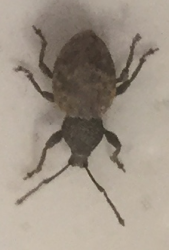
Broad-nosed/short-snouted weevil

6601.    Finding upwards of 6 a day on hardwood floors and/or in bathrooms. Always one alone never with another. Most finds on upper floor of a two story detached residence. Calgary, Alberta. Canada


Number 6601. This is a broad-nosed/short-snouted weevil (Coleoptera: Curculionidae; subfamily Entiminae). These weevils often enter buildings in search of shelter, but do no harm there. Click here for more detailed information.

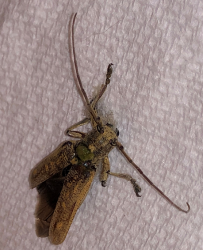
Long-horned wood-boring beetle

6600.      Found flying indoors, wondering what type of beetle (?) this is. August 20, 2019. Uxbridge, Ontario. Canada


Number 6600. This is a long-horned wood-boring beetle (Coleoptera; Cerambycidae). Click here for an image.

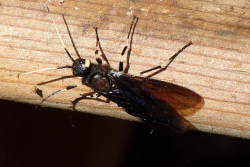
Horntail

6599.      Looks like a spider wasp but my searches have not turned up a match. Somewhat resembles a Tarantula Hawk Wasp but my photo’s white markings are very different. Any help will be gratefully received. Garden Bay, British Columbia. Canada


Number 6599. This is a type of wood wasp known as a horntail (Hymenoptera: Siricidae); it appears to be Urocerus albicornis, whose larvae tunnel in the wood of conifers including fir, larch, spruce, pine, Douglas-fir, hemlock, and western red cedar. A very comprehensive guide to this group of insects can be seen at Click here

Ground beetle

6598.     Found in my office, doesn’t seem to move fast. PRIMEAU, Quebec. Canada


6598.  This is a ground beetle (Coleoptera: Carabidae); these are general predators on other small invertebrates, mainly other insects. Click here for more detailed information

Giant aphids

6597.      On our spruce tree. Bald-faced hornets are swarming all around the area as well ?? Maberly, Ontario. Canada


Number 6597. These are giant aphids (Hemiptera/Sternorrhyncha: Aphididae; subfamily Lachninae). The wasps likely were attracted by the sweet substance (honeydew) secreted by the aphids. Click here for more detailed information

Bark lice

6596.      I found these beetle juice and looking bugs around my Hammock lines. Never seen them before are they new? They had a weird sway to them. Any info would be great thanks. Tiny, Ontario. Canada


Number 6596. These are bark lice (Psocodea: Psocidae); likely Cerastipsocus venosus, a species often referred to as ‘tree cattle.’ They do not cause any harm as they feed on fungi, algae, lichen, dead bark and other materials that occur on tree trunks and large limbs;  Click here for details on their life cycle.

Nymphs of a stink bug

6595.       New Westminster, BC. Canada


Number 6595. These are nymphs of a stink bug (Hemiptera/Heteroptera: Pentatomidae); likely those of the brown marmorated stink bug, Halyomorpha halys, Click here for an image.

Ichneumon wasp

6594.  Hello not sure what kind of insect. I found this in my backyard today and would like to know what it is. Thank you for your time. Sincerely. Nathan. Horseshoe valley. Canada


Number 6594. This is an ichneumon wasp (Hymenoptera: Ichneumonidae); it looks like Saranaca elegans,  Click here for an image. All ichneumon wasps are parasitic on other arthropods, primarily other insects; this species appears to prey upon the caterpillars of the Virginia creeper sphinx moth.

Nymphs of a stink bug

6593.  Victoria, British Columbia. Canada


Number 6593. These are nymphs of a stink bug (Hemiptera/Heteroptera: Pentatomidae). They may be in the genus Chlorochroa (Click here for an example), but the image is not clear enough to be certain.

Dog-day/annual cicada

6592.  Winged insect – 1-11/2″ long on top of a June Bug……in the morning the shell of the June bug was left completely dessicated. Kingston, Ontario. Canada


Number 6592. The winged insect is a dog-day/annual cicada (Hemiptera/Auchenorrhyncha: Cicadidae) that has emerged from its nymphal ‘shell’ (exoskeleton; what you called a June bug). They are called annual cicadas because some emerge every year, and dog-day because their peak emergence usually in late summer (the dog-days).

Long-horned wood-boring beetle

6591.  Hello I am a Life science Student from India. I like details about an insect I found in my house. I would like to know it’s scientific Taxonomy and scientific name, please reply; I hope to get your reply. Manarcad, Kottayam Kerala. India


Number 6591. This is a long-horned wood-boring beetle (Coleoptera: Cerambycidae). There are more than 1500 species recorded from India, Click here for an image.

Pigeon tremex

6590.    I found this large flying insect in my pool and had never seen one before in my area. It was nearly 2 inches long. After some research I believe that it is a Pigeon Tremex. While it was recovering from being in the pool (near death unfortunately), I took this photo. Holland Landing is in central Ontario near Newmarket and in my over 50 years of living here, I have never seen one before. Holland Landing, ON. Canada


Number 6590. This is indeed a pigeon tremex, Tremex columba (Hymenoptera: Siricidae). Click here for details on its life history.

Pomace/vinegar fly

6589.    Montreal, Quebec. Canada


Number 6589. This looks like a pomace/vinegar fly (Diptera: Drosophilidae). Often (but erroneously) called fruit flies, these often become nuisance pests indoors as they can breed very quickly.

Broad-nosed/short-snouted weevil

6588.    Just wondering if you can help me identify this bug ? We just moved into the country and I’ve never seen them before in my life.. there has been more than a few in our house. Thank you!! Norwood, Ontario. Canada


Number 6588. This is a broad-nosed/short-snouted weevil (Coleoptera: Curculionidae; subfamily Entiminae). These often enter buildings in search shelter, but do no harm there. Click here for more detailed information.

Nymph of a dog-day/annual cicada

6587.    Saw this very interesting Bug/Beetle yesterday on a walk with my boy. Late afternoon..around 4:30pm. Weather was sunny, But quite humid. Was just curious what this thing is. London Ontario. Canada


Number 6587. This is a nymph of a dog-day/annual cicada (Hemiptera/Auchenorrhyncha: Cicadidae). The nymphs spend three to five years underground feeding on sap from roots, and when fully grown, they tunnel up to the surface to find a safe place for the adult winged insect to emerge from its nymphal ‘shell.’ They are called annual cicadas because some emerge every year, and dog-day because their peak emergence usually in late summer (the dog-days).

Larva of a carpet beetle

6586.    Found on bed frame. Only found 1. Ft Sill, OK. United States


Number 6586. This is a larva of a carpet beetle (Coleoptera: Dermestidae) in the genus Anthrenus (varied carpet beetle and allies). Click here for detailed information.

German cockroach

6585.    Is this a cockroach. Consecon, Ontario. Canada


Number 6585. Yes it is; it looks like a German cockroach, Blattella germanica (Blattodea: Ectobiidae), a peridomestic species difficult to bring under complete control. Click here for some control recommendations.

Sap beetle

6584.    We have hundreds of these flying around, they are tiny, around 1mm although we have just noticed dozens of smaller ones in the last few days. They don’t seem to bite but are a huge annoyance, flying into drinks and people’s hair. Would like to know what they are so we know how to get rid of them. Kinburn, Ontario. Canada


Number 6584. This is a sap beetle (Coleoptera: Nitidulidae). These beetles feed in soft fruits, such as strawberries, as well as in just about any damaged/fermenting plant tissue (I often see them in corn ears that have been damaged by the corn earworm). They are attracted by the odor of fermenting fruits and vegetables and reportedly will fly into beer or soft drinks. There’s not much that you can do to ‘get rid’ of them unless you can locate and remove/destroy their food source.  

Nymph of a masked hunter

6583.    We found this guy crawling up our bathroom wall, it doesn’t fly or jump it just seems to crawl around. We’ve searched all inches of the web and asked everyone but we cannot seem to find anything… We would really appreciate finding out what this little guy is! Oshawa, Ontario. Canada


Number 6583. This looks like a young nymph of a masked hunter (Reduvius personatus), an assassin bug (Hemiptera/Heteroptera: Reduviidae) often found indoors; Click here for an image. It is an introduced species with a cosmopolitan distribution and is reported to have a very painful bite.   

Plume moth

6582.    Hoping this photo is a good enough shot! Have never seen this before….any ideas? Victoria, British Columbia. Canada


Number 6582. It’s a plume moth (Lepidoptera: Pterophoridae) in a very typical resting pose. Click here for some examples.  

Giant ichneumon wasp

6581.    Wasp like. Long black tail feature. Looks like it has a coat of armor. Probably 6 inches long for the body. Not including tail. Niagara Falls, Ontario. Canada


Number 6581. This is a giant ichneumon wasp (Hymenoptera: Ichneumonidae; Megarhyssa sp. ); likely M. greenei – Click here for images and more detailed information.

Female camel/cave cricket

6580.    We live on a country property, surrounded by forest and at the edge of a pond, with adjacent farmland. This was found in our basement. It is about 1/2″ long rom end to end There is a blue thread on the carpet and (I believe) a hair behind the critter (not part of it, I don’t think). Paris, ON. Canada


Number 6580. This is a very dead female camel/cave cricket (Orthoptera: Rhaphidophoridae). They are for the most part nuisance pests, usually found in dark, damp situations such as basements, caves, under logs, etc. Click here for more detailed information.

Caterpillar of the bedstraw hawkmoth

6579.    Came across this in Victoria BC on a trail. VICTORIA, BC. Canada


Number 6579. This is a caterpillar of the bedstraw hawkmoth, Hyles gallii (Lepidoptera: Sphingidae); Click here for images and more detailed information.

Larva of a leaf beetle

6578.    Can you identify this insect. I was told tent Caterpillar by neighbour but I question it. This was in Lake Cowichan BC. They only last for about 10 days and they are EVERYWHERE. Covering the roads buildings etc. Same outbreak happened about 12 years ago in this same area but nothing in between. Thanks. VICTORIA, BC. Canada


Number 6578. This is a larva of a leaf beetle (Coleoptera: Chrysomelidae). There are several species with a similar appearance; Click here for one example (alder flea beetle).

Nymph of a masked hunter

6577.    Today august 13th 2019, i found that thing! It was indoors in my house entrance walking on my carpet. It looked like white dust as if it were a white thread of something. It looked furry and like a spider. It was so small it could have been the size of a sesame. For now, i only found one! Please let me know what that is. Thank you. Laval, Quebec. Canada


Number 6577.  This looks like a young nymph of a masked hunter (Reduvius personatus), an assassin bug (Hemiptera/Heteroptera: Reduviidae) often found indoors; Click here for an image. It is an introduced species with a cosmopolitan distribution and is reported to have a very painful bite.

Larva of a lady beetle

6576.    I find these on green pepper plants. Are they harmful? Weyburn, Sask. Canada


Number 6576. This insect is beneficial, not harmful; it is a larva of a lady beetle (Coleoptera: Coccinellidae). Click here for more detailed information.

Plume moth

6575.    Found this on my curtain inside and I have no idea what it is? Wasaga Beach, Ontario. Canada


Number 6575. This is a plume moth (Lepidoptera: Pterophoridae); there are several species that can have a quite similar appearance. Click here for some examples.