
Male moth
6542. Branford, ON .Canada
Number 6542. This male moth appears to be in the family Geometridae, a very large family comprising thousands of species. Click here for an example.

Thousands of pest photos submitted for identification.
6542. Branford, ON .Canada
Number 6542. This male moth appears to be in the family Geometridae, a very large family comprising thousands of species. Click here for an example.
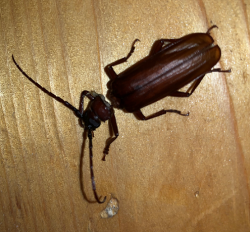
6541. Harrison, Maine. United States
Number 6541. This is a brown prionid, Orthosoma brunneum (Coleoptera: Cerambycidae). It is not considered a pest species; Click here for more detailed information.

6540. Found on a window sill, what is this? It was about an inch long. Edmonton, Ab. Canada
Number 6540. This is a German cockroach, Blattella germanica (Blattodea: Ectobiidae), a peridomestic pest species notoriously difficult to bring under complete control. Click here for some control recommendations.

6539. Only found one It jumps. Was in our basement near the heat pump. Beaconsfield, Quebec. Canada
Number 6539. This is a camel/cave cricket (Orthoptera: Rhaphidophoridae). They are for the most part nuisance pests, usually found in dark, damp situations such as basements, caves, under logs, etc. Click here for more detailed information.

6538. Located in Vaughan Ontario. The bug bit a person on the toe leaving 3 bleeding pin prick bites in a row. Bite happened near backyard pool surrounded by cedar trees. August 2019. Approx 28 – 30 deg celsius. Bit at approx 4 pm. Bug did not die after bite, we smacked it so as to take this picture. Please help us identify this bug, the person that was bitten has lyme disease and is very afraid of dangerous bug bites. Please help thank you. Vaughan, Ontario. Canada
Number 6538. This is a deer fly (Diptera: Tabanidae; Chrysops sp.). Although they can vector several diseases of animals, they do not appear to be a significant vector of any human diseases in North America. Click here and Click here for more detailed information.
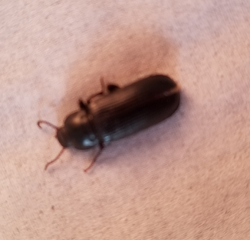
6537. Ever since my parents driveway was redone, they are finding these bugs in their house. What are they? Hope they aren’t dangerous! Ajax, ON. Canada
Number 6537. This looks like the adult of a yellow mealworm, Tenebrio molitor (Coleoptera: Tenebrionidae). Although they may be pests in stored grains, the larvae are valuable as pet food, and roasted in an oven with a little butter and salt, make a tasty snack food. Click here for more detailed information.
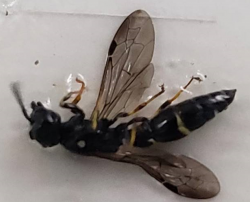
6536. Wasp holes 4 mm wide, the wasps are about 7 mm long. There are boring into 4-yr old dried untreated maple wood used fir shed posts after removing the bark, This is the first year of any wasps. I need to know what they are and if they need to be killed. Halifax, NS. Canada
Number 6536. This does not look like a wood-boring wasp; it looks more like a mason/potter wasp (Hymenoptera: Vespidae; subfamily Eumeninae). I suspect that they are going in the holes either looking for prey or seeing if they would make suitable nesting sites.
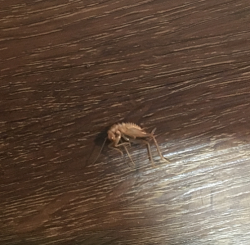
6535. Usually get a couple of these guys in my house during the summer and I’ve never seen anything like them until I moved into my house last summer so I was just curious to try and identify what it is. Fort Vermilion AB. Canada
Number 6535. This is a camel/cave cricket (Orthoptera: Rhaphidophoridae). They are for the most part nuisance pests, usually found in dark, damp situations such as basements, caves, under logs, etc. Click here for more detailed information.
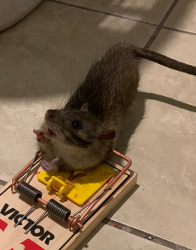
6534. Wondering I’m, what kind of rat this is, Mabey a roof rat or Norway rat ? Hammonds plains, Nova Scotia. Canada
Number 6534. It is difficult to tell from this image. I suggest that you compare your specimen with the chart found at: Click here
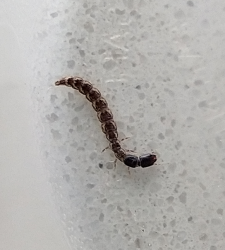
6533. Found 3 days ago, under coffee machine. It moves sinusoidally, and will jump/spring. It seems to be able to use the tip of it’s abdomen to anchour and jump. The length is about 2 cm stretched out. Since it doesn’t have wings I assume it’s a larva. When stretched out the corrugations in the abdomen look brown. Coquitlam, BC. Canada
Number 6533. This is a larva of a snakefly (Raphidioptera: Raphidiidae) in the genus Agulla. They are general predators on other small arthropods. Click here for more detailed information.
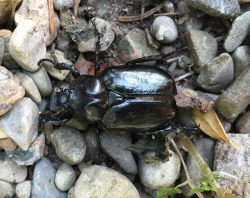
6532. Hi. Does someone know what this beetle is ? Thank you. Michele. Pointe claire, Quebec. Canada
Number 6532. This is Osmoderma eremicola, a scarab beetle (Coleoptera: Scarabaeidae) sometimes known as a leather beetle (because of their odor) or a hermit flower beetle. Their larvae are found in rotting wood. Click here for an example.

6531. Winnipeg, Mb. Canada
Number 6531. This is a sexton/burying beetle (Coleoptera: Silphidae) in the genus Nicrophorus. It looks like Nicrophorus tomentosus, known as the tomentose burying beetle. Unlike other Canadian Nicrophorus, the adults do not bury the carcasses (small mammals/birds) they find, but make a shallow pit and cover the carcass with litter. Click here and Click here for images.
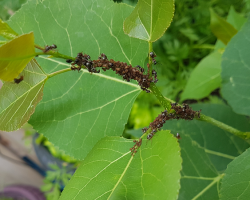
6530. Size 2-3 mm. Month July. Season Summer. Weather conditions: Hot & sunny. Outdoors. I have no idea what the bugs are that these ants are so interested in, nor why they have colonized the plant. I have not been able to ID them through Google. Calgary, AB. Canada
Number 6530. Those are aphids (Hemiptera/Sternorrhyncha: Aphididae), aka ‘plant lice.’ They feed on sap from plants, and as they feed, they excrete excess fluid in the form of ‘honeydew’ which some species of ants find very attractive. Click here for more detailed information.
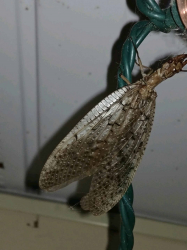
6529. Fergus, Ontario. Canada
Number 6529. This is a female eastern dobsonfly, Corydalus cornutus (Megaloptera: Corydalidae). Their larvae, called hellgrammites, are aquatic predators on other small life forms. Click here for images and more detailed information.
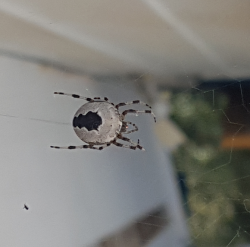
6528. Wondering what kind of spider this is I cant seem to find what it is. Whitehorse, Yukon Territory. Canada
Number 6528. This is a colour morph (var. pyramidatus) of the marbled orb weaver, Araneus marmoreus; Click here for an image. It appears to be much more common in Europe than in North America. Like all other orb weavers, it is harmless to humans.
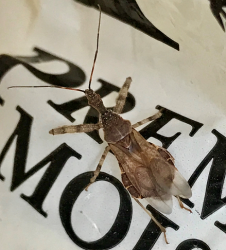
6527. I found this insect in my garden today, I live in Montreal close to the Port and shipping containers. I have been bitten by one like this and it was very painful. I always wondered what it is, maybe an ‘Assassin Bug’? Any input would be very helpful. Best. Karim. Montreal, Quebec. Canada
Number 6527. This is indeed an assassin bug (Hemiptera/Heteroptera: Reduviidae). Their saliva contains proteolytic enzymes that break down the tissues of their prey and this contributes to the painfulness of their bite. Click here for more detailed information.

6526. Body/head is 1/2 inch white with black mark and a bit of yellow on the bottom and sides. Found on outside on the corner of our deck. July 30/19. Weather warm and sunny 23 degrees. Sherwood Park, Alberta. Canada
Number 6526. This is a female orb weaving spider (family Araneidae) in the genus Araneus; it might be a cross orb weaver, Araneus diadematus. All orb weavers are harmless to humans.
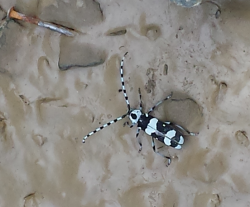
6525. Found this fellow in the mud beside our new home in Salmon Arm. Salmon Arm, British Columbia. Canada
Number 6525. This is a banded alder borer (Rosalia funebris; Coleoptera: Cerambycidae); it is not considered a pest species. Click here for more detailed information.

6524. Hello, We found a few of these guys on the outside of a bag of malted barley flour today… wondering what species it might be and where it might originate from? Thanks! Calgary, Alberta. Canada
Number 6524. This is a water boatman (Hemiptera/Heteroptera: Corixidae). They commonly are found on the surface of ponds where they use their oar-like hind legs to propel themselves. They feed primarily on algae, organic detritus, mosquito larvae, and other small aquatic life forms. They are good fliers and often are found far from water; their occurrence on the bag of flour is strictly accidental.
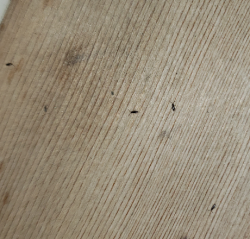
6523. These are extremely small bugs (<1mm). I thought they were bits of dirt until I saw them move. I took the photo in July 2019 inside. I’ve set out glue traps and have caught the largest number in the basement but have found them all over the house as well as outside the house mainly around the windows. Calgary, AB. Canada
Number 6523. These are springtails, primitive arthropods closely related to true insects. Click here for an example. They basically are harmless scavengers on bits of organic matter, but may become nuisance pests when they occur in large numbers indoors. Moisture management and lowering indoor humidity levels will help keep them in check.
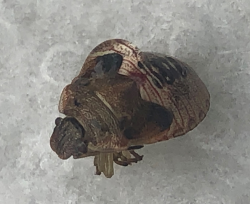
6522. Just wondering what kind of beetle found in my brackets I picked. Honeymoon Bay, Bc. Canada
Number 6522. This is a nymph of a stink bug (Hemiptera/Heteroptera: Pentatomidae). From the looks of it, it may be a predatory species.– Click here for an example.
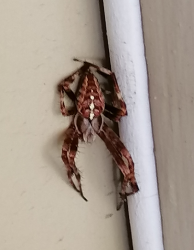
6521. Hello, this spider was on the front door ( I didn’t let him in!) Wondering what kind of spider? Found in end of July in the Vancouver area. Thank you! Vancouver, Bc. Canada
Number 6521. This is a cross orb weaver, Araneus diadematus, a very common and widespread species (in Europe, it is known as the European garden spider). It is harmless to humans.
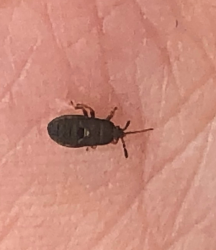
6520. Recently put in new pool. And this week noticed large amount of these bugs crawling around the edge. Scoping them out by the hundreds. Can’t figure out what type of bug this is. Any insight would be helpful. Komoka, Ontario. Canada
Number 6520. Looks like a nymph of a chinch bug (Hemiptera/Heteroptera: Blissidae; Blissus sp.), Click here for an image. These can be serious lawn/turf pests, Click here for more detailed information.
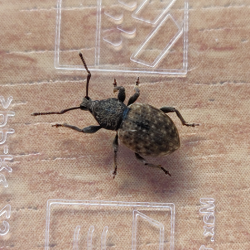
6519. Found indoors. Walking on Hardwood floors and on top of bed. July 29, 2019. Golden, BC. Canada
Number 6519. This is a broad-nosed/short-snouted weevil (Coleoptera: Curculionidae; subfamily Entiminae); these often enter buildings in search of shelter, but do no harm there. Click here for more detailed information.
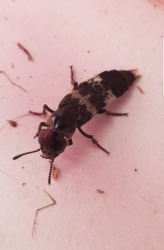
6518. Would just like to know what they are called and if they are a danger to my family and pets. Montague, Pei. Canada
Number 6518. This is a rove beetle (Coleoptera: Staphylinidae). These are general predators on other small arthropods and pose no threat to anything else. Click here for a more typical image.
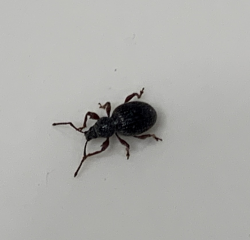
6517. I have a few of these by the edges and corners of my carpet and baseboards. Do you know what insect this is? Thank you. Surrey, BC. Canada
Number 6517. This is a broad-nosed/short-snouted weevil (Coleoptera: Curculionidae; subfamily Entiminae); these often enter buildings in search of shelter, but do no harm there. The larvae of some species, such as the strawberry root weevil and the black vine weevil, can be serious pests. Click here for more detailed information.
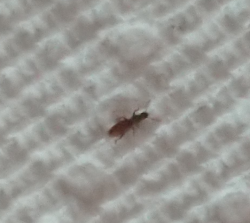
6516. Stellarton, NS. Canada
Number 6516. The image is too blurry for a confident identification, but it might be one of the grain beetles in the genus Oryzaephilus (saw-toothed and merchant grain beetles). These sometimes can be pantry pests, primarily infesting grain-based dry stored food products. Click here for more detailed information.
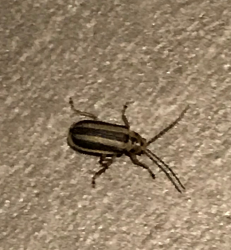
6515. I found this bug under my shirt after being outside under a tree at my work. I can’t seem to find anything that matches this on your website. Toronto, Ontario. Canada
Number 6515. This is a leaf beetle (Coleoptera: Chrysomelidae); it looks like Trirhabda borealis, Click here for an image.
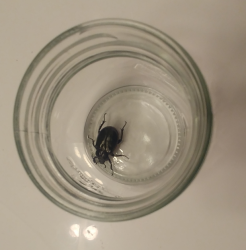
6514. My wife found this in our bedroom on the carpet we never seen anything like this before John Garec. Welland, ON. Canada
Number 6514. This is a scarab beetle (Coleoptera: Scarabaeidae) in the genus Osmoderma. Sometimes called leather beetles because of their odor, their larvae feed in damp, decaying wood.
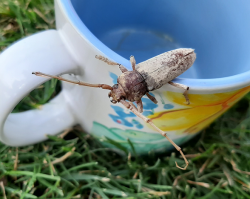
6513. I have searched the internet but am getting nowhere. Can you help identify this big bug? Amherstburg, Ontario. Canada
Number 6513. This is a long-horned wood-boring beetle (Coleoptera: Cerambycidae); it looks like the red oak borer, Enaphalodes rufulus, Click here for an image.
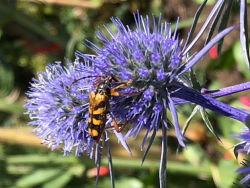
6512. Just wanting the species identification of this beetle. Victoria, BC. Canada
Number 6512. This is a flower longhorn beetle (Coleoptera: Cerambycidae; subfamily Lepturinae); it looks like something in the genus Xestoleptura – Click here for an example.
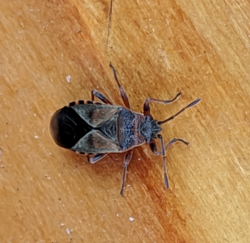
6511. These bugs are all over the deck and up inside the patio umbrella. Dead ones are found by the hundreds every day all over the deck, mostly gathered near the entryways. Only a few were discovered indoors. The picture is of one of the larger ones with the blue color. There are many smaller ones that are brown. Salmon Arm, BC. Canada
Number 6511. This is an elm seed bug, Arocatus melanocephalus (Hemiptera/Heteroptera: Lygaeidae). This is an introduced species that has become a nuisance pest in western North America, Click here for more detailed information.
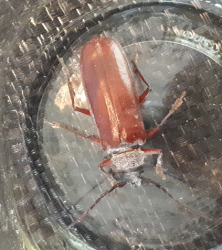
6510. About 2 inches long. Found in a barrel in the garage July 27th. Branchton, Ontario. Canada
Number 6510. This is a long-horned wood-boring beetle (Coleoptera: Cerambycidae) in the subfamily Prioninae. These are among the largest beetles in Canada.