Thousands of pest photos submitted for identification.

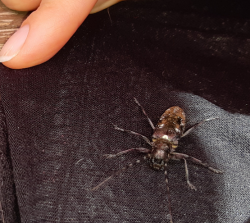
Spotted tree borer

6574.    Hello, Just found him on my shoe. My sons and I were wondering if this is a long horned two banded beetle? Saltspring Island, BC. Canada


Number 6574. This appears to be a spotted tree borer, Synaphaeta guexi (Coleoptea: Cerambycidae). Click here and Click here for images and more detailed information. It does not appear to be an important pest specis.

Black widow spider

6573.    August 11, 2019. Found alive inside home on stairway (open layout) during the night. Vernon, BC. Canada


Number 6573. This is a black widow spider (Latrodectus sp.). Given your location, it most likely is a western black widow spider, L. Hesperus; Click here for more detailed information.

Bee fly

6572.    This insect emerged as if being born from our deck railing while we were outside enjoying a coffee. Warm sunny day (about 25C), mid-morning. We first noticed sawdust dropping from the railing as if something was eating at the deck and then this emerged, spread its wings out and crawled over to the railing edge to get into the sunlight. Photo taken just minutes after it emerged. Delhi, ON. Canada


Number 6572. This is a bee fly (Diptera: Bombyliidae). They are parasitic on bees, primarily ground-nesting bees, but some species specialize in attacking carpenter bees, such as in your case.

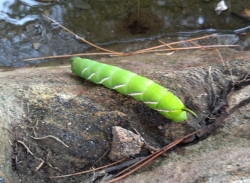
Caterpillar of an imperial moth

6571.    Found on the ground under a pine tree in a pine and spruce plantation. Belleville, ON. Canada


Number 6571. This is a caterpillar of an imperial moth, Eacles imperialis imperialis (Lepidoptera: Saturniidae). Click here for detailed information on its life history.

Teneral of a mature adult

6570.    We found this today, wondering what species of cicadas it is?? It’s the first one I have ever seen up close. Found at Point Gardiner, New Brunswick, Canada. (10 August 2019) Measured about 30-35mm, outdoors, sunny day. I’m hoping the picture made it to you, I only see a file number? Upper Coverdale, New Brunswick. Canada


Number 6570. This is a teneral (newly emerged) specimen which does not exhibit the colour patterns typical of a mature adult. That aside, I believe that it most likely is Neotibicen canicularis; Click here for a mature adult.

Jerusalem cricket

6569.    Found in pool Aug 10 2019. Osoyoos, Bc. Canada


Number 6569. This is a Jerusalem cricket (Orthoptera: Stenopalmatidae; Stenopelmatus sp.). Also known as potato bugs, they appear to be mainly scavengers, but sometimes will eat other insects. Click here for more detailed information.

Rove beetle

6568.    Trying to identify this in basement of house. Barrow Bay, Ontario, Canada. Canada


Number 6568. This is a rove beetle (Coleoptera: Staphylinidae). These are general predators on other small invertebrates, mainly other insects. Click here for a more typical image

Nymph of a white-margined burrower bug

6567.    Hello, I found this bug crawling at night, next to my dogs crate, where he sleeps. We has just come back from a walk, so I don’t know if the bug came from the park we went to or was already in the crate. The bug has 6 legs and 2 antenna, you can’t see the legs that great in the picture. The front 2 legs not seen in picture face the front of his head, where the back 4 legs face the back of his body. The bug is quite small, measuring about a quarter of an inch in length. Thank you! Boston, Massachusetts. United States


Number 6567. This looks like a nymph of a white-margined burrower bug, Sehirus cinctus (Hemiptera/Heteroptera: Cydnidae); Click here for an image. The adults and nymphs feed primarily on the seeds of nettles and plants in the mint family.

Predaceous diving beetle

6566.    Found him in my driveway. Miramichi, New Brunswick. Canada


Number 6566. This is a predaceous diving beetle (Coleoptera: Dytiscidae), and judging from the foreleg I can see, it’s a male. These are general predators on other small aquatic life forms, and being very strong fliers, they often are found at quite some distance from water.

Nymph of a soldier bug

6565.    Found today, indoors. Shelburne, On. Canada


Number 6565. This looks like a nymph of a soldier bug, a stink bug (Hemiptera/Heteroptera: Pentatomidae) in the genus Podisus; Click here for an image. Soldier bugs are general predators on other small arthropods, mainly other insects, and thus usually considered beneficial.

Carpet beetle

6564.    They’re not bedbugs but I find them in my sofa when I clean under the cushions. Sometimes I see them crawling on the floors or on the wall. Never see more than 1 at a time. I do not know what they are. They’re little, like 5-6mm long. They’re like tiny little beetles that can fly – I rarely see them fly, but this little guy got right annoyed with my phone up close and flew into my curtains to hide. Montreal, Quebec. Canada


Number 6564. This is a carpet beetle (Coleoptera: Dermestidae); possibly a banded black carpet beetle (aka wardrobe beetle), Attagenus fasciatus. Click here for images and distribution map.

Pseudoscorpion

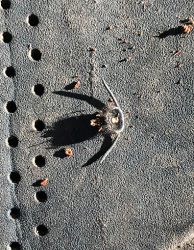
6563.    These bugs appear when clothes are lying around on the floor. Oxford House, MB. Canada


Number 6563. This is a pseudoscorpion, an arachnid related to spiders and true scorpions that prey on other small arthropods. They are non-venomous and harmless to humans. Click here for more detailed information

giant ichneumon wasp

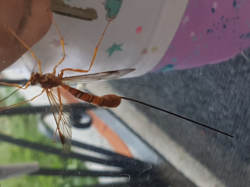
6562.    Note log tail (?) On this thing. The insect was about 4″ long overall. Toronto, ON. Canada


Number 6562. This is a giant ichneumon wasp (Hymenoptera: Ichneumonidae; Megarhyssa sp. ); likely M. greenei – Click here for images and more detailed information.

Ground beetle

6561.    Does this bite? My husband felt like he got stung and we found this. Windsor, Ontario. Canada


Number 6561. This is a ground beetle (Coleoptera: Carabidae), the vast majority of these are general predators on other small arthropods. It is extremely unlikely that it was the cause of your husband’s discomfort. Click here for more detailed information

giant ichneumon wasp

6560.    Found in building entry way. Hamilton, Ontario. Canada


Number 6560. This is a giant ichneumon wasp (Hymenoptera: Ichneumonidae; Megarhyssa sp. ); likely M. greenei – Click here for images and more detailed information.

short-snouted/broad-nosed weevil

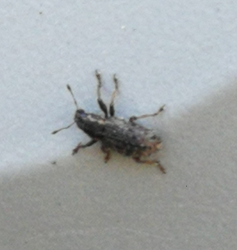
6559.    BRANTFORD, ON. Canada


Number 6559. This is a short-snouted/broad-nosed weevil (Coleoptera: Curculionidae; subfamily Entiminae). These often enter buildings in search of shelter, but do no harm there. Click here for detailed information. 

Caterpillar of the fall webworm

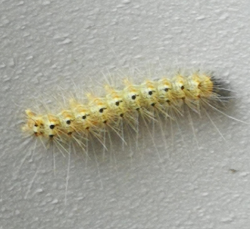
6558.    BRANTFORD, ON. Canada


Number 6558.  This looks like a caterpillar of the fall webworm, Hyphantria cunea (Lepidoptera: Erebidae).  Click here for detailed information.


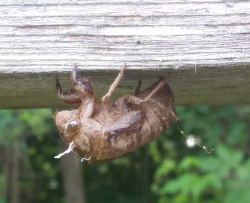
Cicada

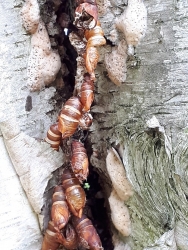
6557.    Hi – I have 2 big birch trees and they are covered with soft, tan colored mounds and dried dead bugs all over. I have pics I can send. I have not seen caterpillars or moths. What is this and how can I treat it? I dont want my trees to die. Thanks. George. Toronto, Ont.


Number 6557.  The “dried dead bugs” are the shells’ (exoskeletons) of a cicada (Hemiptera/Auchenorrhyncha: Cicadidae)’ , likely in the genus Neotibicen (annual/dog-day cicadas). The white filaments are the lining of its breathing tubes (tracheae). The “mounds” could be drying sap exuding from small wounds on the trees. Click here for a video of the molting process.


Cicada

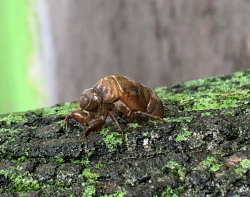
6556.    Came across this insect at a local park and found it again today but it looks as if it shed its outer shell. It is about an inch long and almost as wide and the first pic was taken in July. Curious as to what it is. Toronto, Ontario. Canada.


Number 6556.  This is the empty ‘shell’ (exoskeleton) of a cicada (Hemiptera/Auchenorrhyncha: Cicadidae), likely in the genus Neotibicen (annual/dog-day cicadas). The white filaments are the lining of its breathing tubes (tracheae). Click here for a video of the molting process.


Sowbug

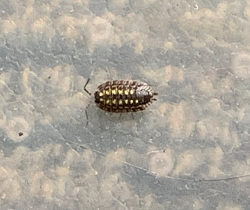
6555.    This was on the floor at work. I have no idea what kind of bug it is. It’s July and I work indoors in an office. I thought maybe a centipede or a beetle? Saskatoon, SK. Canada


Number 6555. This is a sowbug, a terrestrial crustacean in the order Isopoda. These basically are harmless scavengers on decomposing organic matter, but they sometimes become nuisance pests when large numbers occur indoors. They breathe through gills that must be kept moist, so moisture management is the best control.

Nymphs of the white-margined burrower bug

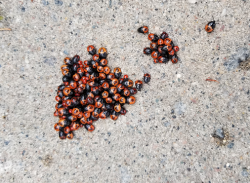
6554.    What is it please. Found pictures online apparently there live in france or.britain. what are they doing.here? Or is it a pest that is native here. Thank you. Monetville, Ontario. Canada


Number 6554. These are nymphs of the white-margined burrower bug, Sehirus cinctus (Hemiptera/Heteroptera: Cydnidae); Click here for an image. It is a native species; the adults and nymphs feed primarily on the seeds of nettles and plants in the mint family.

Bald-faced hornet

6553.    From tip to tip of the “legs” was about 5mm. Found August 1st 2019. Sunny and high 20’s Celsius. Found outdoors at about 250m of elevation on the south-west corner of Pinecone-Burke Provincial Park in Port Coquitlam, BC. I found it when I felt a sharp pain on the inside of my lower leg, very similar to a wasp ‘sting’. It was (trapped? burrowed?) in the top band of my sock, and took a small chunk out of my skin (a bite I assume). Over the next few days my leg got puffy and swollen like it normally does when I get a wasp ‘sting’, and the area around the bite (about 30cm round) was very red and angry looking. The area was not itchy. The swelling and redness have almost gone away 4 days after the bite. Coquitlam, BC. Canada


Number 6553. This might be the detached head of a very dead bald-faced hornet, Dolichovespula maculata (Hymenoptera: Vespidae). Click here for an image.

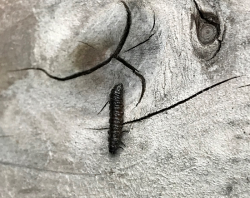
Larva of a leaf beetle

6549.    I pulled this image from google when I was trying to ID an army of larvae I had ridden through tonight. There were thousands walking on downed trees and stumps in the lower bike trails. They were 1cm long, and at first I thought they might be early-stage ladybug larvae, but I’m pretty sure they don’t lay eggs in those numbers. There’s an annual frog migration of tiny forest frogs through those same trails (spring and fall), and I wonder if their route has evolved to coincide with this large food source? That’ll be happening soon- there were already a few froglets out tonight. Thoughts? And ID help please! Cumberland, BC. Canada


Number 6549.  This is a larva of a leaf beetle, but I cannot tell which species from this image.


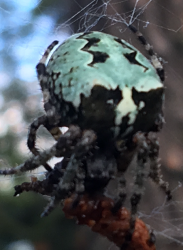
Giant lichen orb weaver

6552.    Seen at lake near campers camping. Fort Frances, On. Canada


Number 6552. This is a giant lichen orb weaver, Araneus bicentenarius, a species widely distributed in eastern North America. Click here for an image and distribution map.

Elm seed bug

6551.    Very small. Winged. Orange coloured underside. First noted around exterior/interior window frames. Have also noticed few in the house. Not sure if these are cedar seed bugs? Please advise on how best to permanently get rid of them. Thank you! Vancouver, BC. Canada


Number 6551. This is an elm seed bug, Arocatus melanocephalus (Hemiptera/Heteroptera: Lygaeidae), an introduced species that has become a nuisance pest in many areas. Click here for more detailed information.

Short-snouted/broad-nosed weevil

6550.    Stirling, ON. Canada


Number 6550. This is a short-snouted/broad-nosed weevil (Coleoptera: Curculionidae; subfamily Entiminae). These often enter buildings in search of shelter, but do no harm there. Click here for detailed information. 

Long-horned wood-boring beetle

6549.    Found on our driveway. Missing one antenna and seems to have slight damage to wing/shell cover. I would like to know what type of beetle this is. My thumb (wearing garden glove) is in one picture to show how big the beetle is. Kelowna, BC. Canada


Number 6549.  This is a long-horned wood-boring beetle (Coleoptera: Cerambycidae) in the subfamily Prioninae.  Click here for an image.


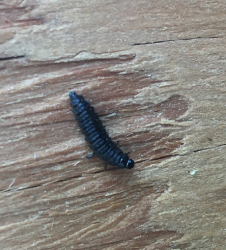
Larva of a leaf beetle

6548.    1cm long crawling larvae multiplying and crawling all over cedar deck, garden boxes and overhang structure. When brushed away they come apart and guts are yellowish orange. Appeared in July and have multiplied considerably in the last week in north vancouver. North Vancouver, Bc. Canada


Number 6548.  This is a larva of a leaf beetle, but I cannot tell which species from this image.


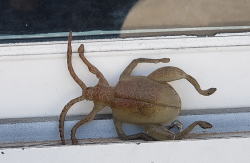
Tropical leaf beetle

6547.    Saw this beast today on my next door neighbor’s outside window. It’s huge…at least 3″ long! Any idea what it is? Hamilton, Ontario. Canada


Number 6547.  This appears to be a rubber/plastic model of a tropical leaf beetle (Coleoptera: Chrysomelidae) known as a frog-legged leaf beetle. Click Here for an image.


Cicada

6546.     This bug was found on the underside of the top rail of our fence on Aug 4/19 in Cambridge, NS. I have looked through 285 pics but can’t identify it. Hope you can. Cambridge, NS. Canada


Number 6546.  This is the empty ‘shell’ (exoskeleton) of a cicada (Hemiptera/Auchenorrhyncha: Cicadidae), likely in the genus Neotibicen (annual/dog-day cicadas). The white filaments are the lining of its breathing tubes (tracheae). Click here for a video of the molting process.


Caterpillar of a sphinx moth

6545.    Approximately 5 + ish cm long at Six Mile Lake in Ontario. Toronto, Ontario. Canada


Number 6545.  This is a caterpillar of a sphinx moth (Lepidoptera: Sphingidae); it looks like a wild cherry sphinx, Sphinx drupiferarum Click here for images and more detailed information.


Western conifer seed bug

6544.    This guy was on my car in Mississauga, ON, in August. TORONTO, ON. Canada


Number 6544.  This is a western conifer seed bug, Leptoglossus occidentalis (Hemiptera/Heteroptera: Coreidae). Although harmless, these can become nuisance pests when they enter homes in search of shelter. Click here for more detailed information.


White-spotted pine sawyer

6543.    This giant beetle landed in my shirt and wouldn’t get out and would make noises when I’d try to get it off. Scary. New Glasgow, Nova Scotia. Canada


Number 6543.  This looks like a white-spotted pine sawyer, Monochamus scutellatus (Coleoptera: Cerambycidae). It is not considered a pest species, Click here for more detailed information.