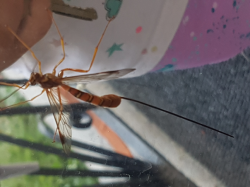
giant ichneumon wasp
6560. Found in building entry way. Hamilton, Ontario. Canada
Number 6560. This is a giant ichneumon wasp (Hymenoptera: Ichneumonidae; Megarhyssa sp. ); likely M. greenei – Click here for images and more detailed information.

6560. Found in building entry way. Hamilton, Ontario. Canada
Number 6560. This is a giant ichneumon wasp (Hymenoptera: Ichneumonidae; Megarhyssa sp. ); likely M. greenei – Click here for images and more detailed information.
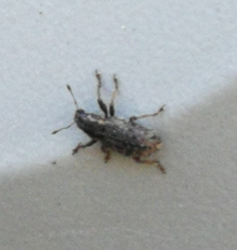
6559. BRANTFORD, ON. Canada
Number 6559. This is a short-snouted/broad-nosed weevil (Coleoptera: Curculionidae; subfamily Entiminae). These often enter buildings in search of shelter, but do no harm there. Click here for detailed information.
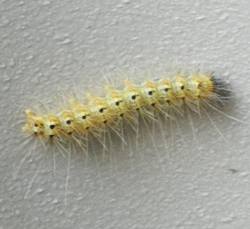
6558. BRANTFORD, ON. Canada
Number 6558. This looks like a caterpillar of the fall webworm, Hyphantria cunea (Lepidoptera: Erebidae). Click here for detailed information.
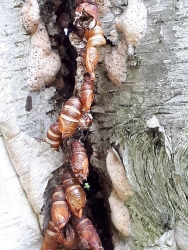
6557. Hi – I have 2 big birch trees and they are covered with soft, tan colored mounds and dried dead bugs all over. I have pics I can send. I have not seen caterpillars or moths. What is this and how can I treat it? I dont want my trees to die. Thanks. George. Toronto, Ont.
Number 6557. The “dried dead bugs” are the shells’ (exoskeletons) of a cicada (Hemiptera/Auchenorrhyncha: Cicadidae)’ , likely in the genus Neotibicen (annual/dog-day cicadas). The white filaments are the lining of its breathing tubes (tracheae). The “mounds” could be drying sap exuding from small wounds on the trees. Click here for a video of the molting process.
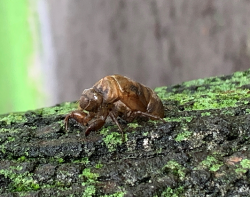
6556. Came across this insect at a local park and found it again today but it looks as if it shed its outer shell. It is about an inch long and almost as wide and the first pic was taken in July. Curious as to what it is. Toronto, Ontario. Canada.
Number 6556. This is the empty ‘shell’ (exoskeleton) of a cicada (Hemiptera/Auchenorrhyncha: Cicadidae), likely in the genus Neotibicen (annual/dog-day cicadas). The white filaments are the lining of its breathing tubes (tracheae). Click here for a video of the molting process.
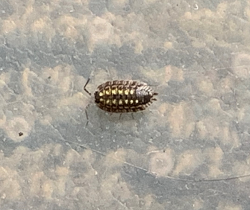
6555. This was on the floor at work. I have no idea what kind of bug it is. It’s July and I work indoors in an office. I thought maybe a centipede or a beetle? Saskatoon, SK. Canada
Number 6555. This is a sowbug, a terrestrial crustacean in the order Isopoda. These basically are harmless scavengers on decomposing organic matter, but they sometimes become nuisance pests when large numbers occur indoors. They breathe through gills that must be kept moist, so moisture management is the best control.
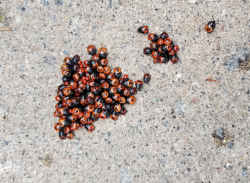
6554. What is it please. Found pictures online apparently there live in france or.britain. what are they doing.here? Or is it a pest that is native here. Thank you. Monetville, Ontario. Canada
Number 6554. These are nymphs of the white-margined burrower bug, Sehirus cinctus (Hemiptera/Heteroptera: Cydnidae); Click here for an image. It is a native species; the adults and nymphs feed primarily on the seeds of nettles and plants in the mint family.
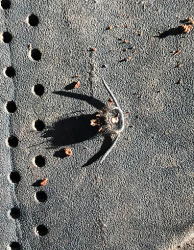
6553. From tip to tip of the “legs” was about 5mm. Found August 1st 2019. Sunny and high 20’s Celsius. Found outdoors at about 250m of elevation on the south-west corner of Pinecone-Burke Provincial Park in Port Coquitlam, BC. I found it when I felt a sharp pain on the inside of my lower leg, very similar to a wasp ‘sting’. It was (trapped? burrowed?) in the top band of my sock, and took a small chunk out of my skin (a bite I assume). Over the next few days my leg got puffy and swollen like it normally does when I get a wasp ‘sting’, and the area around the bite (about 30cm round) was very red and angry looking. The area was not itchy. The swelling and redness have almost gone away 4 days after the bite. Coquitlam, BC. Canada
Number 6553. This might be the detached head of a very dead bald-faced hornet, Dolichovespula maculata (Hymenoptera: Vespidae). Click here for an image.
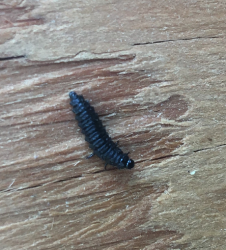
6549. I pulled this image from google when I was trying to ID an army of larvae I had ridden through tonight. There were thousands walking on downed trees and stumps in the lower bike trails. They were 1cm long, and at first I thought they might be early-stage ladybug larvae, but I’m pretty sure they don’t lay eggs in those numbers. There’s an annual frog migration of tiny forest frogs through those same trails (spring and fall), and I wonder if their route has evolved to coincide with this large food source? That’ll be happening soon- there were already a few froglets out tonight. Thoughts? And ID help please! Cumberland, BC. Canada
Number 6549. This is a larva of a leaf beetle, but I cannot tell which species from this image.
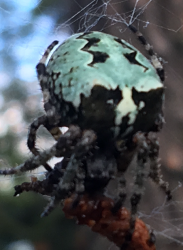
6552. Seen at lake near campers camping. Fort Frances, On. Canada
Number 6552. This is a giant lichen orb weaver, Araneus bicentenarius, a species widely distributed in eastern North America. Click here for an image and distribution map.

6551. Very small. Winged. Orange coloured underside. First noted around exterior/interior window frames. Have also noticed few in the house. Not sure if these are cedar seed bugs? Please advise on how best to permanently get rid of them. Thank you! Vancouver, BC. Canada
Number 6551. This is an elm seed bug, Arocatus melanocephalus (Hemiptera/Heteroptera: Lygaeidae), an introduced species that has become a nuisance pest in many areas. Click here for more detailed information.

6550. Stirling, ON. Canada
Number 6550. This is a short-snouted/broad-nosed weevil (Coleoptera: Curculionidae; subfamily Entiminae). These often enter buildings in search of shelter, but do no harm there. Click here for detailed information.

6549. Found on our driveway. Missing one antenna and seems to have slight damage to wing/shell cover. I would like to know what type of beetle this is. My thumb (wearing garden glove) is in one picture to show how big the beetle is. Kelowna, BC. Canada
Number 6549. This is a long-horned wood-boring beetle (Coleoptera: Cerambycidae) in the subfamily Prioninae. Click here for an image.
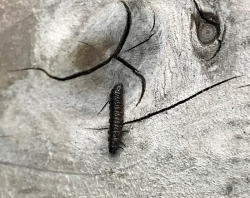
6548. 1cm long crawling larvae multiplying and crawling all over cedar deck, garden boxes and overhang structure. When brushed away they come apart and guts are yellowish orange. Appeared in July and have multiplied considerably in the last week in north vancouver. North Vancouver, Bc. Canada
Number 6548. This is a larva of a leaf beetle, but I cannot tell which species from this image.
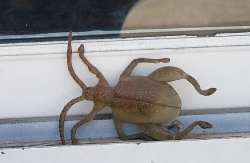
6547. Saw this beast today on my next door neighbor’s outside window. It’s huge…at least 3″ long! Any idea what it is? Hamilton, Ontario. Canada
Number 6547. This appears to be a rubber/plastic model of a tropical leaf beetle (Coleoptera: Chrysomelidae) known as a frog-legged leaf beetle. Click Here for an image.
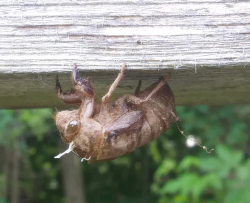
6546. This bug was found on the underside of the top rail of our fence on Aug 4/19 in Cambridge, NS. I have looked through 285 pics but can’t identify it. Hope you can. Cambridge, NS. Canada
Number 6546. This is the empty ‘shell’ (exoskeleton) of a cicada (Hemiptera/Auchenorrhyncha: Cicadidae), likely in the genus Neotibicen (annual/dog-day cicadas). The white filaments are the lining of its breathing tubes (tracheae). Click here for a video of the molting process.
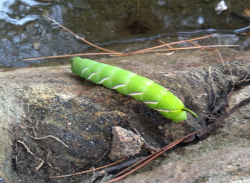
6545. Approximately 5 + ish cm long at Six Mile Lake in Ontario. Toronto, Ontario. Canada
Number 6545. This is a caterpillar of a sphinx moth (Lepidoptera: Sphingidae); it looks like a wild cherry sphinx, Sphinx drupiferarum Click here for images and more detailed information.

6544. This guy was on my car in Mississauga, ON, in August. TORONTO, ON. Canada
Number 6544. This is a western conifer seed bug, Leptoglossus occidentalis (Hemiptera/Heteroptera: Coreidae). Although harmless, these can become nuisance pests when they enter homes in search of shelter. Click here for more detailed information.
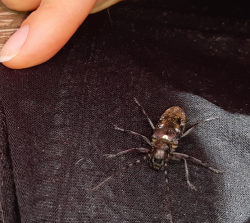
6543. This giant beetle landed in my shirt and wouldn’t get out and would make noises when I’d try to get it off. Scary. New Glasgow, Nova Scotia. Canada
Number 6543. This looks like a white-spotted pine sawyer, Monochamus scutellatus (Coleoptera: Cerambycidae). It is not considered a pest species, Click here for more detailed information.

6542. Branford, ON .Canada
Number 6542. This male moth appears to be in the family Geometridae, a very large family comprising thousands of species. Click here for an example.
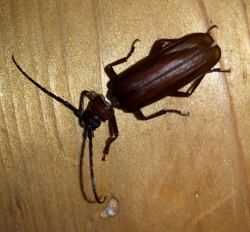
6541. Harrison, Maine. United States
Number 6541. This is a brown prionid, Orthosoma brunneum (Coleoptera: Cerambycidae). It is not considered a pest species; Click here for more detailed information.

6540. Found on a window sill, what is this? It was about an inch long. Edmonton, Ab. Canada
Number 6540. This is a German cockroach, Blattella germanica (Blattodea: Ectobiidae), a peridomestic pest species notoriously difficult to bring under complete control. Click here for some control recommendations.

6539. Only found one It jumps. Was in our basement near the heat pump. Beaconsfield, Quebec. Canada
Number 6539. This is a camel/cave cricket (Orthoptera: Rhaphidophoridae). They are for the most part nuisance pests, usually found in dark, damp situations such as basements, caves, under logs, etc. Click here for more detailed information.

6538. Located in Vaughan Ontario. The bug bit a person on the toe leaving 3 bleeding pin prick bites in a row. Bite happened near backyard pool surrounded by cedar trees. August 2019. Approx 28 – 30 deg celsius. Bit at approx 4 pm. Bug did not die after bite, we smacked it so as to take this picture. Please help us identify this bug, the person that was bitten has lyme disease and is very afraid of dangerous bug bites. Please help thank you. Vaughan, Ontario. Canada
Number 6538. This is a deer fly (Diptera: Tabanidae; Chrysops sp.). Although they can vector several diseases of animals, they do not appear to be a significant vector of any human diseases in North America. Click here and Click here for more detailed information.
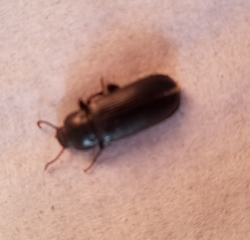
6537. Ever since my parents driveway was redone, they are finding these bugs in their house. What are they? Hope they aren’t dangerous! Ajax, ON. Canada
Number 6537. This looks like the adult of a yellow mealworm, Tenebrio molitor (Coleoptera: Tenebrionidae). Although they may be pests in stored grains, the larvae are valuable as pet food, and roasted in an oven with a little butter and salt, make a tasty snack food. Click here for more detailed information.
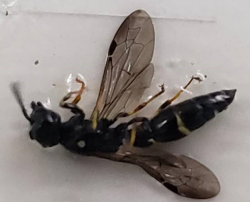
6536. Wasp holes 4 mm wide, the wasps are about 7 mm long. There are boring into 4-yr old dried untreated maple wood used fir shed posts after removing the bark, This is the first year of any wasps. I need to know what they are and if they need to be killed. Halifax, NS. Canada
Number 6536. This does not look like a wood-boring wasp; it looks more like a mason/potter wasp (Hymenoptera: Vespidae; subfamily Eumeninae). I suspect that they are going in the holes either looking for prey or seeing if they would make suitable nesting sites.
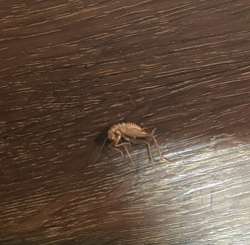
6535. Usually get a couple of these guys in my house during the summer and I’ve never seen anything like them until I moved into my house last summer so I was just curious to try and identify what it is. Fort Vermilion AB. Canada
Number 6535. This is a camel/cave cricket (Orthoptera: Rhaphidophoridae). They are for the most part nuisance pests, usually found in dark, damp situations such as basements, caves, under logs, etc. Click here for more detailed information.
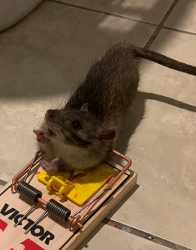
6534. Wondering I’m, what kind of rat this is, Mabey a roof rat or Norway rat ? Hammonds plains, Nova Scotia. Canada
Number 6534. It is difficult to tell from this image. I suggest that you compare your specimen with the chart found at: Click here
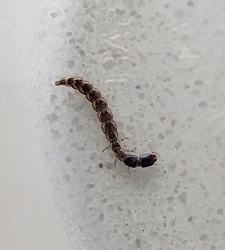
6533. Found 3 days ago, under coffee machine. It moves sinusoidally, and will jump/spring. It seems to be able to use the tip of it’s abdomen to anchour and jump. The length is about 2 cm stretched out. Since it doesn’t have wings I assume it’s a larva. When stretched out the corrugations in the abdomen look brown. Coquitlam, BC. Canada
Number 6533. This is a larva of a snakefly (Raphidioptera: Raphidiidae) in the genus Agulla. They are general predators on other small arthropods. Click here for more detailed information.
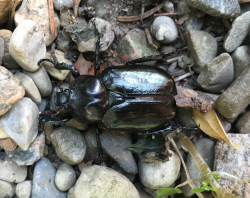
6532. Hi. Does someone know what this beetle is ? Thank you. Michele. Pointe claire, Quebec. Canada
Number 6532. This is Osmoderma eremicola, a scarab beetle (Coleoptera: Scarabaeidae) sometimes known as a leather beetle (because of their odor) or a hermit flower beetle. Their larvae are found in rotting wood. Click here for an example.

6531. Winnipeg, Mb. Canada
Number 6531. This is a sexton/burying beetle (Coleoptera: Silphidae) in the genus Nicrophorus. It looks like Nicrophorus tomentosus, known as the tomentose burying beetle. Unlike other Canadian Nicrophorus, the adults do not bury the carcasses (small mammals/birds) they find, but make a shallow pit and cover the carcass with litter. Click here and Click here for images.
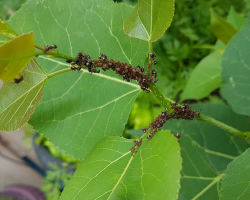
6530. Size 2-3 mm. Month July. Season Summer. Weather conditions: Hot & sunny. Outdoors. I have no idea what the bugs are that these ants are so interested in, nor why they have colonized the plant. I have not been able to ID them through Google. Calgary, AB. Canada
Number 6530. Those are aphids (Hemiptera/Sternorrhyncha: Aphididae), aka ‘plant lice.’ They feed on sap from plants, and as they feed, they excrete excess fluid in the form of ‘honeydew’ which some species of ants find very attractive. Click here for more detailed information.
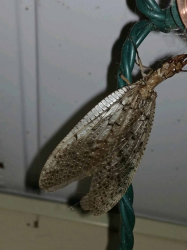
6529. Fergus, Ontario. Canada
Number 6529. This is a female eastern dobsonfly, Corydalus cornutus (Megaloptera: Corydalidae). Their larvae, called hellgrammites, are aquatic predators on other small life forms. Click here for images and more detailed information.