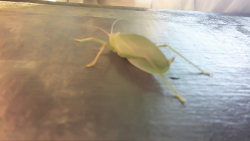
Colour morph

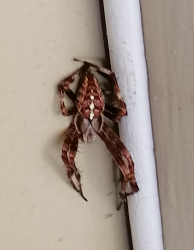
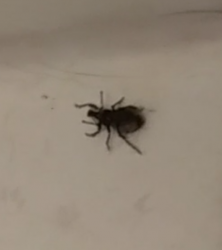
6528. Wondering what kind of spider this is I cant seem to find what it is. Whitehorse, Yukon Territory. Canada

Number 6528.  This is a colour morph (var. pyramidatus) of the marbled orb weaver, Araneus marmoreus; Click here for an image. It appears to be much more common in Europe than in North America. Like all other orb weavers, it is harmless to humans.
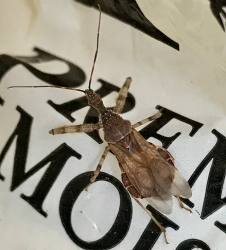
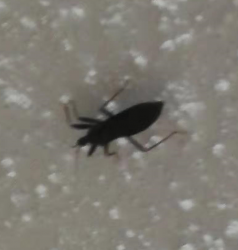
Assassin bug

6527.  I found this insect in my garden today, I live in Montreal close to the Port and shipping containers. I have been bitten by one like this and it was very painful. I always wondered what it is, maybe an ‘Assassin Bug’? Any input would be very helpful. Best. Karim. Montreal, Quebec. Canada

Number 6527.  This is indeed an assassin bug (Hemiptera/Heteroptera: Reduviidae). Their saliva contains proteolytic enzymes that break down the tissues of their prey and this contributes to the painfulness of their bite. Click here for more detailed information.

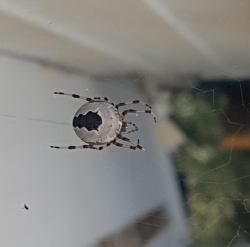
Female orb weaving spider

6526.  Body/head is 1/2 inch white with black mark and a bit of yellow on the bottom and sides. Found on outside on the corner of our deck. July 30/19. Weather warm and sunny 23 degrees. Sherwood Park, Alberta. Canada

Number 6526.  This is a female orb weaving spider (family Araneidae) in the genus Araneus; it might be a cross orb weaver, Araneus diadematus. All orb weavers are harmless to humans.

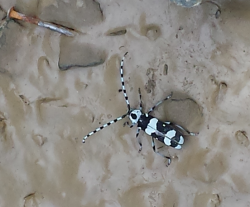
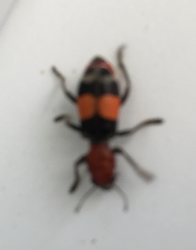
Banded alder borer

6525.  Found this fellow in the mud beside our new home in Salmon Arm. Salmon Arm, British Columbia. Canada

Number 6525.  This is a banded alder borer (Rosalia funebris; Coleoptera: Cerambycidae); it is not considered a pest species. Click here for more detailed information.

Water boatman

6524.  Hello, We found a few of these guys on the outside of a bag of malted barley flour today… wondering what species it might be and where it might originate from? Thanks! Calgary, Alberta. Canada

Number 6524.  This is a water boatman (Hemiptera/Heteroptera: Corixidae). They commonly are found on the surface of ponds where they use their oar-like hind legs to propel themselves. They feed primarily on algae, organic detritus, mosquito larvae, and other small aquatic life forms. They are good fliers and often are found far from water; their occurrence on the bag of flour is strictly accidental.

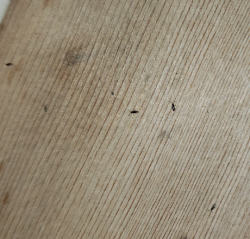
Springtails

6523.  These are extremely small bugs (<1mm). I thought they were bits of dirt until I saw them move. I took the photo in July 2019 inside. I’ve set out glue traps and have caught the largest number in the basement but have found them all over the house as well as outside the house mainly around the windows. Calgary, AB. Canada

Number 6523.  These are springtails, primitive arthropods closely related to true insects. Click here for an example. They basically are harmless scavengers on bits of organic matter, but may become nuisance pests when they occur in large numbers indoors. Moisture management and lowering indoor humidity levels will help keep them in check.

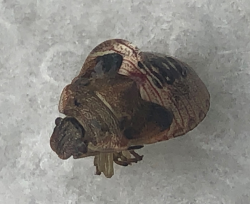
Nymph of a stink bug

6522.  Just wondering what kind of beetle found in my brackets I picked. Honeymoon Bay, Bc. Canada

Number 6522.  This is a nymph of a stink bug (Hemiptera/Heteroptera: Pentatomidae). From the looks of it, it may be a predatory species.– Click here for an example.

Cross orb weaver

6521.  Hello, this spider was on the front door ( I didn’t let him in!) Wondering what kind of spider? Found in end of July in the Vancouver area. Thank you! Vancouver, Bc. Canada

Number 6521.  This is a cross orb weaver, Araneus diadematus, a very common and widespread species (in Europe, it is known as the European garden spider). It is harmless to humans.
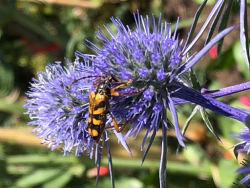
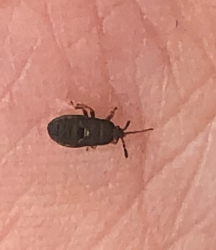
Nymph of a chinch bug

6520. Recently put in new pool. And this week noticed large amount of these bugs crawling around the edge. Scoping them out by the hundreds. Can’t figure out what type of bug this is. Any insight would be helpful. Komoka, Ontario. Canada

Number 6520.  Looks like a nymph of a chinch bug (Hemiptera/Heteroptera: Blissidae; Blissus sp.), Click here for an image. These can be serious lawn/turf pests, Click here for more detailed information.

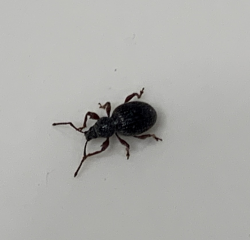
Broad-nosed/short-snouted weevil

6519. Found indoors. Walking on Hardwood floors and on top of bed. July 29, 2019. Golden, BC. Canada

Number 6519.  This is a broad-nosed/short-snouted weevil (Coleoptera: Curculionidae; subfamily Entiminae); these often enter buildings in search of shelter, but do no harm there. Click here for more detailed information.

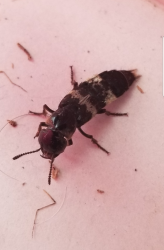
Rove beetle

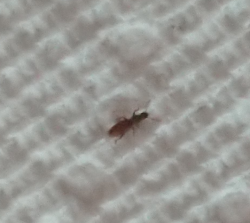
6518. Would just like to know what they are called and if they are a danger to my family and pets. Montague, Pei. Canada

Number 6518.  This is a rove beetle (Coleoptera: Staphylinidae). These are general predators on other small arthropods and pose no threat to anything else. Click here for a more typical image.

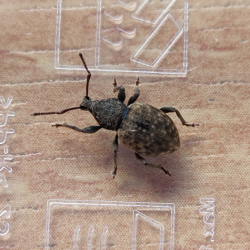
Broad-nosed/short-snouted weevil

6517. I have a few of these by the edges and corners of my carpet and baseboards. Do you know what insect this is? Thank you. Surrey, BC. Canada

Number 6517.  This is a broad-nosed/short-snouted weevil (Coleoptera: Curculionidae; subfamily Entiminae); these often enter buildings in search of shelter, but do no harm there. The larvae of some species, such as the strawberry root weevil and the black vine weevil, can be serious pests. Click here for more detailed information.

Saw-toothed and merchant grain beetles

6516. Stellarton, NS. Canada

Number 6516.  The image is too blurry for a confident identification, but it might be one of the grain beetles in the genus Oryzaephilus (saw-toothed and merchant grain beetles). These sometimes can be pantry pests, primarily infesting grain-based dry stored food products. Click here for more detailed information.

Leaf beetle

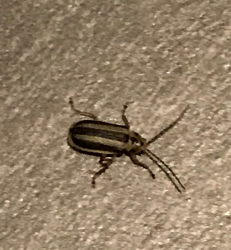
6515. I found this bug under my shirt after being outside under a tree at my work. I can’t seem to find anything that matches this on your website. Toronto, Ontario. Canada

Number 6515.  This is a leaf beetle (Coleoptera: Chrysomelidae); it looks like Trirhabda borealis, Click here for an image.

Scarab beetle

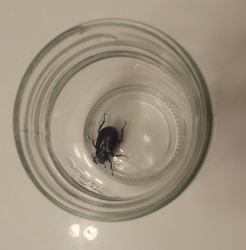
6514. My wife found this in our bedroom on the carpet we never seen anything like this before John Garec. Welland, ON. Canada

Number 6514.  This is a scarab beetle (Coleoptera: Scarabaeidae) in the genus Osmoderma. Sometimes called leather beetles because of their odor, their larvae feed in damp, decaying wood.

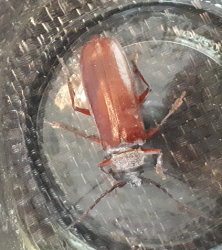
Long-horned wood-boring beetle

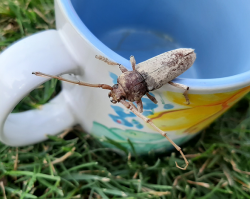
6513.  I have searched the internet but am getting nowhere. Can you help identify this big bug? Amherstburg, Ontario. Canada

Number 6513.  This is a long-horned wood-boring beetle (Coleoptera: Cerambycidae); it looks like the red oak borer, Enaphalodes rufulus, Click here for an image.

Flower longhorn beetle

6512.  Just wanting the species identification of this beetle. Victoria, BC. Canada

Number 6512.  This is a flower longhorn beetle (Coleoptera: Cerambycidae; subfamily Lepturinae); it looks like something in the genus Xestoleptura – Click here for an example.

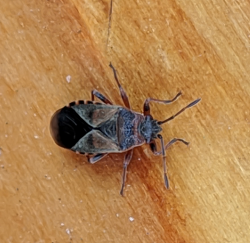
Elm seed bug

6511.  These bugs are all over the deck and up inside the patio umbrella. Dead ones are found by the hundreds every day all over the deck, mostly gathered near the entryways. Only a few were discovered indoors. The picture is of one of the larger ones with the blue color. There are many smaller ones that are brown. Salmon Arm, BC. Canada

Number 6511.  This is an elm seed bug, Arocatus melanocephalus (Hemiptera/Heteroptera: Lygaeidae). This is an introduced species that has become a nuisance pest in western North America, Click here for more detailed information.

Long-horned wood-boring beetle

6510.  About 2 inches long. Found in a barrel in the garage July 27th. Branchton, Ontario. Canada

Number 6510.  This is a long-horned wood-boring beetle (Coleoptera: Cerambycidae) in the subfamily Prioninae. These are among the largest beetles in Canada.

Larva of a lacewing

6509.  Hi, tried searching but haven’t been able to locate an image to identify this guy. Felt pain on my big two, saw him on top after he sunk his mandibles into me. Probably pick him up when crossed my lawn in southern Ontario, Canada. Thank you. Scarborough, Ontario. Canada

Number 6509.  This is a larva of a lacewing (Neuroptera: Chrysopidae), these are general predators on small soft-bodied arthropods such as aphids and caterpillars. They occasionally will ‘sample’ human skin, but their bite is harmless.

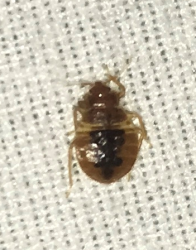
Bed bug

6508.  Port carling, Ontario. Canada

Number 6508.  This is a bed bug, Cimex lectularius (Hemiptera/Heteroptera: Cimicidae), Click here for detailed information.

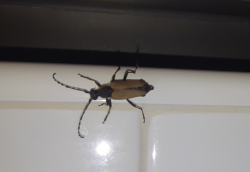
Flower longhorn beetle

6507.  Found this bug at work and let him crawl around for a while then set him free after he ended up in my hair haha. Found in summer, he was about a size of a quarter. Tried to identify him, maybe a long horned beetle? New Glasgow Nova scotia. Canada

Number 6507.  This is a flower longhorn beetle (Coleoptera: Cerambycidae; subfamily Lepturinae) in the genus Trigonarthris, Click here for an example.

Assassin bug

6506.  Black colour with six legs and wings, found on the roof of bed room inside house in the evening of July 25th 2019. Size of a quarter coin. Weather is sunny during the day, around 28 degrees Celsius. Child had one insect bite last night on the face, almost not visible by end of day today, not sure if it is by this insect. Is this a kissing bug? Markham, Ontario. Canada

Number 6506.  This is an assassin bug known as a masked hunter (Reduvius personatus; Hemiptera/Heteroptera: Reduviidae), a cosmopolitan species often found indoors and reputed to have a very painful ‘bite’- Click here for more detailed information. Kissing bugs belong to a different subfamily within Reduviidae.

Checkered beetle

6505.  Huntsville, Ontario. Canada

Number 6505.  This is a checkered beetle (Coleoptera: Cleridae) in the genus Enoclerus. Click here for an example. These are general predators on other small arthropods; some specialize on wood infesting insects such as bark beetles.

Long-horned wood-boring beetle

6504.  Some sort of beetle. Huntsville, Ontario. Canada

Number 6504.  This is a long-horned wood-boring beetle (Coleoptera: Cerambycidae), it looks like Calloides nobilis; Click here for an image. This does not appear to be a pest species.

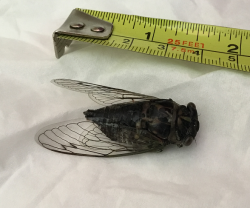
Dogday cicada

6503.  The kids found it while sorting laundry brought in from outside. We are also in process of moving so we have a lot of boxes around and we are shifting things a lot. The kids hit it with a fly swatter, but it wasn’t very active (daytime). What is it? Do I need to be worried? Greenfield Park, QC. Canada

Number 6503.  No need to worry, this is an annual/dogday cicada (Hymenoptera/Auchenorrhyncha: Cicadidae) in the genus Neotibicen; Click here for more detailed information.

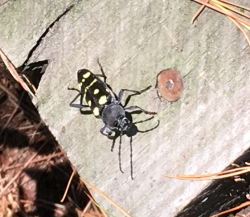
Wood wasp

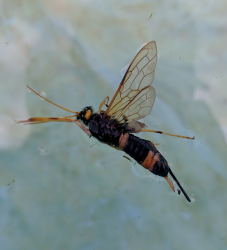
6502.  Hi, I can’t look it all of the photos. Don’t like bugs, I tried haha. This was in our pool. Williams Lake, BC. Canada

Number 6502.  This is a wood wasp (Hymenoptera: Siricidae) in the genus Urocerus, likely Urocerus flavicornis; Click here for an image. Their larvae bore in the wood of dead/dying trees.

Larva of a leaf beetle

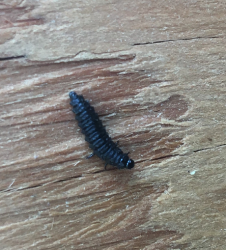
6501.  There were several hundred of these larvae found at our local swimming/paddling lake, crawling up the pathway and inside the boathouse. Noticed in July during a short heatwave of 30 degrees (could be coincidence). They seem to be attracted to wood, and possibly water. Any idea what these are? Are they invasive or harmful to our ecosystem? If so is there any way to eradicate? Pemberton, BC. Canada

Number 6501.  This is a larva of a leaf beetle (Coleoptera: Chrysomelidae); they likely had been feeding on shrubs or trees in that area.

Broad-nosed/short-snouted weevil

6500.  1 quarter inch long. Very hard to squish. CALGARY, AB. Canada

Number 6500.  This is a broad-nosed/short-snouted weevil (Coleoptera: Curculionidae; subfamily Entiminae). These often come indoors in search of shelter, but do no harm there. Click here for images and more information. 

Wasp nest dermestid

6499.  Burnaby, British Columbia. Canada

Number 6499.  This looks like Reesa vespulae (Coleoptera: Dermestidae). Known as the wasp nest dermestid, it often is found in bird and wasp nests outdoors. Indoors, it can be a pest of museum specimens (especially dry insects), stored seeds and dried plant material.

Common true katydid

6498.  Hello – please let me know what this insect is. I’ve never seen one before. Thanks! Cassandra. Mississauga On.
Canada


Number 6498.  This is a common true katydid, Pterophylla camellifolia (Orthoptera: Tettigoniidae); Click here for detailed information.

Japanese beetle

6497.  Hi, I’ve seen these insects on a few occasions this July. They appear to be a type of beetle and they can vary in colour: another I saw had an almost metallic orange colour. I’ve only ever seen them in hot weather and they seem to like carcasses as I saw several on a rat corpse when I was walking my dog. Toronto, Ontario. Canada

Number 6497.  This is a Japanese beetle, Popillia japonica (Coleoptera: Scarabaeidae), an introduced species that has become a very serious pest. Click here for detailed information.

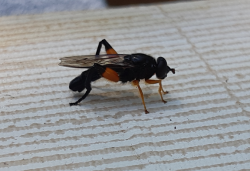
Hover/flower fly

6496.  These photos were taken at Buck Lake Alberta. Edmonton, AB. Canada

Number 6496.  This appears to be Chalcosyrphus curvaria, a hover/flower fly (Diptera: Syrphidae); Click here for an image. Their larvae reportedly feed in rotting wood; perhaps on the fungi therein.