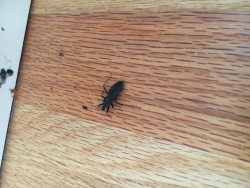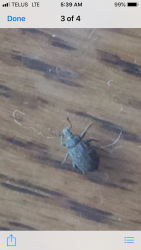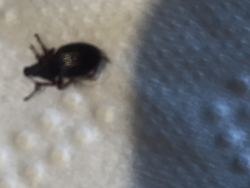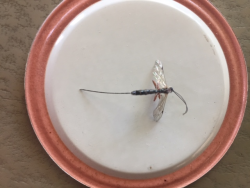
Broad-nosed/short-snouted weevil

6495.  Toronto, Ontario. Canada

Number 6495.  this looks like a broad-nosed/short-snouted weevil (Coleoptera: Curculionidae; subfamily Entiminae). These often come indoors in search of shelter, but do no harm there. Click here for images and more information. 

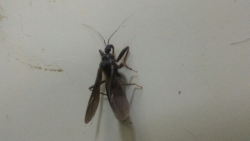
Male flying ants

6494.  The insects were beside our washing machine on the floor. There were hundreds of them crawling out of the bathroom where the washer is located. They appeared to have come out at the base of the wall. We used RAID on them. This happened on Friday, July 19, 2019. The odd one is still showing up inside the house. Victoria, BC. Canada

Number 6494.  These are male flying ants. Given their location, they might be carpenter ants (Camponotus sp.). If so, you should also be seeing some females, which would be similar in appearance, but much bigger. Click here for an image of a male and female side-by-side.

Long-horned wood-boring beetle

6493.  Trying to understand what type of Beatle this is… Thanks. Arnprior, Canada – Ontario. Canada

Number 6493.  This is a long-horned wood-boring beetle (Coleoptera: Cerambycidae). It looks like Monochamus notatus, a species known as the northeastern pine sawyer. Click here for an image.

Broad-nosed/short-snouted weevil

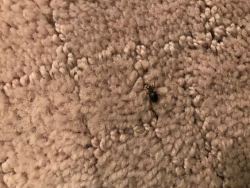
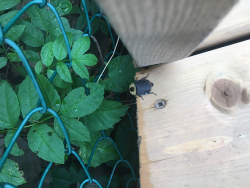
6492.  Small black bugs have been found on our entrance carpet near front door, in the bathroom near our patio, on the wall in our living room, and on the carpet in the hallway upstairs. The weather is very warm today and we haven’t seen these bugs before, although have lived here for 1.5 years. Any idea what these are? Surrey, BC. Canada

Number 6492.  This is a broad-nosed/short-snouted weevil (Coleoptera: Curculionidae; subfamily Entiminae). These often come indoors in search of shelter, but do no harm there.

Click beetle

6491.  Whitby, Ontario. Canada

Number 6491.  This is a click beetle (Coleoptera: Elateridae), a harmless accidental visitor.

Springtail,

6490.  Picture of tiny insects found in basement windowsill (taken in Toronto, Ontario Canada) mid- July. Toronto Ontario. Canada

Number 6490.  This appears to be a springtail, a primitive arthropod in the order Collembola, closely related to true insects. Ones like your specimen basically are harmless scavengers on bits of organic matter, but sometimes can be nuisance pests when they occur in numbers indoors. Moisture/humidity management is the best control.

Hover/flower fly

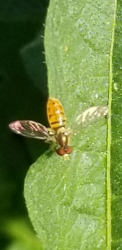
6489.  This insect is eating the leaves on my rasberrys and my potatos. What is it? Headingley, Mb. Canada

Number 6489.  This insect would not be damaging your plants. It is a hover/flower fly (Diptera: Syrphidae); their larvae feed on aphids and the like while the adult flies can be valuable pollinators.

Giant ichneumon wasp

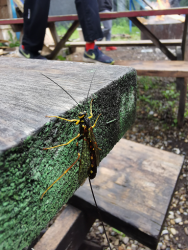
6488.  Calgary, AB. Canada

Number 6488.  This is a giant ichneumon wasp (Hymenoptera: Ichneumonidae; Megarhyssa sp.), likely the western giant ichneumon wasp, Megarhyssa nortoni. Click here for more detailed information.

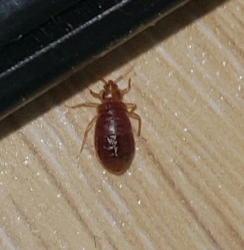
Bed bug

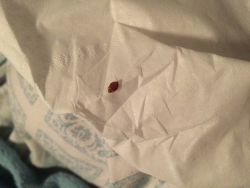
6487.  Tiny found only in one room in the entire house. Calgary, Alberta. Canada

Number 6487.  This looks like a bed bug. Cimex lectularius (Hemiptera/Heteroptera: Cimicidae); Click here for detailed information on the subject.

Nymph of an ambush bug

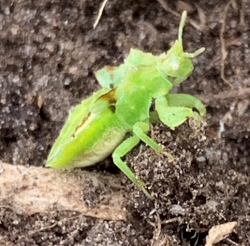
6486.  Gardening on July 19 found at least fifty of these in the overgrown, grassy section of the garden. They were most prolific between a rose bush and a hosta. There is some damage to the hosta, none on the rose bush. I cannot find this identical insect anywhere. It is fairly small, about the size of a ladybug. Omemee, Ontario. Canada

Number 6486.  This is a nymph of an ambush bug, Hemiptera/Heteroptera: Reduviidae; subfamily Phymatinae. These are ambush predators on other small arthropods, mainly other insects. They usually are found on vegetation where they tend to blend in and often escape casual notice, Click here for more detailed information.
American carrion beetle

6485.  Paris, Ontario. Canada

Number 6485.  This is an American carrion beetle, Necrophila americana (Coleoptera: Silphidae). Click here for an image and more detailed information.
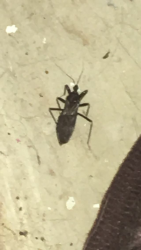
Camel/cave cricket

6484.  I just found this dead on our step its huge for a grasshopper had a lobster like body. Summerside, PE. Canada

Number 6484.  This is a camel/cave cricket (Orthoptera: Rhaphidophoridae); they most often are found in dark, moist, undisturbed places such as caves, basements, under logs or rocks, etc. They appear to be mainly scavengers.

Alpine longhorn beetle

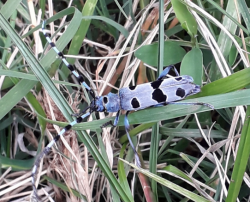
6483.  Please help me to know is this dangerous insect because I see for the first time. muharrem fejza, pristina Kosovo

Number 6483.  This is an Alpine longhorn beetle Rosalia alpine (Coleoptera: Cerambycidae). It is a protected species in much of Europe; Click here for more detailed information. 
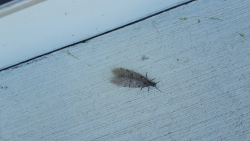
Assassin bug

6482.  This is the second one I find in my house. What are they and how do I get rid of them? Thank you!!!!! London, On. Canada

Number 6482.  This is an assassin bug known as a masked hunter (Reduvius personatus; Hemiptera/Heteroptera: Reduviidae). This is a cosmopolitan species often found indoors and reputed to have a very painful ‘bite’- Click here for more detailed information. The only way to completely get rid of them would be to find and get rid of the other insects that they are feeding on. 
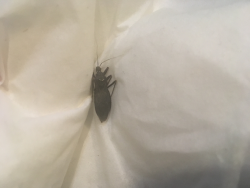
Nymph of a wheel bug

6481.  Several of them spotted in Georgia (USA). Hamilton, ON. Canada

Number 6481.  This is a nymph of a wheel bug, Arilus cristatus (Hemiptera/Heteroptera: Reduviidae), the largest assassin bug in North America. Click here for more detailed information.

Assassin bug

6480.  Winnipeg, Manitoba. Canada

Number 6480.  This is an assassin bug known as a masked hunter (Reduvius personatus; Hemiptera/Heteroptera: Reduviidae). This is a cosmopolitan species often found indoors and reputed to have a very painful ‘bite’- Click here for more detailed information.

Broad-nosed short-snouted weevil

6479.  Just moved into a new acreage south of Okotoks, Alberta. Have found many of these identical (all the same bug) bugs in 1-2 bedrooms. Have been vacuming them up for last 3 days. they seem to be crawling out of the long carpet ( only in bedrooms ). These are not found all over the house. Just mainly the one bedroom and the bedroom below ( walk out basement ). If we had to count how many of these we have found ~ 30+. Trying to find out what they are and if they are harmful to humans or structure. Thanks for any help. Rob St Martin. Okotoks, Alberta. Canada

Number 6479.  This is a broad-nosed short-snouted weevil (Coleoptera: Curculionidae; subfamily Entiminae). They often enter buildings in search of shelter, but do no harm there. Simply sweep/vacuum them up and dispose of them.

Nymph of a stink bug

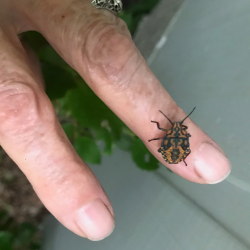
6478.  A group of these bugs gathered together next to each other and have spent two days together on the siding of my house. I thought the pattern of their markings was beautiful but I do not remember ever seeing these bugs before. Winnipeg, Manitoba. Canada

Number 6478.  This is a nymph of a stink bug (Hemiptera/Heteroptera: Pentatomidae) in the genus Apoecilus, Click here for an image. These are predatory, feeding mainly on caterpillars.

Jumping spider

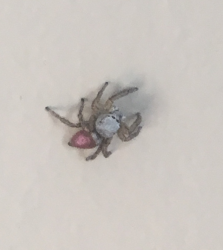
6477.  I am trying to identify this 1/4-1/2” pink and blue spider. Kitchener, ON. Canada

Number 6477.  This is a jumping spider (family Salticidae); looks like something in the genus Phidippus, a very large and diverse genus

Dark-winged fungus gnats

6476.  Hello, I would like to know how can I get rid of these small black bugs that are flying around my living area in the basement. I am finding them in the bathtub, bathroom, bedroom and my office. they are very annoying and they seem to be attracted to light as they do go near a lamp or my phone in the dark. I don’t know if these are drain flies. I haven’t seen them come up from the drain. I have put Apple Cider Vinegar with Palmolive dish soap in 2 little bowls and I have caught approx. 10 in each bowl. But they are a lot more as I have killed 100 of these little annoying buggers. I have submitted a picture of them on here but no reply yet as what they are and how I can get rid of them for once and for all. Please help. thank you. London, ON.

Number 6476.  These most likely are dark-winged fungus gnats (Diptera: Sciaridae). Their larvae usually are found in very wet/saturated soil having a high organic material content, such as in over-watered potted plants. If you have potted plants in our around your premises, allow the soil to dry out as much as practical between waterings. If you have no such plants and they are coming in from outside, you’re options are rather limited.  Click here for some suggestions.

Broad-nosed short-snouted weevil

6475.  Please let me know what can I do to get ready of this I see a 1 or 2 a week in my house thank. vancouver, bc. Canada

Number 6475.  This is a broad-nosed short-snouted weevil (Coleoptera: Curculionidae; subfamily Entiminae). They often enter buildings in search of shelter, but do no harm there. Simply sweep/vacuum up any that gain entry and dispose of them.

Assassin bug

6474.  I found what looks like an assassin bug on my apartment floor because of its classic tubular mouth piece and mantis like front legs. I am wondering if this bug carries the deadly Chagas disease or is it just an assassin bug with a painful bite.I never expected these bugs to be so far north from their usual habitat. Montreal, Quebec. Canada

Number 6474.  This is an assassin bug known as a masked hunter (Reduvius personatus; Hemiptera/Heteroptera: Reduviidae). This is a cosmopolitan species often found indoors. They are not disease vectors, but are reported to have a very painful bite.- Click here for more detailed information.

Broad-nosed short-snouted weevil

6473. 30. We want to have this bug identified and know if they bite. We live in a basement. Etobicoke, Ontario. Canada

Number 6473.  This is a broad-nosed short-snouted weevil (Coleoptera: Curculionidae; subfamily Entiminae). They often enter buildings in search of shelter, but do no harm there. They do not bite. 

Spider beetle

6471. 28. Montreal, Quebec. Canada

Number 6471.  This is a spider beetle (Coleoptera: Anobiidae; subfamily Ptininae) in the genus Mezium. These beetles can infest dry stored food products, so you check all areas where dry food products are stored for signs of infestation. Click here for more detailed information.

Cigarette beetle

6470. This is a blown up picture. These bugs are tiny and fly. I noticed them in my bathroom at first. Thank you for your assistance. Newark, Ohio. United States

Number 6470.  This looks like a cigarette beetle, Lasioderma serricorne (Coleoptera: Anobiidae). This beetle and its close cousin, the drugstore beetle, Stegobium paniceum (Coleoptera: Anobiidae), can be serious pantry pests. You should check all areas where dry food products (including whole grains) are stored for signs of infestation. Click here for more detailed information.

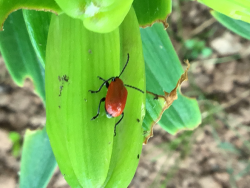
Lily leaf beetle

6469. How do I get this out of my flower garden. Valley, Nova Scotia. Canada

Number 6469.  This is a lily leaf beetle, Lilioceris lilii (Coleoptera: Chrysomelidae), an introduced species that has become quite a pest. I collected the first specimens reported from West Virginia last year. Click here for detailed information including control recommendations.

Ichneumon wasp

6468. This was found in my home in Courtenay BC. We do not know what it is, thanks. Courtenay, British Columbia. Canada

Number 6468.  This is an ichneumon wasp (Hymenoptera: Ichneumonidae). These all are parasitic on other arthropods, mainly other insects. They are harmless to humans.

Larva of a lacewing

6467. This insect attached to my leg with a certainly noticeable, but not overly painful, bite – and at first appearances seemed to be a small worm. It is very small and measures about 5mm in length. Photo was taken by Lexi Johnson on a paper towel. South Surrey, British Columbia. Canada

Number 6467.  This is a larva of a lacewing (Neuroptera: Chrysopidae). These are general predators on other small, soft-bodied arthropods such as aphids and caterpillars. Occasionally, they will ‘sample’ human skin, but their bite is harmless. Excellent photograph, by the way.

Bed bug

6466. I found it moving on my hand when I was home. The size is 3-4mm, and it was fed with blood (found out when I killed it using a napkin. I doubt between bedbug and bodylice, but these are just guesses… this is the first time we see such a thing! Vancouver, BC. Canada

Number 6466.  This is indeed a bed bug; Click here for detailed information on the subject.

Assassin bug

6465. What kind of bug is this? This is my second time seeing them in my bathroom. Dingwall, Toronto ON. Canada

Number 6465.  This is an assassin bug known as a masked hunter (Reduvius personatus; Hemiptera/Heteroptera: Reduviidae). This is a cosmopolitan species often found indoors and reputed to have a very painful ‘bite’- Click here for more detailed information.

Female summer fishfly

6464. It was on my back yard door. Niagara Falls, ON. Canada

Number 6464.  This looks like a female summer fishfly, Chauliodes pectinicornis (Megaloptera: Corydalidae; subfamily Chauliodinae); their larvae are aquatic and sometimes called hellgrammites. Click here for more detailed information.

Assassin bug

6463. Have found about 4 of these at different times the last few days inside the house. 2-3cm? One on shower curtain, two others around windows at night. This one flew short distance. We recently had some construction done in a basement bathroom. July 2019. Toronto, ON. Canada

Number 6463.  This is an assassin bug known as a masked hunter (Reduvius personatus; Hemiptera/Heteroptera: Reduviidae). This is a cosmopolitan species often found indoors and reputed to have a very painful ‘bite’- Click here for more detailed information. The fact that you’ve found several indicates that there must be a fair population of other insects in your house for them to feed on.

Rove beetle

6462. LANGLEY, BC. Canada

Number 6462.  This is a rove beetle (Coleoptera: Staphylinidae). These are general predators on other small arthropods.