
Dolomedes triton
6428. Hampton, New Brunswick. Canada
Number 6428. This is Dolomedes triton, a fishing spider in the family Pisauridae. Beautiful specimen; glad you didn’t harm it!

6428. Hampton, New Brunswick. Canada
Number 6428. This is Dolomedes triton, a fishing spider in the family Pisauridae. Beautiful specimen; glad you didn’t harm it!

6427. Trying to bite cattle and humans. MUN 40 East. Ste Genevieve, Manitoba. Canada
Number 6427. This is a black horse fly, Tabanus atratus (Diptera: Tabanidae), one of the largest species of horse fly in North America. Click here for more detailed information.

6426. Our honeysuckle vines have many of these insects crawling slowly over the leaves. 1-2 mm very shiny black and the larger ones have a red margin. Never seen them before here’ Allenby, Victoria, BC. Canada
Number 6426. These are nymphs of a stink bug (Hemiptera/Heteroptera: Pentatomidae) in the genus Chlorochroa – Click here for an example.

6425. Many tiny holes in log inside cabin – Piles of wood dust near holes. Gordon Drive, Naples, FL. United States
Number 6425. This is a horned powder-post beetle (Coleoptera: Bostrichidae), Click here for an example.

6424. Is this a tick. Nadeau St. Quesnel, BC. Canada
Number 6424. This is a broad-nosed short-snouted weevil (Coleoptera: Curculionidae; subfamily Entiminae) such as a black vine weevil. These often enter buildings in search of shelter, but do no damage there.
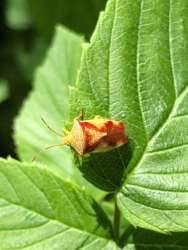
6423. Spotted in late June, outside on a raspberry bush leaf in mid-afternoon. It’s body was half an inch long or less. Calgary, Alberta. Canada
Number 6423. This is a red-cross shield bug, Elasmostethus cruciatus (Hemiptera/Heteroptera: Acanthosomatidae); Click here for an image. This is not a pest species.

6422. I bought a air conditioner at Costco. While opening the box, this spider jumped onto my head. The air conditioner is made in China but packed in Ontario. Can you tell me if this is a Canadian spider and harmless. I released him outside before considering the matter. Montebello, Quebec. Canada
Number 6422. This is a female dark fishing spider, Dolomedes tenebrosus (family Pisauridae), the largest spider species native to Ontario. Not at all dangerous to humans, and in spite of its name, these can be found a long distance from water. Click here for more detailed information.
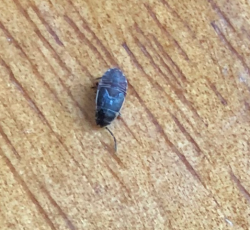
6421. They are insane outside my house and starting to come inside would like to know what kind of bug this is. They started about last week June 17ish, they’re hiding along door frames and widows. Lundar, Manitoba. Canada
Number 6421. This is a nymph of an elm seed bug, Arocatus melanocephalus (Hemiptera/Heteroptera: Lygaeidae). This is an introduced species that had become a serious nuisance pest in many areas of North America. Click here for more detailed information.

6420. Tiny, size of fruit fly but do not fly. In upstairs bathroom, many on ceiling. Mcrae Drive, Toronto, Ontario. Canada
Number 6420. Looks like a foreign grain beetle, Ahasverus advena (Coleoptera: Silvanidae). Also known as the new house beetle, these basically are nuisance pests that cause no real harm and control seldom is warranted. Click here for more detailed information

6419. What are these? My house been attacked by these little worm, mostly under my bed. Do they bite? Montgomery
Timmins, On. Canada
Number 6419. This is a larva of a beetle in the genus Dermestes, such as the larder beetle, Dermestes lardarius (Coleoptera: Dermestidae). Visit Click here for more detailed information including control recommendations.

6418. I know this is only a web but I’ve never seen one like this with such a well-defined hole. I thought you might be interested. I have no idea what the spider looks like who built it. Nanoose Bay, British Columbia. Canada
Number 6418. This web likely was made by a funnel-weaver spider in the family Agelenidae. Visit Click here for an example.
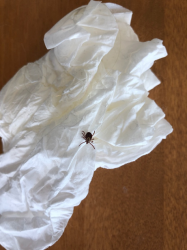
6417. Found in my daughter’s bedroom. Tottenham, ON. Canada
Number 6417. This appears to be a female American dog tick (aka wood tick), Dermacentor variabilis, Click here for more detailed information.

6416. Richmond, BC. Canada
Number 6416. This is a ten-lined June beetle, Polyphylla decemlineata (Coleoptera: Scarabaeidae), their larvae can be pests on tree farms – Click here for more detailed information.

6415. Found in June 2019 in the window of our sunroom. Cambridge, Ontario. Canada
Number 6415. This is a golden-backed snipe fly, Chrysopilus thoracicus (Diptera: Rhagionidae); Click here for an image and more detailed information.

6414. Hamilton, ON. Canada
Number 6414. This is an assassin bug (Hemiptera/Heteroptera: Reduviidae) called the masked hunter (Reduvius personatus), an introduced species with a cosmopolitan distribution. These are general predators on other small arthropods, and are reputed to have a very painful (but not dangerous) bite. Click here

6413. These bugs have been found indoor (and outside) a dorm residence in Vancouver, BC in June 2019. I’m not sure if they’re biting but I have had a few bite recently. They are typically 4-7mm long with a hard exterior (as can be felt when they’re squished). Vancouver, British Columbia. Canada
Number 6413. This is a nymph of a boxelder bug (Hemiptera/Heteroptera: Rhopalidae; Boisea sp.). Generally considered nuisance pests, they have been known to damage fruit late in the season – Click Here for more detailed information.

6412. I have started to see these guys crawling around on my floor. They are very small and seem to have a hard shell (they are difficult to squish). When they sense danger, they pull their legs underneath themselves. Mississauga, Ontario. Canada
Number 6412. This is a weevil (Coleoptera: Curculionidae); it appears to be one of the grain/granary weevils in the genus Sitophilus, Click here for more detailed information.
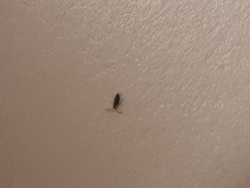
6411. Good day, My name is Ed and I live south west of Edmonton, Alberta about 30 miles. Lately I have been seeing many tiny little specks on my kitchen counter, some in the sink and even a couple on the bathroom countertop. They are small, basically a speck moving around but they seem to be able to jump about 1 inch. We have been trying to get rid of them and even with the kitchen being emptied we are still finding them. It is hard to even get a decent picture as they are so small. What are they? Thank you. Parkland County, Alberta. Canada
Number 6411. These are springtails, primitive arthropods in the order Collembola, closely related to true insects. These basically are nuisance pests best controlled through proper moisture management (they require moist conditions/high humidity in order to thrive).
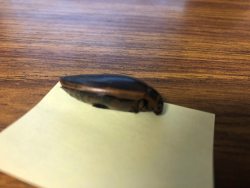
6410. Found this on the ground in this state. unsure of what it is? almost looks like a cockroach. Edmonton, Alberta. Canada
Number 6410. This is a very dead predaceous diving beetle (Coleoptera: Dytiscidae) that has lost all its legs. These are general predators on small aquatic life forms; they are strong fliers and often are found quite some distance from the nearest water.
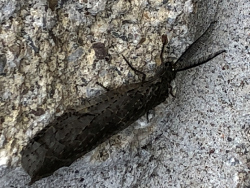
6409. I have lived in Ontario, all my life, and have never seen this type of Insect creature before! It was approximately 2.5 -3 inches in length, and about 1 inch in girth. Could you please Identify? I was in Peterborough last week(18-21 June 2019) and it was around my friends pool during the day. It was able to fly but only a short distance (20 ft or so each time we approached and nudged it away from our dogs. It did not make any sounds). Please get back to me with your prognosis at your convenience! Thanking you in advance. Central Eastern Ontario, Trenton, Ontario. Canada
Number 6409. This is a fishfly (Megaloptera: Corydalidae; Chauliodes sp.). Their larvae, called hellgrammites, are aquatic predators on other small life forms. Click Here for more detailed information

6408. This bug crawled on my leg in a restaurant downtown Toronto – kindly help identify. Thank you. 1234 college st
St, Toronto Ontario. Canada
Number 6408. This is a nymph of a plant bug in the family Miridae. Strictly a plant feeder.
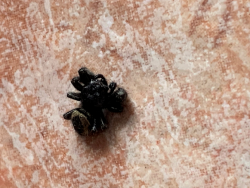
6407. Found this spider walking on my kitchen ceiling, never seen one like this before, should I be concerned. Hanmer, Ontario. Canada
Number 6407. This is a jumping spider (family Salticidae); may be in the genus Phidippus. These are harmless to humans.

6406. Found two of these today in the house. Hoping not harmful. Regina, Saskatchewan. Canada
Number 6406. This is an assassin bug (Hemiptera/Heteroptera: Reduviidae) called the masked hunter (Reduvius personatus), an introduced species with a cosmopolitan distribution. These are general predators on other small arthropods, and are reputed to have a very painful (but not dangerous) bite.

6405. The bug on the wall of house flys and bites. Winnipeg, Manitoba, Canada
Number 6405. This is a female predaceous diving beetle (Coleoptera: Dytiscidae). These are general predators on small aquatic life forms; they are strong fliers and often are found quite some distance from the nearest water. Their bite is harmless.
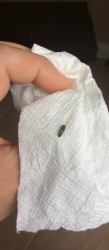
6404 I found 5 of these in different locations in my house and one I found had a lot of little one around, the big ones jump and are really hard to kill. They are almost a centimetre long. could you please help me thanks in advance. Big River, New Brunswick. Canada
Number 6404. This is a click beetle (Coleoptera: Elateridae), a harmless accidental intruder.
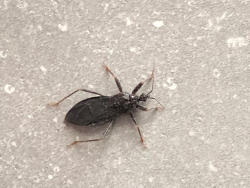
6403 What kind of insect that I discovered this morning hidden under plate. Is it a cockroach or? Thank you. Montreal, Qc. Canada
Number 6403. This is an assassin bug (Hemiptera/Heteroptera: Reduviidae) called the masked hunter (Reduvius personatus), an introduced species with a cosmopolitan distribution. These are general predators on other small arthropods, and are reputed to have a very painful (but not dangerous) bite.
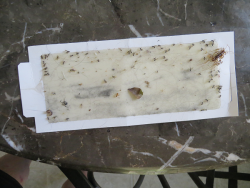
6402 I’m wanting to know what the prominent bugs are on the glue strip that was left under the couch. I think they are the culprits that bite us and leave giant welts. I also have a photo a what appears to be the same bug, only 10 times bigger. thanks, Rod. Sycamore Ridge Drive, Simpsonville, SC 29681 United States
Number 6402. The largest critter at upper right is a centipede, possibly a house centipede (Scutigera coleoptrata). These are venomous, but will not bite unprovoked. Most of the insects on the strip appear to be flying ants or gnats; certainly nothing that would be responsible for any bites.
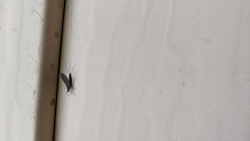
6401 Small and long flying bug with three tails. They have resided on our balcony. There’s at least 50 of them. I had swatted them all away (some dead) and they came back in greater numbers a few days later. We live close to a river and do not have any lights on our balcony. CALGARY, Alberta. Canada
Number 6401. This is a mayfly (order Ephemeroptera). These spend most of their lives as nymphs/naiads at the bottoms of streams and lakes where they constitute an important part of the feed web there. The adults you see seldom live more than a day; just long enough to mate and lay eggs. They do not feed and are completely harmless.

6400 Not sure what type of beetle this is. Carleton Place, ON. Canada
Number 6400. This is a metallic wood boring beetle (Coleoptera: Buprestidae) in the genus Dicera, Click here for an example. Their larvae often are called flat-headed wood borers because the area immediately behind their head usually is much wider and flatter than the rest of their body. Some species can be serious timber pests.

6399 8. They seem to start off as the small red ones, and grow into the bigger brown ones. Unless they’re different species, infesting at the same time :/ Kelowna, British Columbia Canada
Number 6399. This is a nymph of a boxelder bug (Hemiptera/Heteroptera: Rhopalidae; Boisea sp.). Generally considered nuisance pests, they have been known to damage fruit late in the season – Click here for more detailed information.
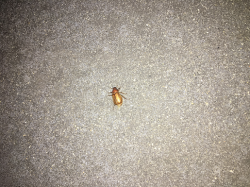
6398 Hi there, I live in a low rise condo building on the 4th floor and every night in the summer, around dusk, a swarm of what look like flying, gold beetles come out from somewhere in the roof flashing. I have a good quality picture of one. What are they and how can I be rid of them?? Thanks; Mike
Number 6398. This is a scarab beetle (Coleoptera: Scarabaeidae), they are not living in the roof flashing, but flew up there. Their larvae are underground feeders on plant roots and some species can be serious lawn/turf pests.
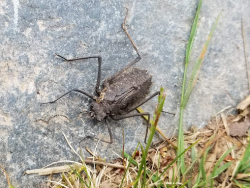
6397 Found at Shubenacabie Canal Park near the lake, June 15 2019. Quite large, over 2 cm long, heavily armoured. Halifax, Nova Scotia, Canada
Number 6397. You must be near a stream or pond, as this is a dragonfly nymph that has completed its growth and has left the water in order to find a safe place to transform into the winged adult stage.

6396 Please identify. This was found in my newer build home near light switch in en-suite. Never seen before. Was smaller than picture. Brantford, Ontario Canada
Number 6396. This is a click beetle (Coleoptera: Elateridae), a harmless accidental intruder.