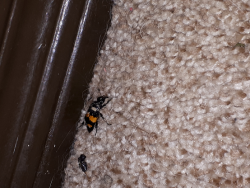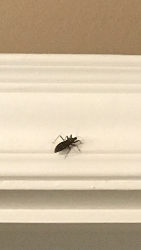
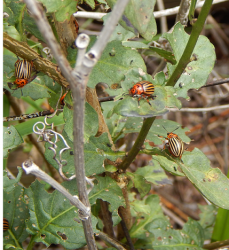
Colorado potato beetles

6461. These ‘beetles’ are twice the size of a ladybug, but the same shape. I took these photos today (July 12th, 2019) in the yard near the lake. They are/have devoured whatever plant that is that is like a vine, gets purple flowers on it and then they turn into red ‘berries’ that the birds like! Please advise what they are and how can I get rid of them/keep them off my expensive shrubs and plants!!! thanks. Vernon, B.C. Canada.

Number 6461.  These are Colorado potato beetles. Leptinotarsa decimlineata (Coleoptera: Chrysomelidae). They feed only on plants in the nightshade family (Solanaceae), including potatoes, tomatoes, peppers, etc.
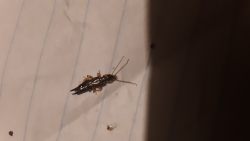
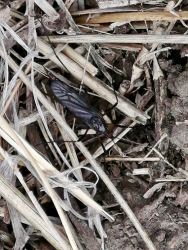
Earwig

6460. It bit me about 3 weeks ago its still swollen tonight i have fever. Society Hill, South Carolina. United States

Number 6460.  This is an earwig (order Dermaptera); it is extremely unlikely that it was the cause of your distress. They very rarely bite, and are more likely to pinch you with their forceps-like cerci. I am unaware of any reports of an earwig bite having any significant consequences.

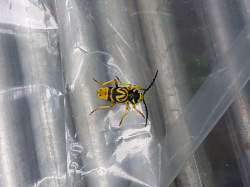
Sugar maple borer

6459. Very curious about what this big is. Thank you. Penetanguishene, Ontario. Canada

Number 6459.  This is a sugar maple borer, Glycobius speciosus (Coleoptera: Cerambycidae), Click here for an image. Their larvae mine under the bark of living sugar maple trees.

Female predaceous diving beetle

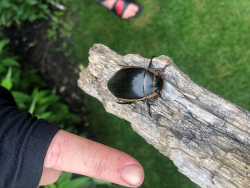
6458. Cambridge, Ontario. Canada

Number 6458.  This is a female predaceous diving beetle (Coleoptera: Dytiscidae). These are general predators on other small aquatic life forms; they are strong fliers that may be found quite some distance from any water.

Scavenger beetle

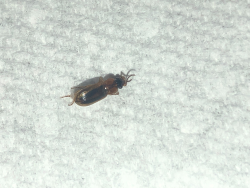
6457. Found 2 in my sons bed. I checked his head and it doesn’t appear to be lice. Please help. Red Deer, Canada

Number 6457.  This is a tiny, harmless beetle of some kind; possibly a minute scavenger beetle (Coleoptera: Latridiidae), Click here for an example.

Wood wasp

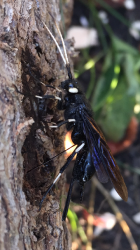
6456. I have more photos available, when I poked it it didn’t fly, it let me get as close as I wanted without moving but it wasn’t dead, I’m just curious to what it is, as I’ve never seen one before. Edmonton, Alberta. Canada

Number 6456.  This is Urocerus albicornis, a wood wasp (Hymenoptera: Siricidae),  Click here for an image. They lack a sting and are harmless; their larvae bore in the wood of dead/dying trees.

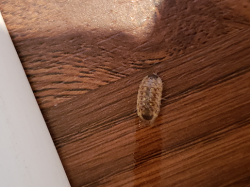
Larva of a carpet beetle

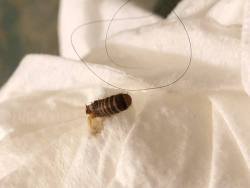
6455. Is this a carpet beetle larvae? Scarborough, Ontario. Canada

Number 6455.  It does look like a larva of a carpet beetle (Coleoptera: Dermestidae) in the genus Anthrenus.

German cockroach

6454. Please help. St. thomas, Ontario. Canada

Number 6454.  This is a German cockroach, Blattella germanica (Blattoidea: Ectobiidae), a cosmopolitan species that is notoriously difficult to eradicate.  Click here for control recommendations.

Bed bug

6453. Dwight Ave. Oshawa, Ontario. Canada

Number 6453.  This looks suspiciously like a bed bug;  Click here for detailed information.

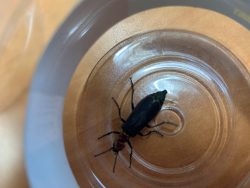
Sexton/burying beetle

6452. I noticed my cat trying to get on the window ledge and that’s when I saw thing. I have no idea what it is and it’s the first time I saw this in my house. I hope that it’s not poisonous since I do have small children and animals. Range Road 272, Spruce Grove, Alberta. Canada

Number 6452.  This is a sexton/burying beetle (Coleoptera: Silphidae; Nicrophorus sp.), possibly Nicrophorus tomentosus, known as the tomentose burying beetle. These are harmless, and perform a valuable service in finding and burying small mammal and bird carcasses that then serve as food for their larvae.

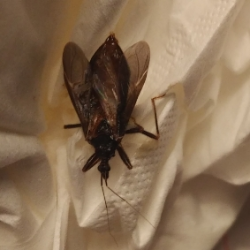
Assassin bug

6451. I have never had these insects in the house before, but this is the third one that I’ve killed this week. It is a flying insect that I’ve seen in the evening or early nighttime, flies slowly, relatively easy to kill. Any thoughts? Glenelg St W. Lindsay, Ontario. Canada

Number 6451. This is an assassin bug known as a masked hunter (Reduvius personatus; Hemiptera/Heteroptera: Reduviidae). This is a cosmopolitan species often found indoors and reputed to have a very painful ‘bite’- Click here for more detailed information.

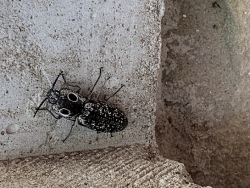
Eyed elater

6450. Approx 2 1.2” long, two eye type marlins st the top of its body, not sure if it had wings. When I placed a glass over the top of it, it withdrew its head and legs into its body. King Street West, Chatham-Kent, Ontario. Canada

Number 6450. This is an eyed elater, Alaus oculatus (Coleoptera: Elateridae). Also known as the eastern eyed click beetle, click beetles in the genus Alaus are the largest members of their family in North America. Their larvae live in decaying wood where they prey on the larvae and pupae of other beetles found there.

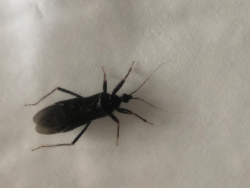
Assassin bug

6449. Found this bug in the house near my exterior door. Chelford rd. Toronto, Ontario. Canada

Number 6449. This is an assassin bug known as a masked hunter (Reduvius personatus; Hemiptera/Heteroptera: Reduviidae). This is a cosmopolitan species often found indoors and reputed to have a very painful ‘bite’- Click here for more detailed information.

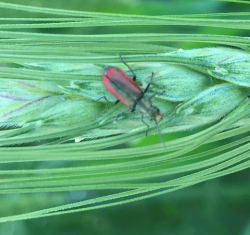
Scarlet malachite beetle

6448. Hello. I found about 6 to 7 of these beetles on my durum wheat that I am growing in my garden. I was wondering if these are a beneficial insect or a pest. If you could identify it, that would be great. Thanks. Humboldt, Saskatchewan. Canada

Number 6448. This is a scarlet malachite beetle, Malachius aeneus (Coleoptera: Melyridae); definitely not a pest species. Click here for more detailed information.

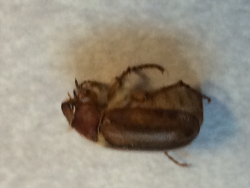
Scarab beetle

6447. Found this dead bug, plus another dozen or so, outside, in the capture of my gutters, coming from the second story roof. Any idea what it might be. Romaniuk Place, Richmond, British Columbia. Canada

Number 6447. This is a scarab beetle (Coleoptera: Scarabaeidae); it looks like one those commonly called June bugs or May beetles. These are clumsy fliers, and probably landed on the roof and tumbled into the gutter.

Larvae of a lacewing

6446. Roughly quarter inch long when fully flat, they probably can either bite or sting, fast moving when they want to. I’ve found dozens of these things under a large tree that only lets moss grow under it in my front yard. Are they a weevil or similar? Thank you for the help. Nith Rd. Cambridge, Ontario. Canada

Number 6446. These is larvae of a lacewing (Neuroptera: Chrysopidae). These are general predators on other small, soft-bodied arthropods such as aphids and caterpillars.

Larva of a lacewing

6445. Very slow moving bug. When I touched it, it’s lower body was able to stretch out, and retract back again. Very strange creature! Seaforth, Ontario. Canada

Number 6445. This is a larva of a lacewing (Neuroptera: Chrysopidae). These are general predators on other small, soft-bodied arthropods such as aphids and caterpillars. Occasionally, they will ‘sample’ human skin, but their bite is harmless.

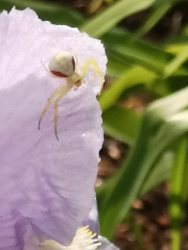
Crab spider

6444. Taking July 6, 2019. Early morning stroll in my flower garden. This spider was eating a bee prior to this picture… Hot, sunny and humide morning… Rue Principale, Néguac, New Brunswick. Canada

Number 6444. This is a Misumena vatia, a crab spider (family Thomisidae) known as the goldenrod crab spider. This species can change its color to better match its surroundings; Click here for more detailed information.

Assassin bug

6443. Was found in my bathroom above the door… about the size of a wasp. Beginning of July. Croft Ave, Milton, On. Canada

Number 6443. This looks like an assassin bug known as a masked hunter (Reduvius personatus; Hemiptera/Heteroptera: Reduviidae). This is a cosmopolitan species often found indoors and reputed to have a very painful ‘bite’- Click here for more detailed information.

March fly

6442. Found outside in research plots in a field near Vanscoy. Two of the same insect were seen fighting. Many have been spotted around the wheat and canola plots. Do not know if they are eating or damaging any of the crops. Insect is approximately an inch long. Have seen them walking/gliding over the ground by walking and possibly using its wings. Have seen none getting higher than a foot off the ground. The days the pictures were taken, approximately 2 weeks ago, it was warm out (not hot) and partially cloudy. Prairie Ln Road, North of Highway 7
Vanscoy, Saskatchewan. Canada

Number 6442. This is a March fly (Diptera: Bibionidae). Most species are harmless; the larvae of a few can be pests, feeding on underground plant parts. Click here for more detailed information

Terrestrial crustacean

6441. Windsor, ON. Canada

Number 6441. This is a terrestrial crustacean in the order Isopoda; common names include sowbug, pillbug, woodlouse, and slater. The vast majority of these are harmless scavengers on decomposing organic matter.

Blister beetle

6440. Large beetle type. Not sure if it can fly but has wings. Rear is an iridescent green and head area is iridescent reddish purple. Smaller antenna, head appears to be roach like or ant like. Saskatoon, Saskatchewan Canada.

Number 6440. This is a blister beetle (Coleoptera: Meloidae) in the genus Lytta; Click here example.

Mayfly

6439. First time ever seeing one of these bugs, to me it looks like sucker fish or bottom feeder. Found on my window outside so it must fly. Maybe new to the Yukon. Haines Junction, Yukon. Canada

Number 6439. This is a mayfly (order Ephemeroptera). The adults only live for a day or so; just long enough to find mates and lay eggs. They do not feed, but may become nuisances when they emerge in large numbers. They spend most of their lives as nymphs in streams and ponds/small lakes where they constitute an important link in the aquatic food web. They actually are quite common in the Yukon, Click here for details.

Female spring fishfly

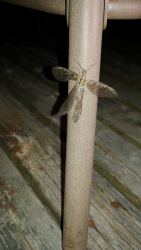
6438. Found on our deck at night first week of July. Flew right in my partners face. Nova Scotia. Thanks! Dartmouth, Nova Scotia. Canada

Number 6438. This looks like a female spring fishfly, Chauliodes rastricornis (Megaloptera: Corydalidae; subfamily Chauliodinae); their larvae are aquatic and sometimes called hellgrammites. Click here for more detailed information.

Click beetle

6437. Found crawling along the patio … about the size of a common black ant, which I thought it was initially; however, when provoked it jumped several inches in the air. Caught this one and two others, and found they seemed to be coming out from under a garden shed, that is adjacent to our patio. Simply wondering what this is, whether it is harmful in any way, or perhaps a predator to other insects. Thanks. Kitchener, Ontario. Canada

Number 6437. This is a click beetle (Coleoptera: Elateridae); the larvae of some species are known as wireworms. Click here for an example. 

Small-eyed sphinx moth

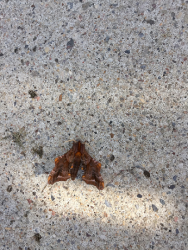
6436. What is this??? High river, Alberta. Canada

Number 6436. This is a small-eyed sphinx moth, Paonias myops (Lepidoptera: Sphingidae), Click here for more detailed information.

Ten-lined June beetle

6435. Yacht Rd. Sechelt, British Columbia. Canada

Number 6435. This is a ten-lined June beetle, Polyphylla decemlineata (Coleoptera: Scarabaeidae), their larvae can be pests on tree farms – Click here for more detailed information.

Larva of an aquatic beetle

6434. Found in a small lake in Hearst, Ontario. Hearst, Ontario. Canada

Number 6434. This is a larva of an aquatic beetle, either a predaceous diving beetle (family Dytiscidae) or a water scavenger beetle (family Hydrophilidae). Similar in appearance, both are general predators on other small aquatic life forms.

Ground beetle

6433. Found on the floor of house in the kitchen. There were a few found. June 2019 in Ontario. Black underbelly. Six legs. Light brown. Stripes down body but doesn’t start at head. No spikes on legs. Worried it was a German cockroach but doesn’t seem to fit the pictures. Please advise. Thanks. Birchview Drive, Oshawa, ON. Canada

Number 6433. This is a ground beetle (Coleoptera: Carabidae). The vast majority of these beetles are general predators on other small arthropods, but a few rogue species feed on germinating seeds.

Dark fishing spider

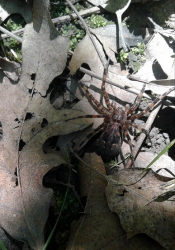
6432. Wheatley conservation area. southwestern ontario near windsor by lake erie. Windsor, Ontario. Canada

Number 6432. This is a dark fishing spider, Dolomedes tenebrosus (family Pisauridae), the largest spider species native to Ontario. Not at all dangerous to humans, and in spite of its name, these can be found a long distance from water. Click here for more detailed information.

Broad-nosed short-snouted weevil

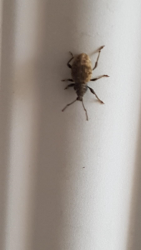
6431. What is it. Nadeau St. Quesnel, BC. Canada

Number 6431. This is a broad-nosed short-snouted weevil (Coleoptera: Curculionidae; subfamily Entiminae) such as a black vine weevil.

Mayfly

6430. Darling Street, St. John’s, NL. Canada

Number 6430. This is a mayfly (order Ephemeroptera). The adults only live for a day or so; just long enough to find mates and lay eggs. They do not feed, but may become nuisances when they emerge in large numbers. They spend most of their lives as nymphs in streams and ponds/small lakes where they constitute an important link in the aquatic food web.

Tortoise beetle

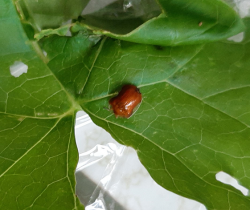
6429. Bug is square shaped; about 4 mm wide and 4 mm long. Eats marigolds and even toxic rhubarb leaves. It lives mainly by the cement wall of the house. love to know what is, because it eats everything a normal bug would never eat. I’ve looked on many bug identifying sites and nothing looks like it. ridge rd. Sprinfield, nova scotia. Canada

Number 6429. This is a tortoise beetle (Coleoptera: Chrysomelidae; subfamily Cassidinae) in the genus Charidotella, Click here for an example. It is not reported to be a serious pest species.